2016-2026 TRAVELOGUE – Canada By Train with Oscar Peterson’s Canadiana Suite

Cover Art to the 1967 Release of The Canadiana Suite – Click to Listen
First conceptualized as an evocative musical journey by rail across the vast, varied and distinctive expanses of Canada, Oscar Peterson's 1965 piece The Canadiana Suite remains for me an inspirational and essential accompaniment for a transcontinental Canadian journey by train.
More than 60 years on since Oscar Peterson composed The Canadiana Suite, rail travel in Canada is not what it once was. While the piece is a rich, evocative, musical tour of Canada by train, it is neither a detailed guide book nor a pedanticly annotated railway map. Instead, each individual suite encourages thought, imaginative reflection and appreciation of the journey and of Canada more generally. What follows in this essay is an imaginative expansion of what a transcontinental Canadian rail journey looks like today, framed and inspired by the spirit and individual works of The Canadiana Suite.
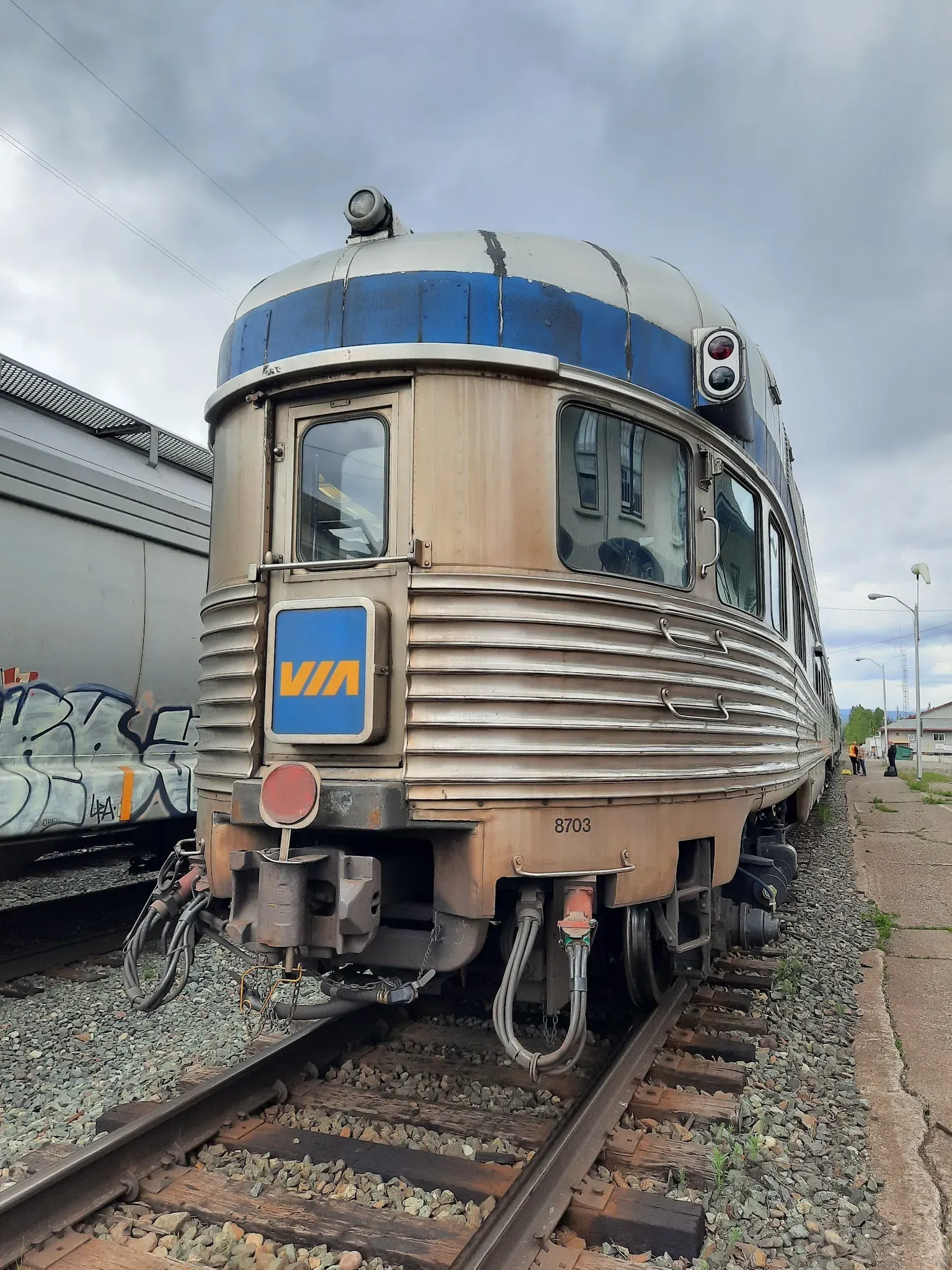 |
The iconic Park Car of VIA Rail Train 5 pauses for a station stop at Smithers, BC. May 2024.
In The Canadiana Suite, the pace of the music finds its flow from the rhythm of train travel, not just the ubiquitous clickety-clack of the track, but also the rolling ebb and flow of the train's movement, the bounce and sway over switches and into curves, on thin ribbons of steel, both at great speed and at slow trundle, reflecting a delicacy of observation that betrays, in my estimation, a child's attentive and formative fascination with the charming musicality of travel by train.
Oscar was the son of a CPR Porter based in Montréal in the early 20th Century. Canadian Heritage moments portray a young Oscar, at home in Little Burgundy in Montréal, faithfully at the keyboard practicing while his Dad was away working routes from Saint John in the east to Vancouver in the west.
“The pieces that make up Oscar's Canadiana Suite, recorded first in 1964, proceed across Canada from east to west, which is the way the country thinks, in the precise sequence of the railway journey from the Atlantic to the Pacific: Ballad to the East, Laurentides Waltz (les Laurentides is the French name for the Laurentian Mountains of Québec, and anyone born and raised in Québec, like Oscar, tends to think of them that way), Place St. Henri, Hogtown Blues (Canadians traditionally dislike Toronto and have since time out of mind called it Hogtown), Blues of the Prairies, March Past, which refers to the Calgary Stampede parade, and Land of the Misty Giants (the Rocky Mountains). Those pieces are like views from a train window; or perhaps memories of a father's descriptions of the land when he would come home from his journeys and supervise his son's piano lessons.”
- Gene Lees, Oscar Peterson: The Will To Swing
Today I am a railway worker. I grew up in a railway family with Grandparents and Great-Grandparents all having signed-on with the railway. To some extent, it seems right to say that the children of railway workers live with a mix of curiosity, fascination, loneliness, resignation and admiration about the life that their caregivers live on the railway. They see their parent leave home and go away for days and maybe weeks at a time, come home exhausted and spent, desperate to recover and enjoy family life before the railway calls and they are obliged again to go to work on the train.
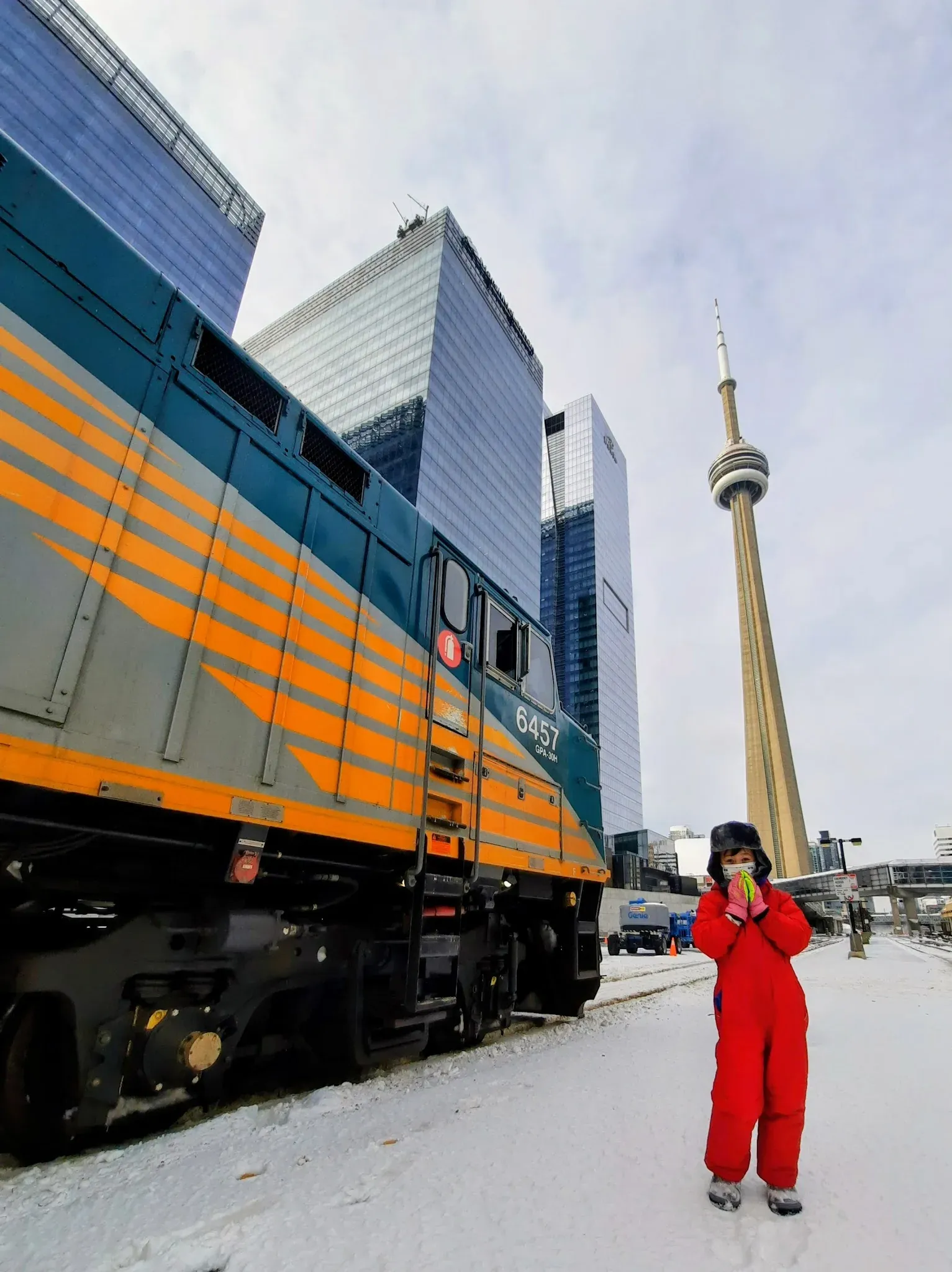 |
At the same time, perhaps the railway child beams with wonder about the life of their parent working on the train, far away from home, traveling all day and all night, for days at a time, winding through impossibly remote and incredibly beautiful landscapes, as the train makes its progression through towns large and small, traversing and bringing the vast expanses of the country together.
 |
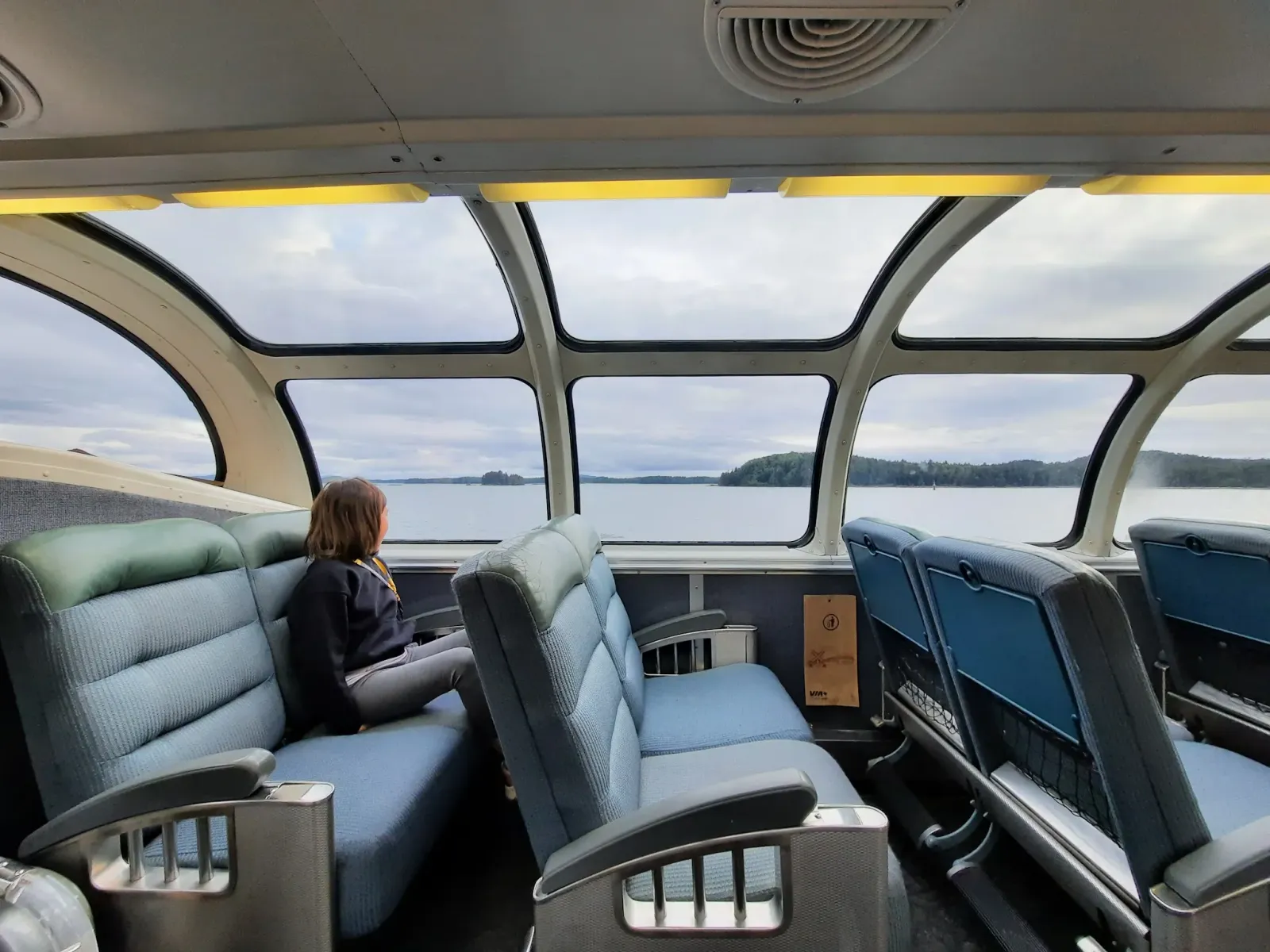
Thus for me, The Canadiana Suite also serves to evidence the deep impression railway life makes upon the imagination of the children of railway workers. It is therefore, in its way, an homage to railway workers, and indeed to their children, to the sacrifices they make and to the imagination that their work and their absence at home instills in their children – and indeed upon the imagination of all Canadians who, at some point in their childhood, simply marveled at the experience of taking the train, and have kept those fond, marvellous and formative memories with them through life.
 |
Throughout my travels across Canada by train, The Canadiana Suite has served as a reflective musical accompaniment, as a way to marshall my thinking about the experience and to organise the photos I take along the way.
The challenges of photography on a transcontinental train journey – the glare from interior lights, dirty windows, unpredictable sun angles and a ‘perfect shot’ which is frequently and randomly fouled by trees and other fast moving and unforeseen ephemera – all of these challenges are ultimately and practically insurmountable. For my part, I embrace the imperfections – the physical frame of the windows, the safety stickers, the bedsheets of a sleeping car, the tablecloths of a dining car, the perspective from a coach seat – capturing not just the majesty of the scenery but also the lived experience of the journey on-board.
Ultimately, there are many experiences on a transcontinental Canadian train journey that can't be photographed and simply have to be experienced.
 |
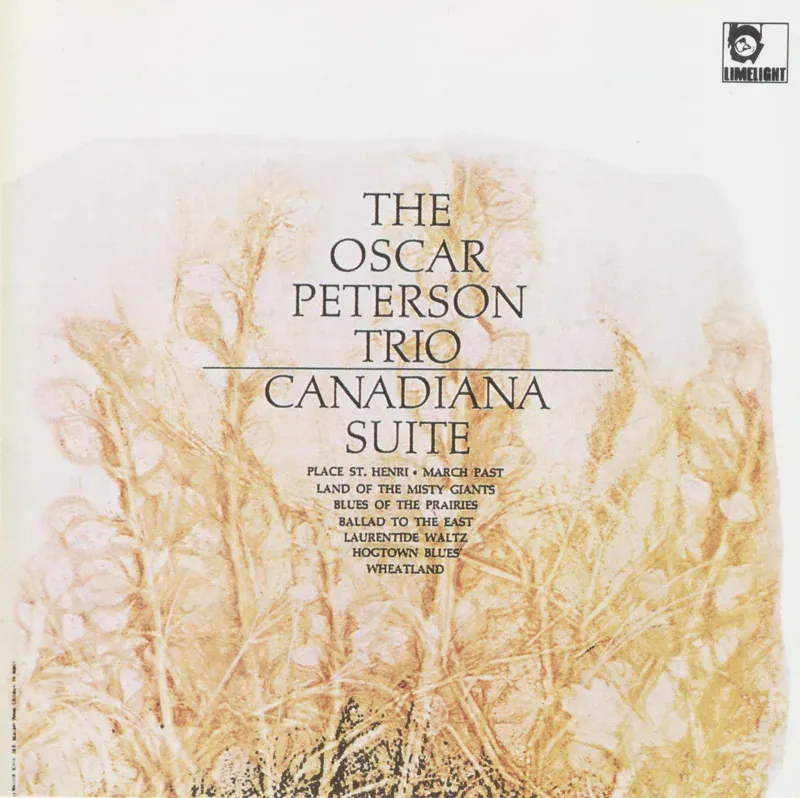 |
Cover Art to the 1965 Release of The Canadiana Suite
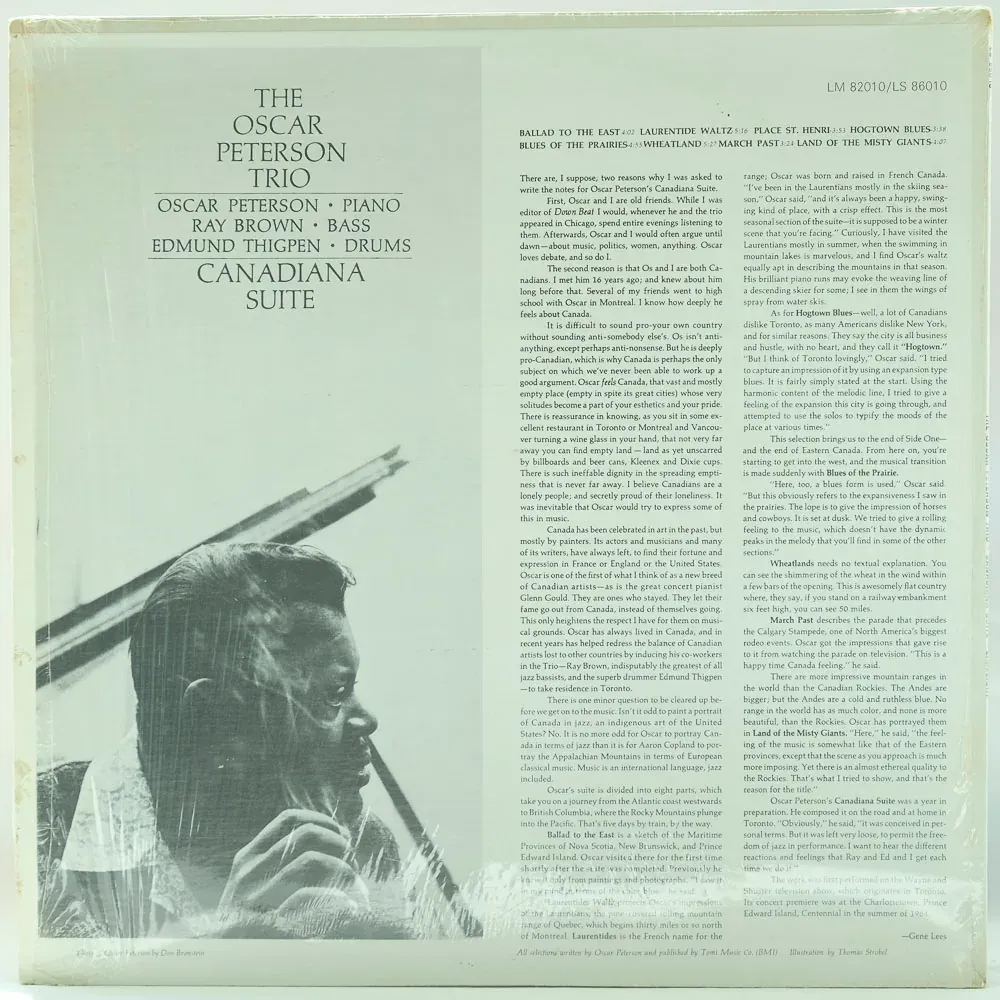 |
Liner Notes to the 1967 Release of The Canadiana Suite
1 Ballad To The East
“Ballad to the East is a sketch of the Maritime Provinces of Nova Scotia, New Brunswick, and Prince Edward Island. Oscar visited there for the first time shortly after the suite was completed. Previously he knew it only from paintings and photographs. "I saw it in my mind in terms of the color blue,” he said.”
The first three notes of the Ballad to the East are seemingly the iconic notes of the audible tone that preceded on-board passenger announcements on CPR trains as early as the 1960s. These three notes frame the beginning of our musical journey across Canada, serving both to hail our departure and to add comfort and regularity to a new and exciting experience. As the piece expands from these three notes, the first day of our journey seems to begin, a beacon to hospitality and comfort, helping us to locate ourselves on our journey as we make stops along the line, and finally as a kind of railway lullaby, our beds having been prepared for the night, and we fall asleep to the rhythm of the train, with a view of a Maritime sunset from our sleeping car window.
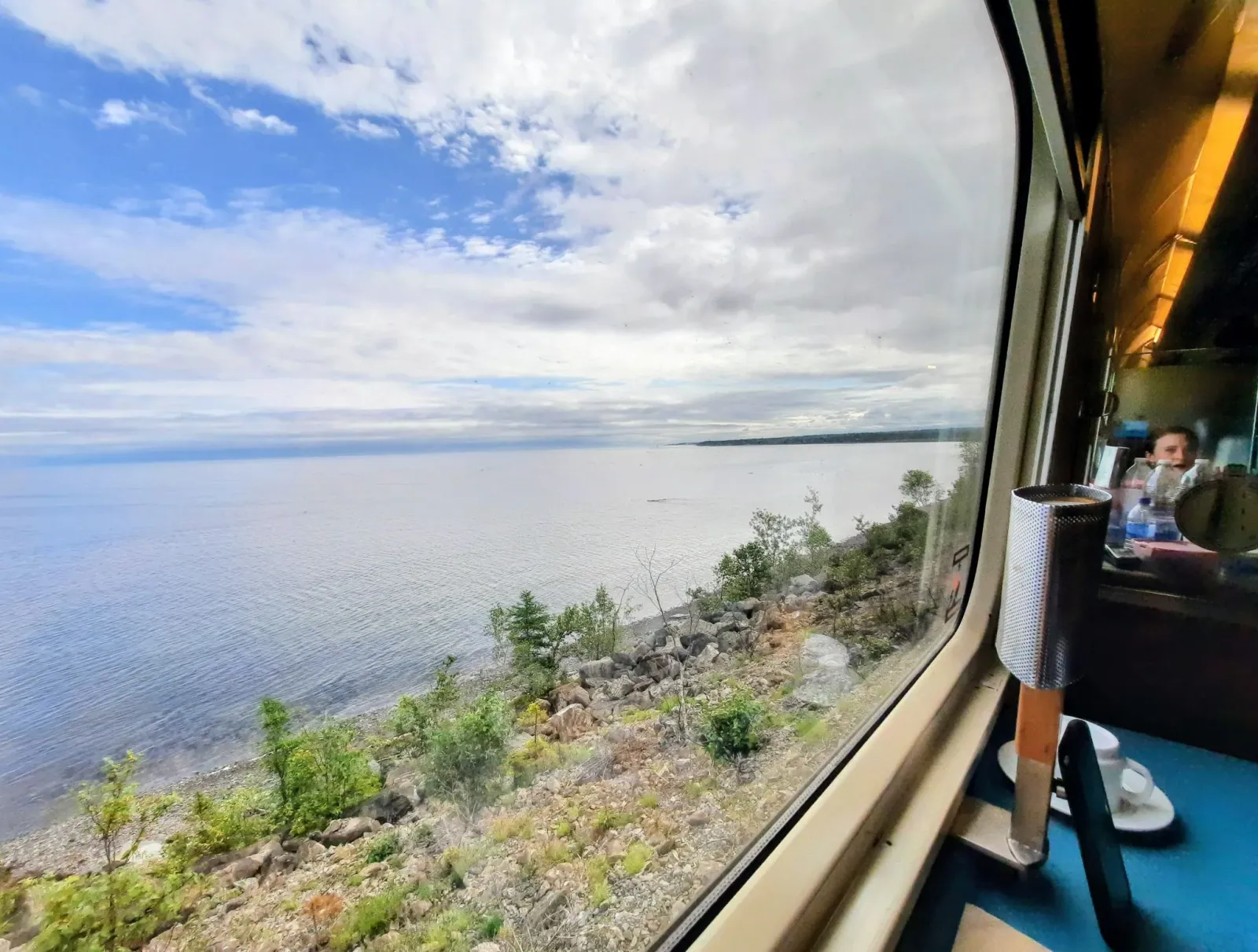 |
Views of the Bay of Chaleur near Charlo, NB enjoyed alongside the breakfast service in the dining car on VIA Train 14. August 2023.
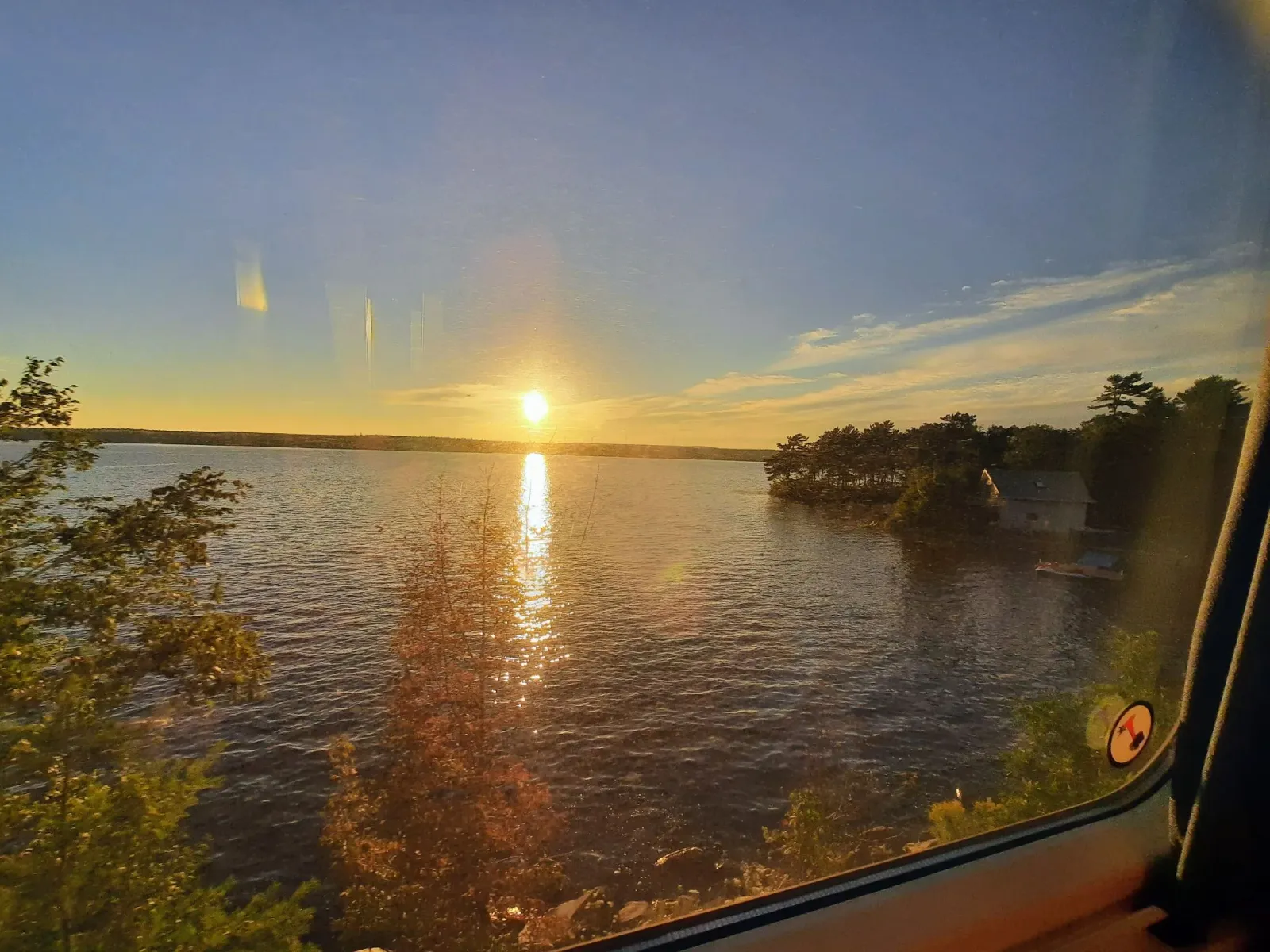 |
Maritime sunset over the Shubenacadie Grand Lake in Nova Scotia, as enjoyed from VIA Train 14. August 2023.
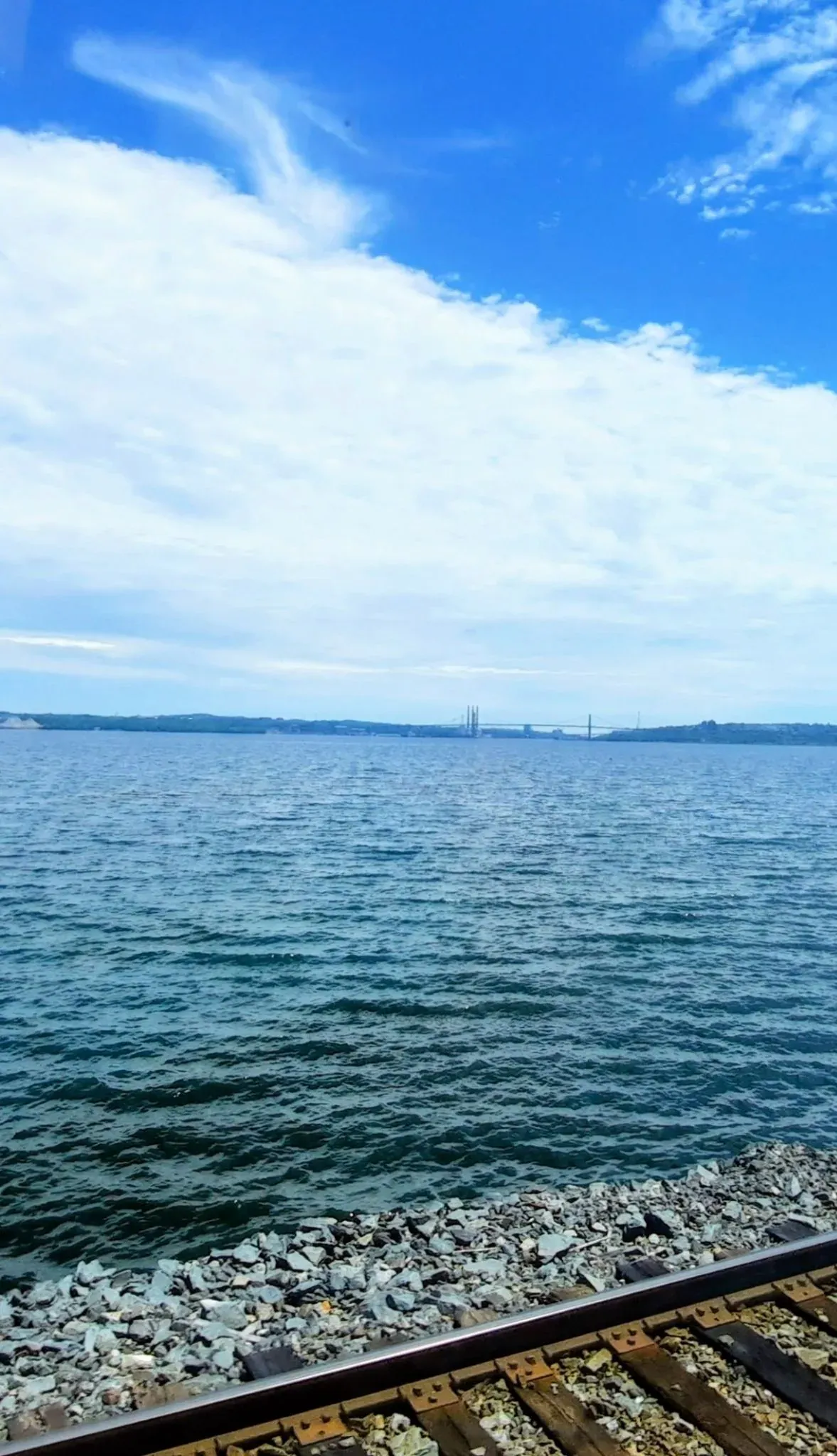 |
Shortly after departure from Halifax, NS, VIA train 15 hugs the shores of the Bedford Basin, at Bedford, NS, the last view of Halifax in the distance, and the last ocean view Transcontinental travelers will enjoy before reaching the end of their journey 6 days later at the Pacific Ocean. June 2024.
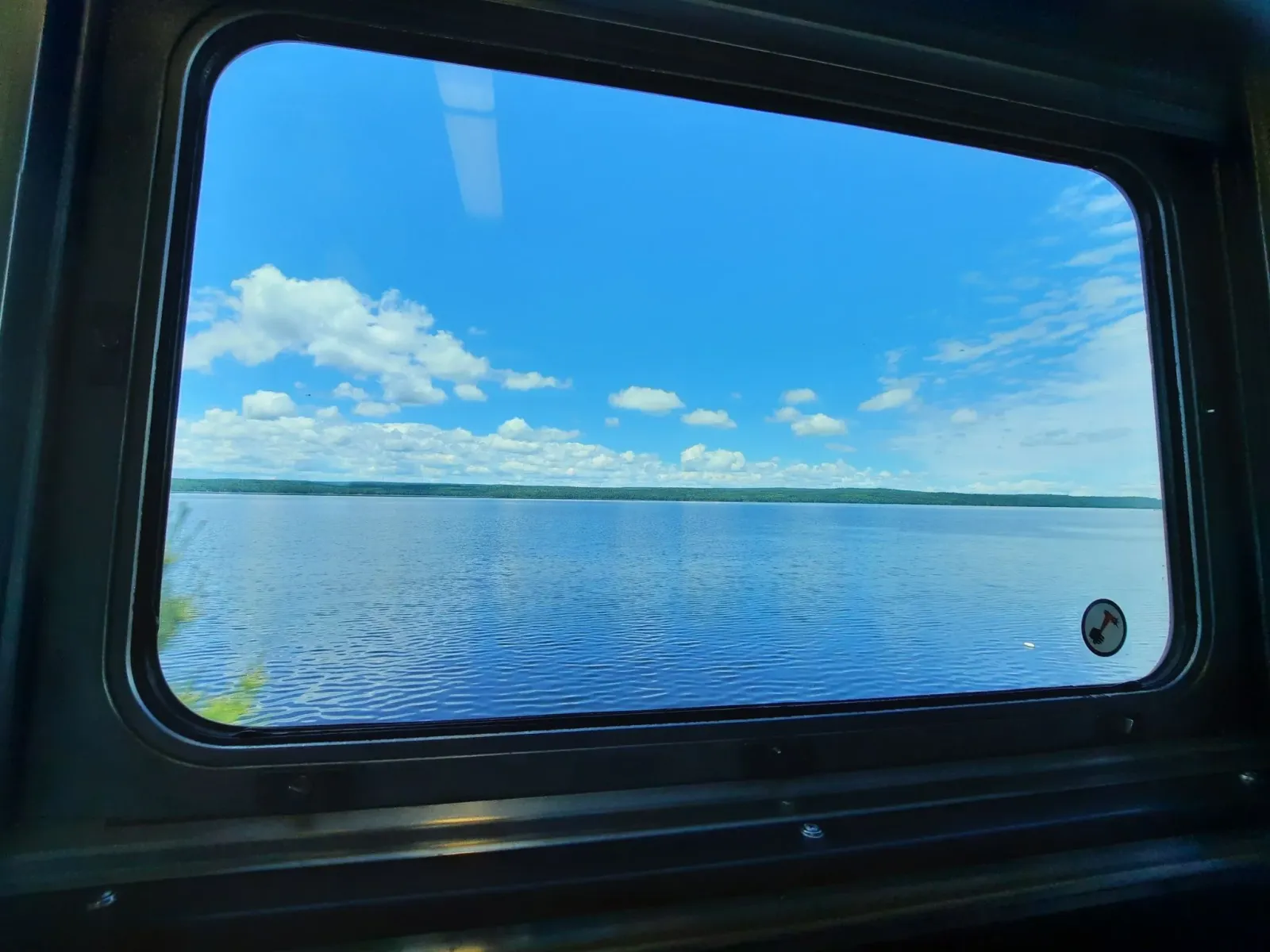 |
Train 15 passing still waters on the Shubenacadie Grand Lake, NS. June 2024.
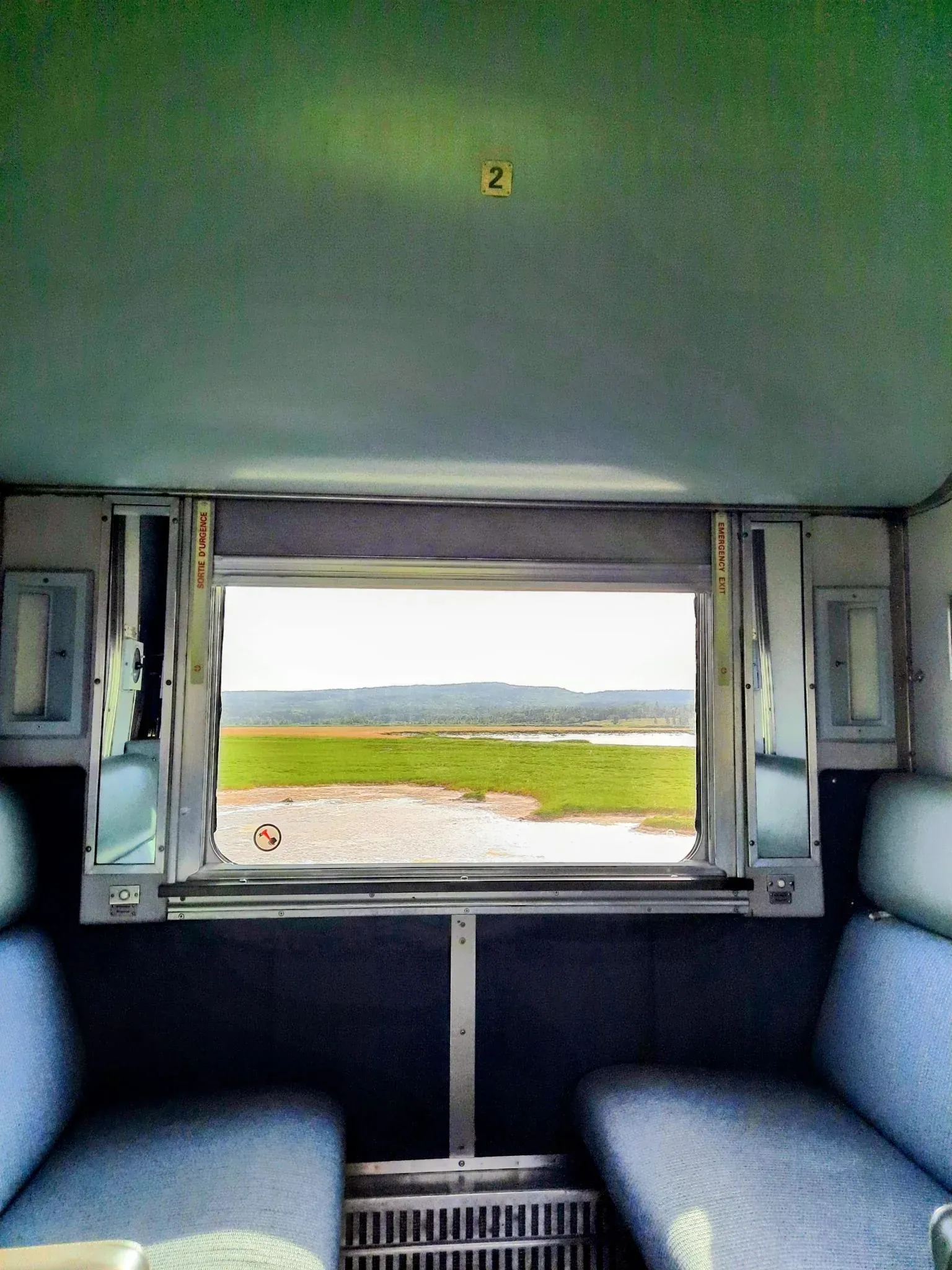 |
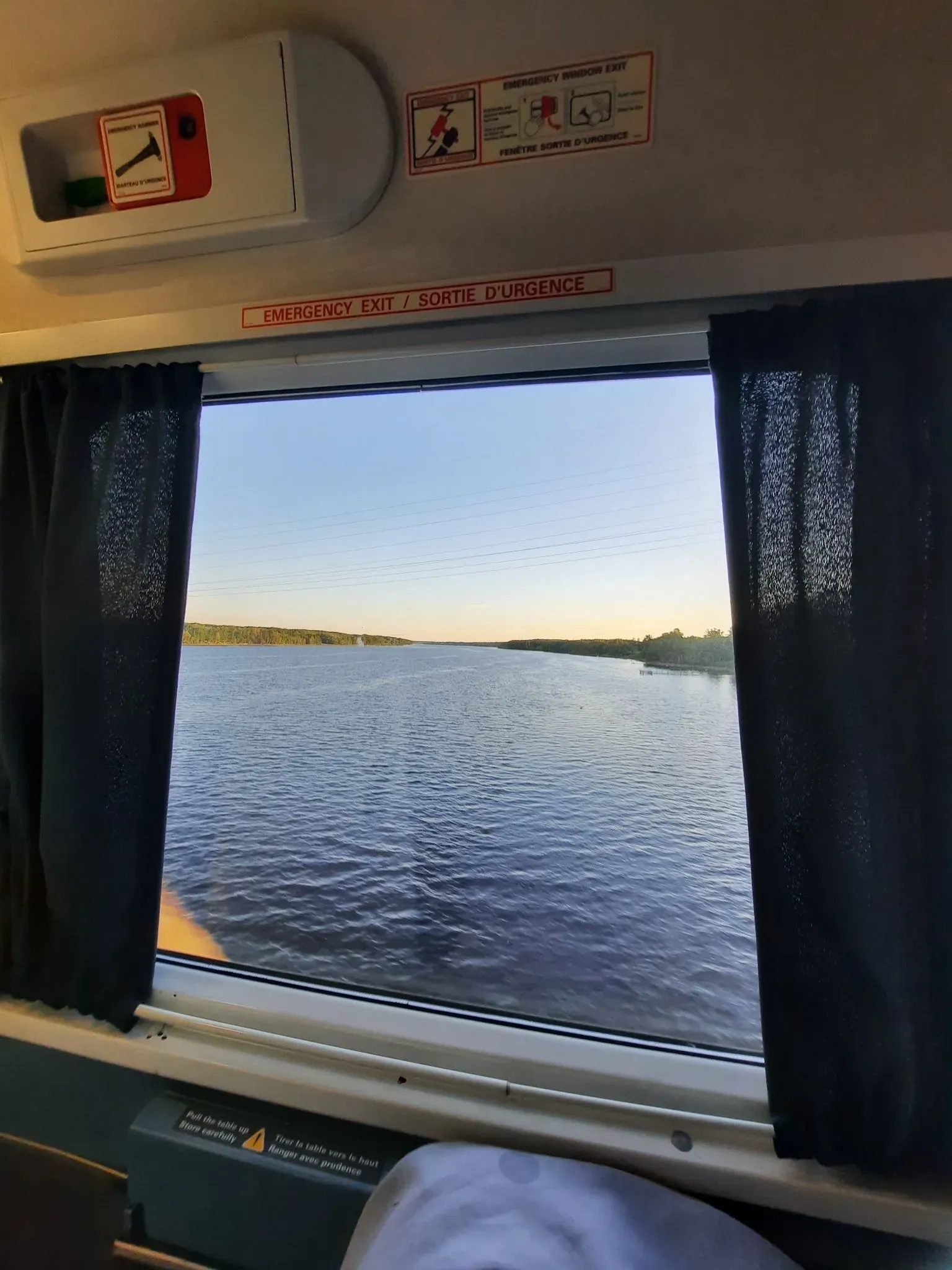
Stunning views of the tides at the Bay of Fundy near Taylor Village, NB. July 2025.
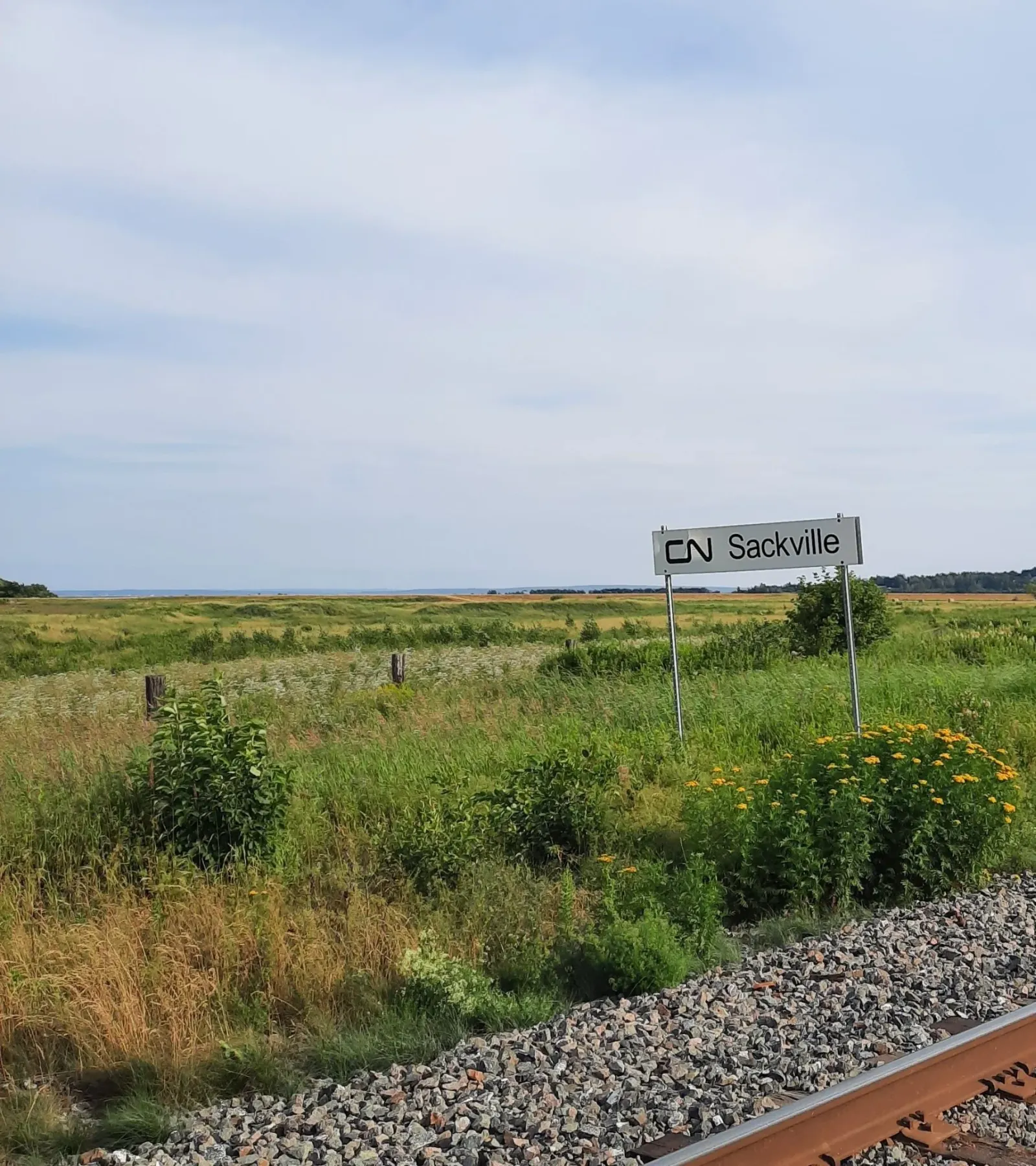 |
The Tantramar Marshes as seen from the VIA Rail station at Sackville, NB. July 2025.
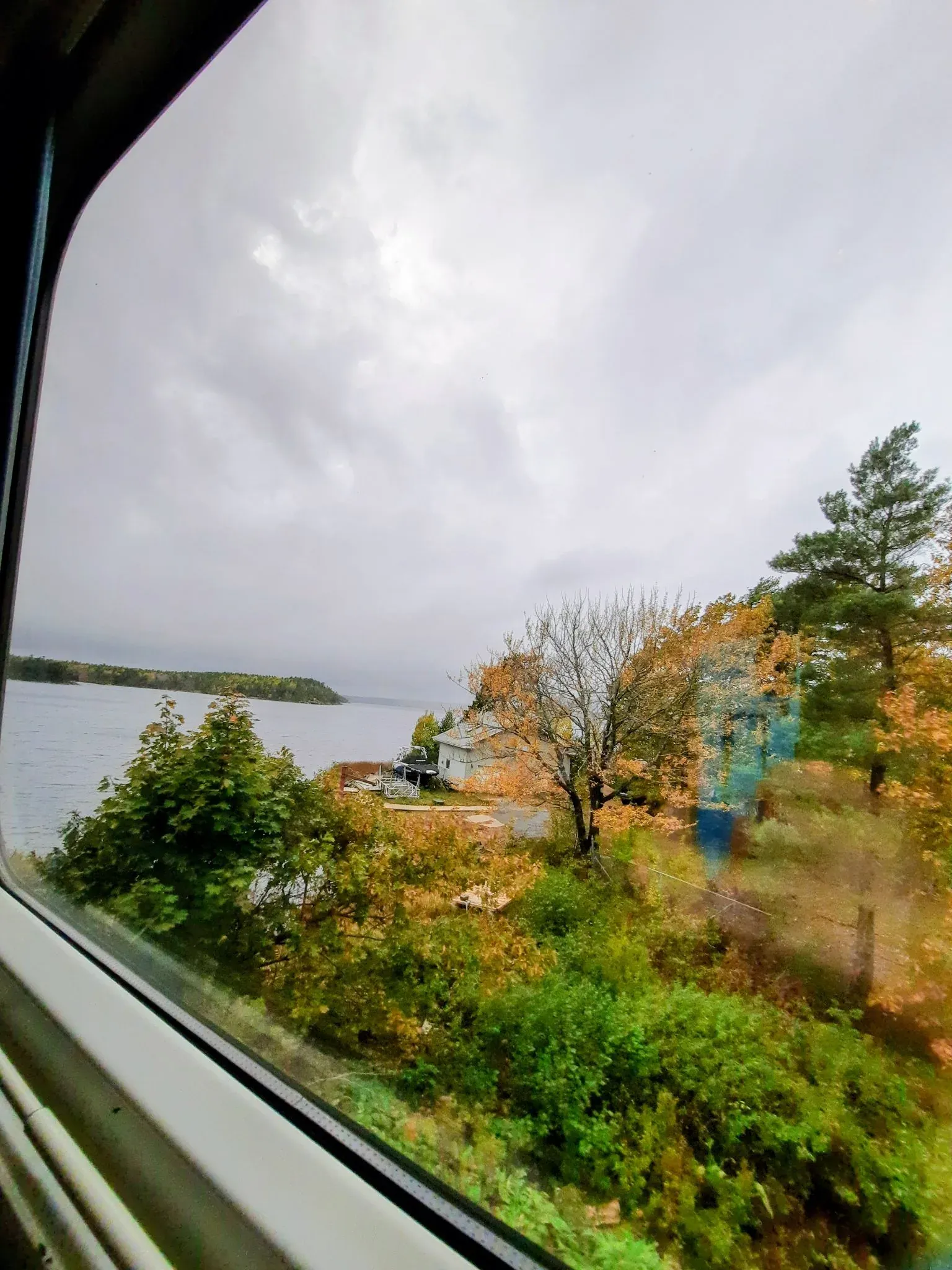 |
Bursts of autumnal colours race past as VIA Train 14 skirts Rocky Lake in Nova Scotia. October 2022.
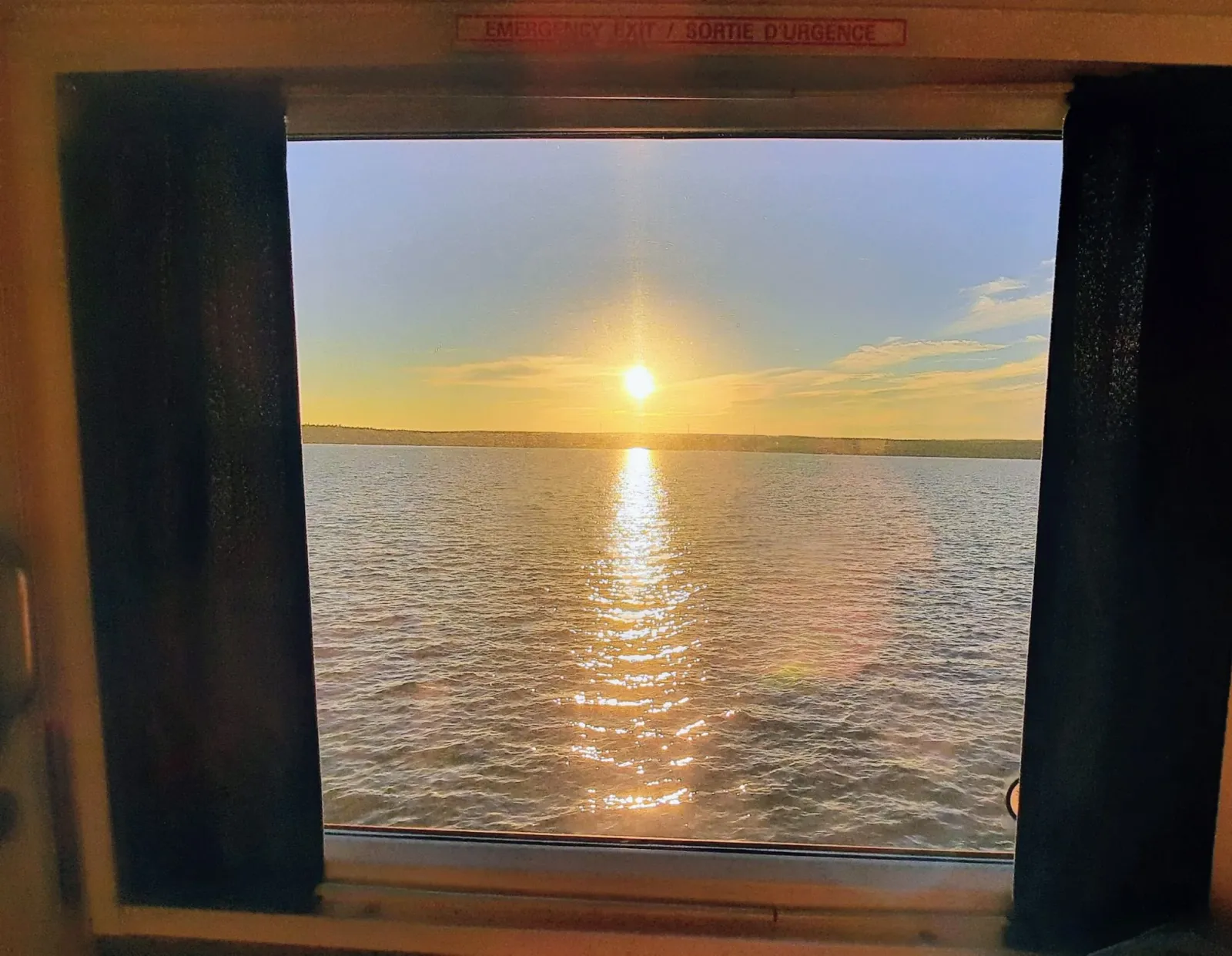 |
The sun sets over the Shubenacadie Grand Lake in Nova Scotia, framed by the window of VIA Train 14. August 2023.
 |
Crossing the Southwest Miramichi River on VIA Train 14 at Miramichi, NB. August 2023.
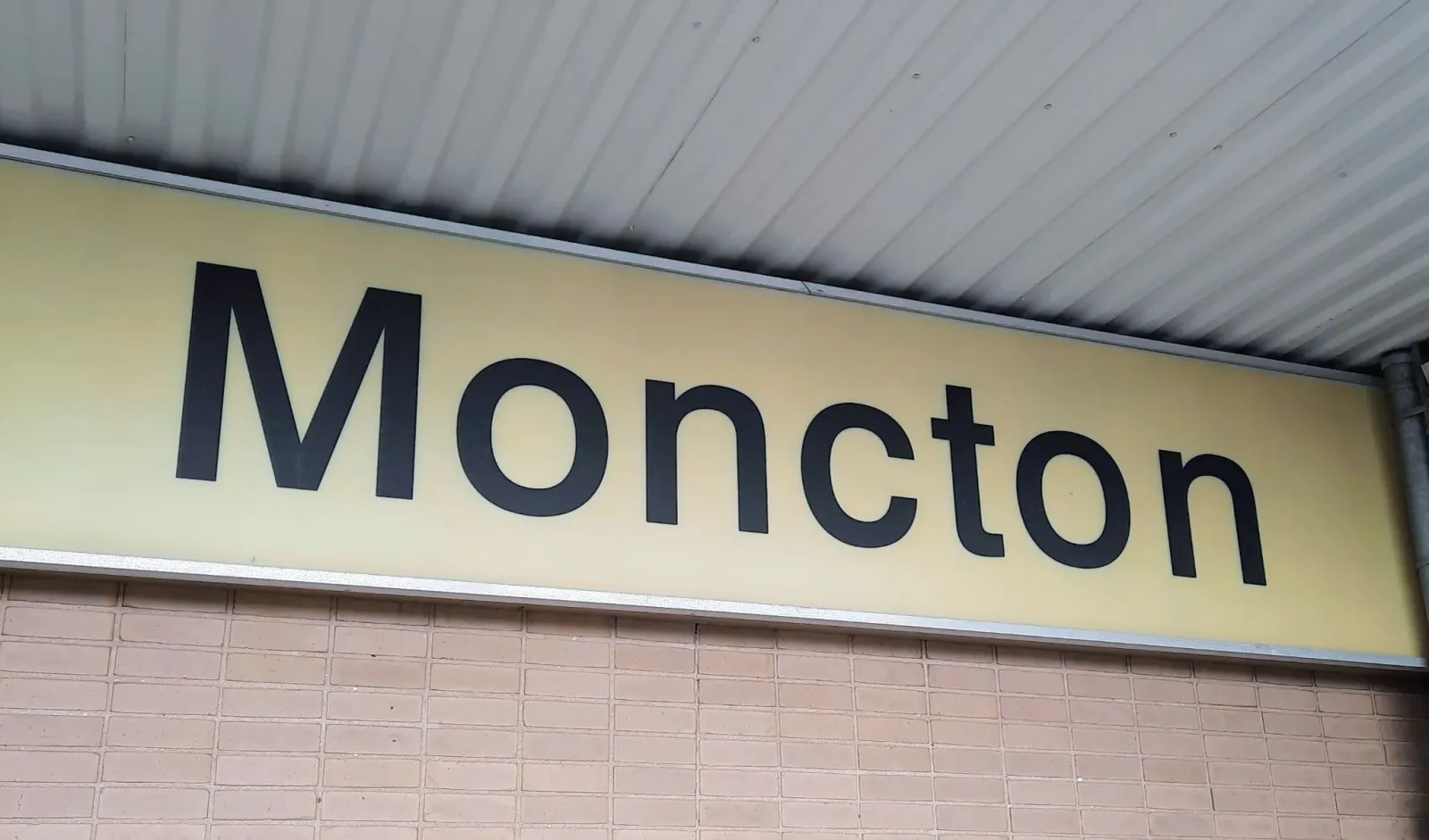 |
1960’s era CN signage at Moncton, NB VIA Rail Station. August 2023.
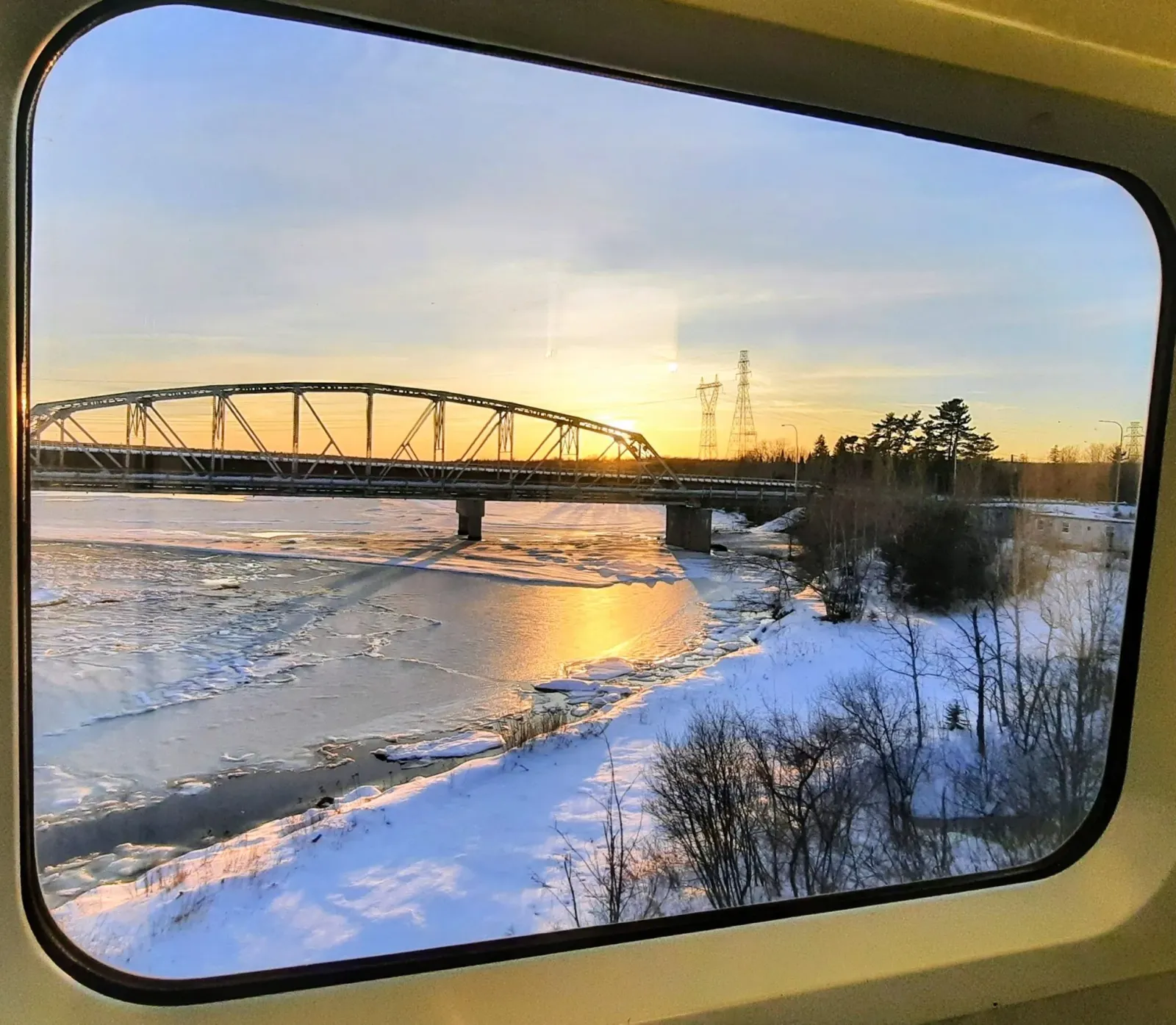 |
As the spring thaw nears, there is still a frosty scene crossing the Northwest Miramichi River on VIA train 14 at Miramichi, NB. March 2024.
As The Ocean, VIA Rail Trains 14 and 15, makes its way between Montréal and Halifax, the timetable provides that some of the most stunning scenery on the line, through the Matapédia Valley and the Bas Saint-Laurent, are traversed during the night. One night I recall staying up late in the deep of winter, easily -20c and clear, with a full and brilliant moon, a crisp and silent scene of black, blue and white hues as the train wound its way through the picturesque, still winter night of the Matapédia Valley.
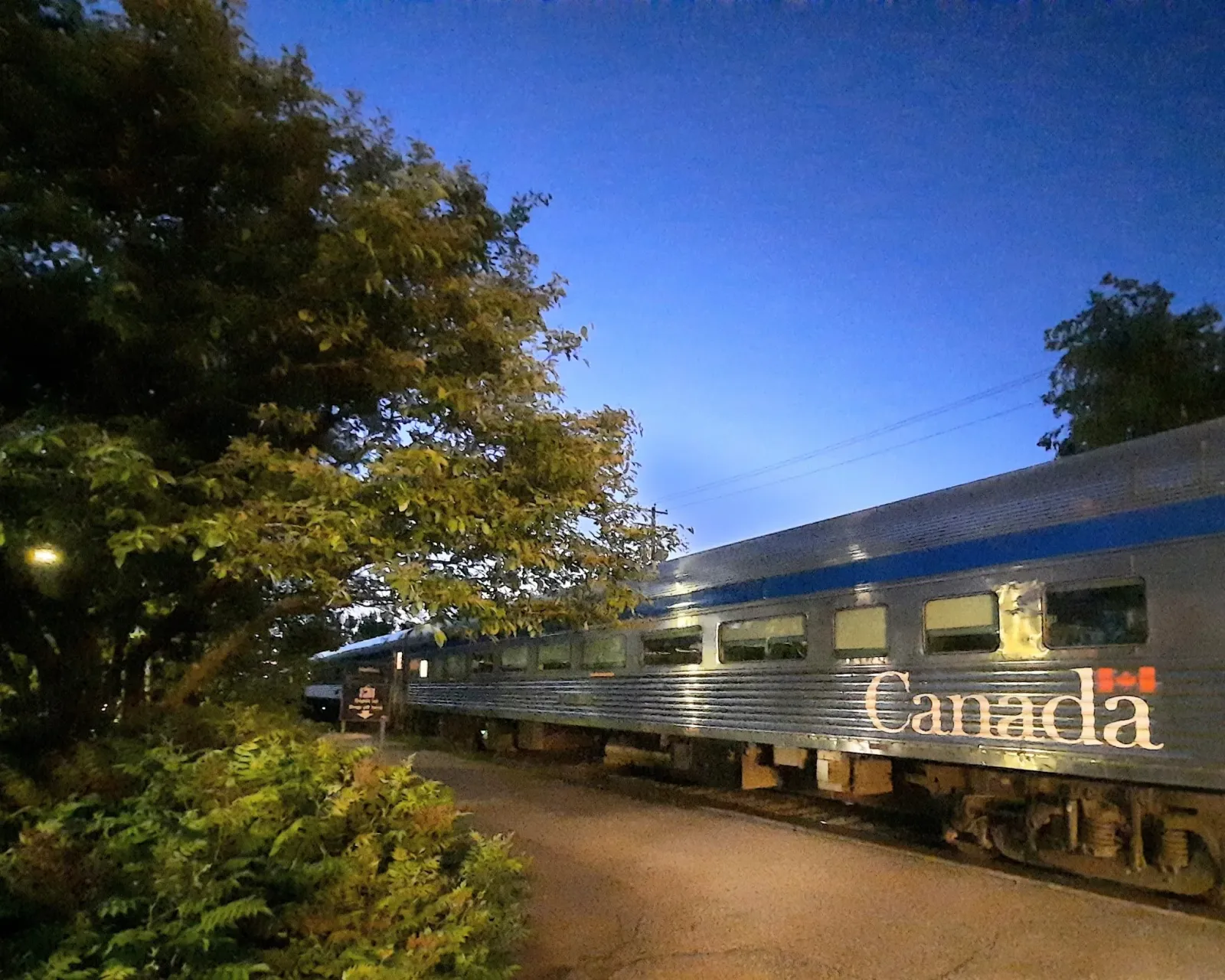 |
The sun is just coming up Rimouski, QC as Train 14 makes its station stop in the early morning hours. June 2026.
Further along, on the shores of the Bas Saint-Laurent, especially between Rimouski and Rivière-du-Loup, again our train is scheduled to pass in the low light of early morning. But on the night of the solstice, the longest day of the year, I watched the sun rise over the sweeping valley, 6km wide and known for its big, marvelous sunrises that you can see coming up for ages. At times the train travels low in the valley, hugging the coast so near that you can gauge the height of the tides and observe the still morning life of the river; at other times riding high up on the valley, bringing into relief the vast expanse of the river, its surrounding valleys and the life of the small towns and villages we pass through in the quiet chill of the early morning.
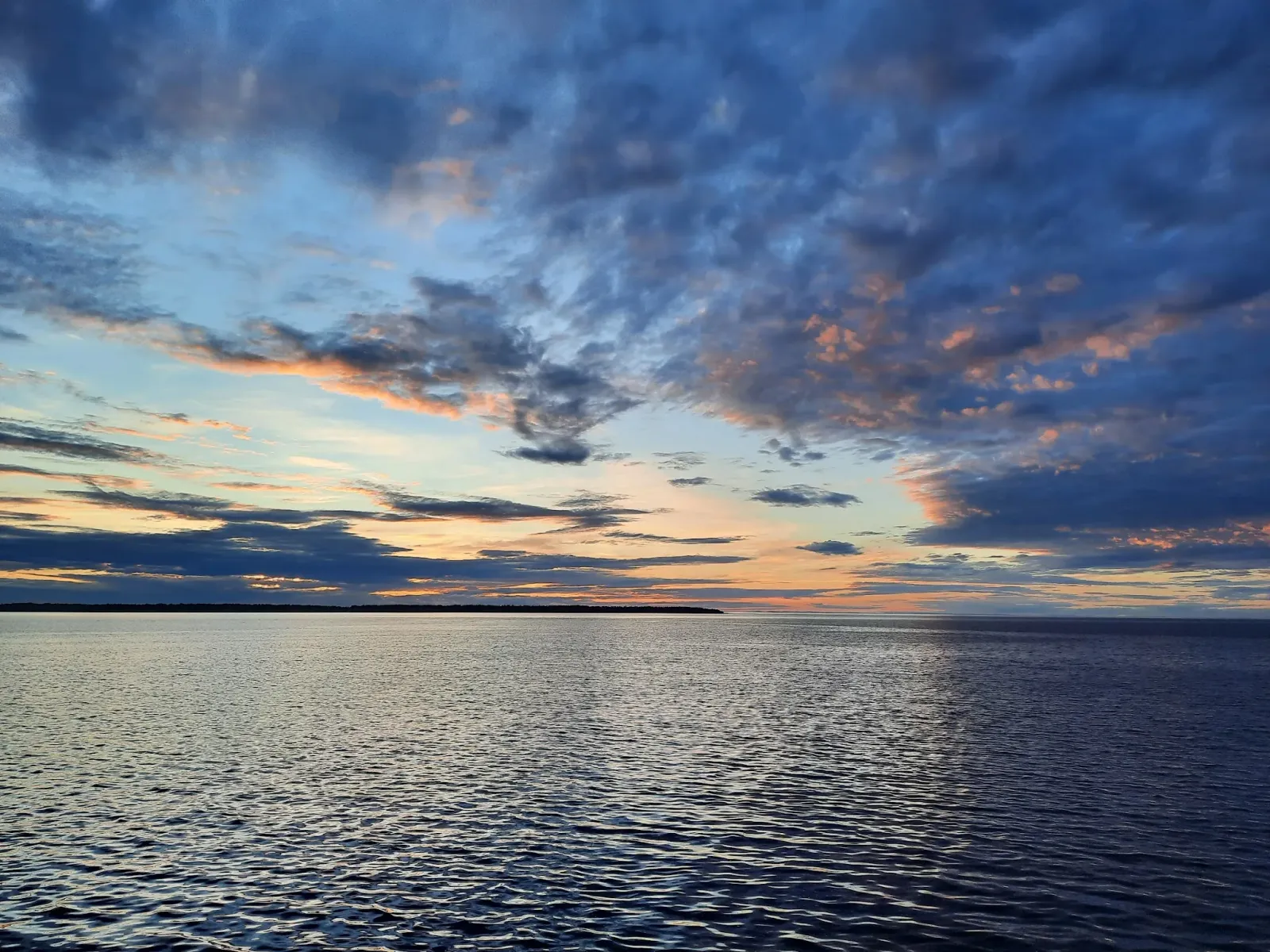 |
Big sunrises at Rimouski, QC. June 2026.
These moments are unique, difficult to reproduce and mostly impossible to capture without special photographic equipment, and thus there are times when the best moments of a transcontinental rail journey, like some of the best things in life, must simply be appreciated in the moment.
2 Laurentide Waltz
“Laurentides Waltz projects Oscar's impressions of the Laurentians, the pine-covered rolling mountain range of Québec, which begins thirty miles or so north of Montréal. Laurentides is the French name for the range; Oscar was born and raised in French Canada. "I've been in the Laurentians mostly in the skiing season,” Oscar said, "and it's always been a happy, swinging kind of place, with a crisp effect. This is the most seasonal section of the suite—it is supposed to be a winter scene that you're facing." Curiously, I have visited the Laurentians mostly in summer, when the swimming in mountain lakes is marvelous, and I find Oscar's waltz equally apt in describing the mountains in that season. His brilliant piano runs may evoke the weaving line of a descending skier for some; I see in them the wings of spray from water skis.”
Click to Listen
Today the railway no longer travels to Les Laurentides north of Montréal, serving the ski hills and cottage country in the Laurentians – a lost railway destination, like so many others in Canada. Fortunately, the Suite’s inherent capacity for imaginative expansion allows for our conception of the piece to include the length and breadth of the formidable Laurentian mountain range, from the Ontario border to the northern shore of the St Lawrence River – a winter scene, as described in the liner notes of the album, draped and enrobed and subsumed in the full splendour of winter’s majesty.
Pictured below are photos from VIA Rail’s Montréal to Senneterre service, which traverses the remote regions of Abitibi-Témiscamingue and Mauricie in the north of Québec, providing an essential service to communities with no road access.
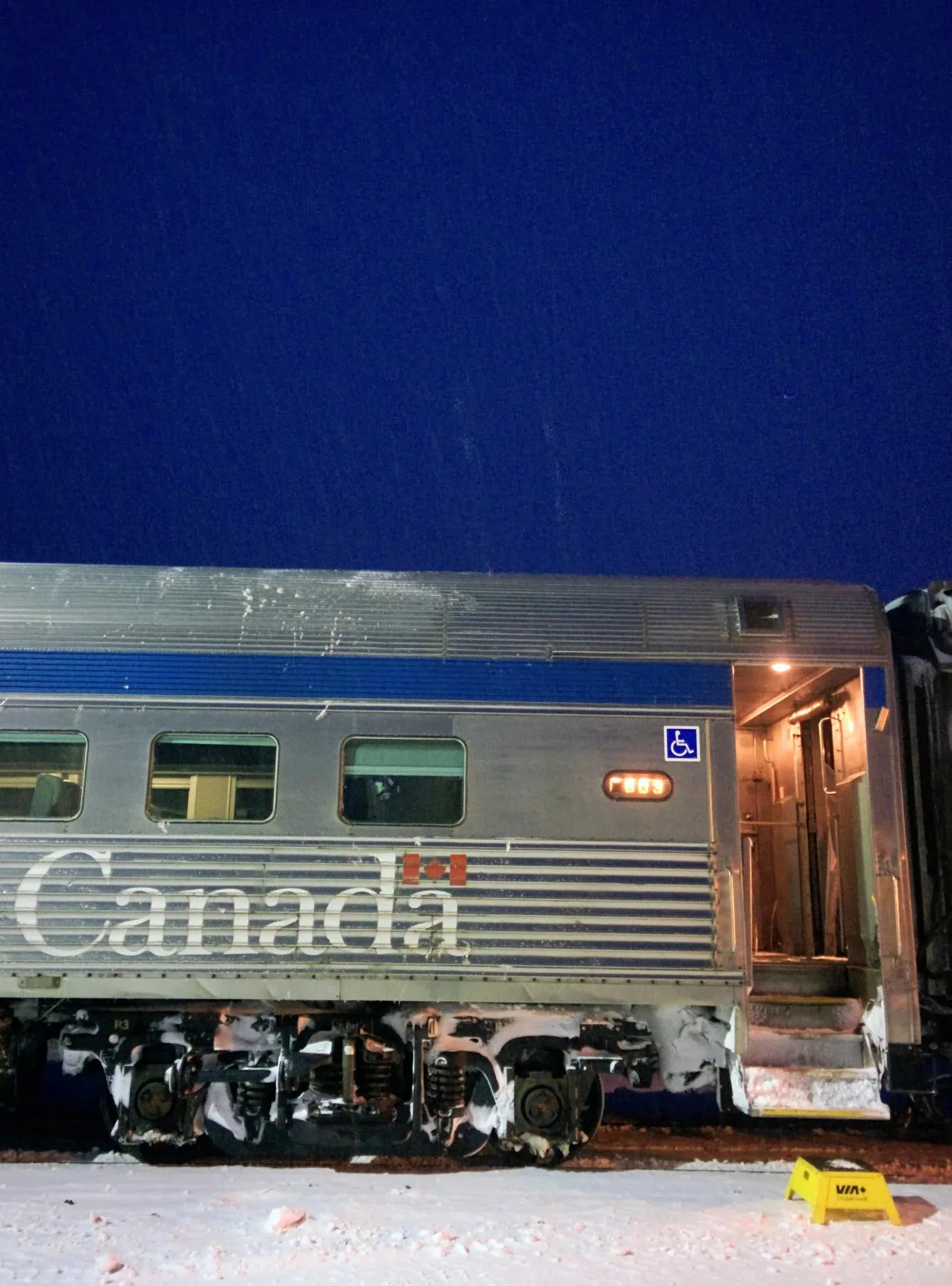 |
VIA Rail 603 makes a snowy station stop at Parent, QC. February 2016.
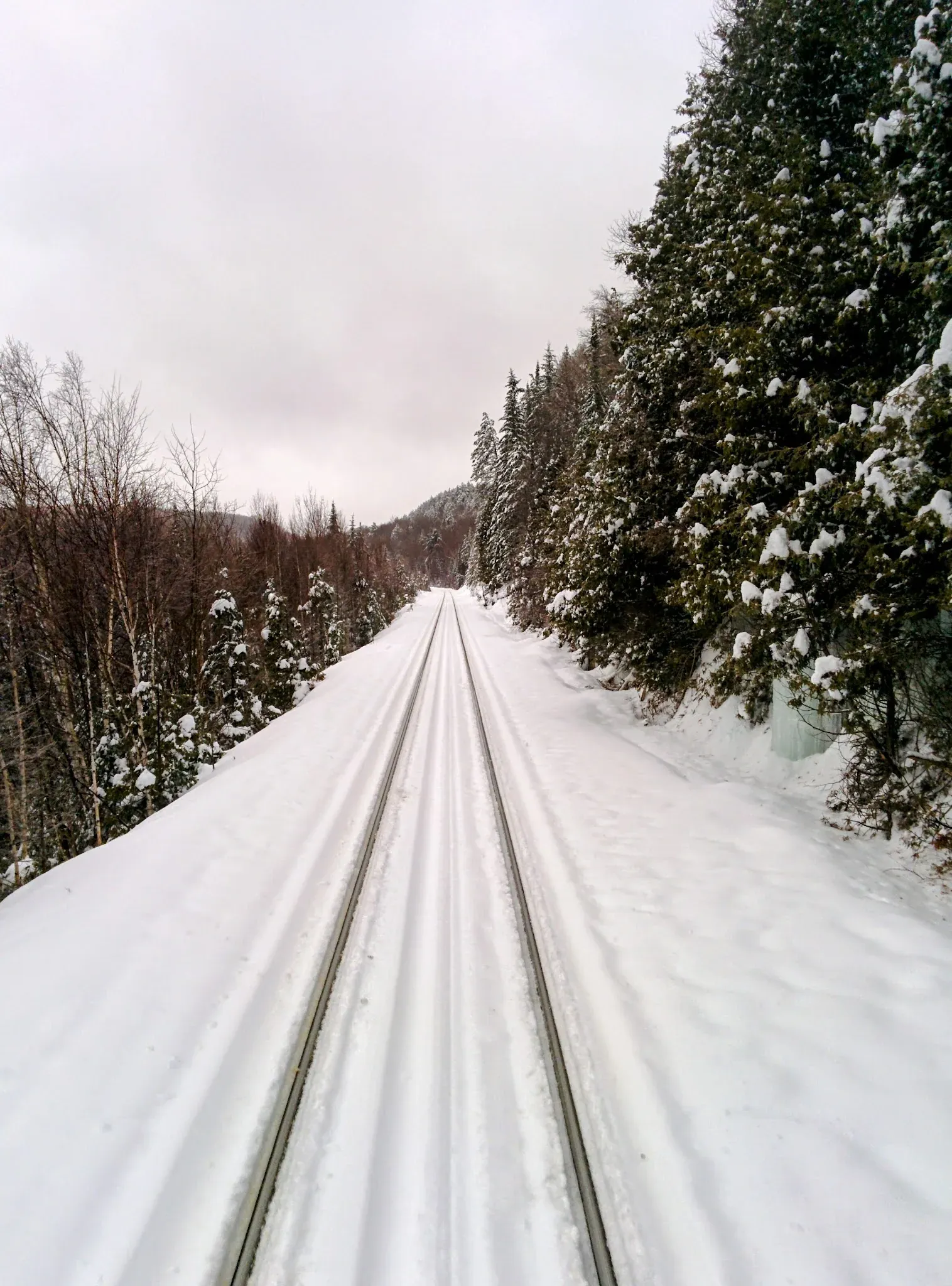 |
VIA Rail 603 outside La Tuque, QC. February 2016.
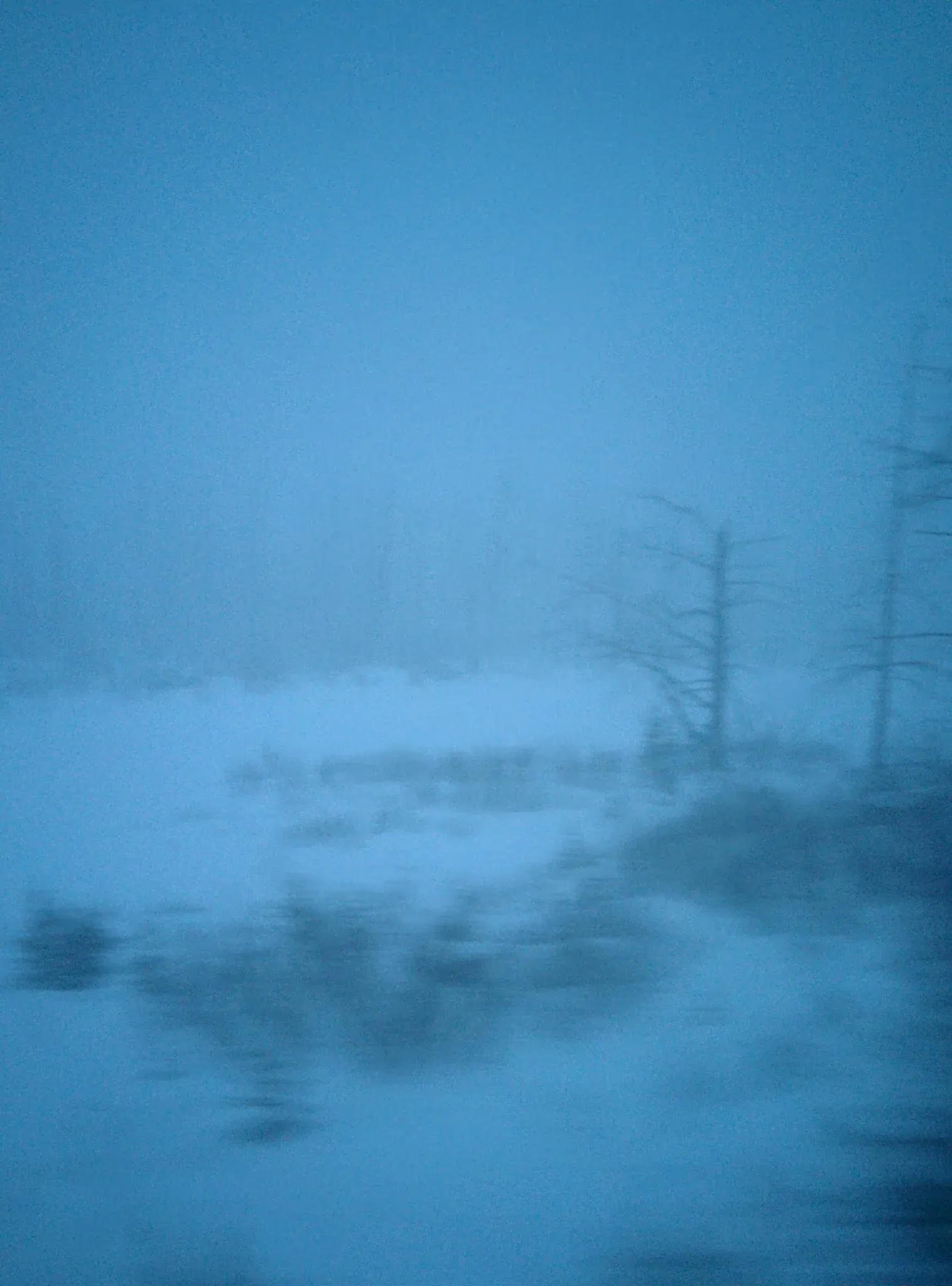 |
VIA Rail 604 Paradis, QC. February 2016.
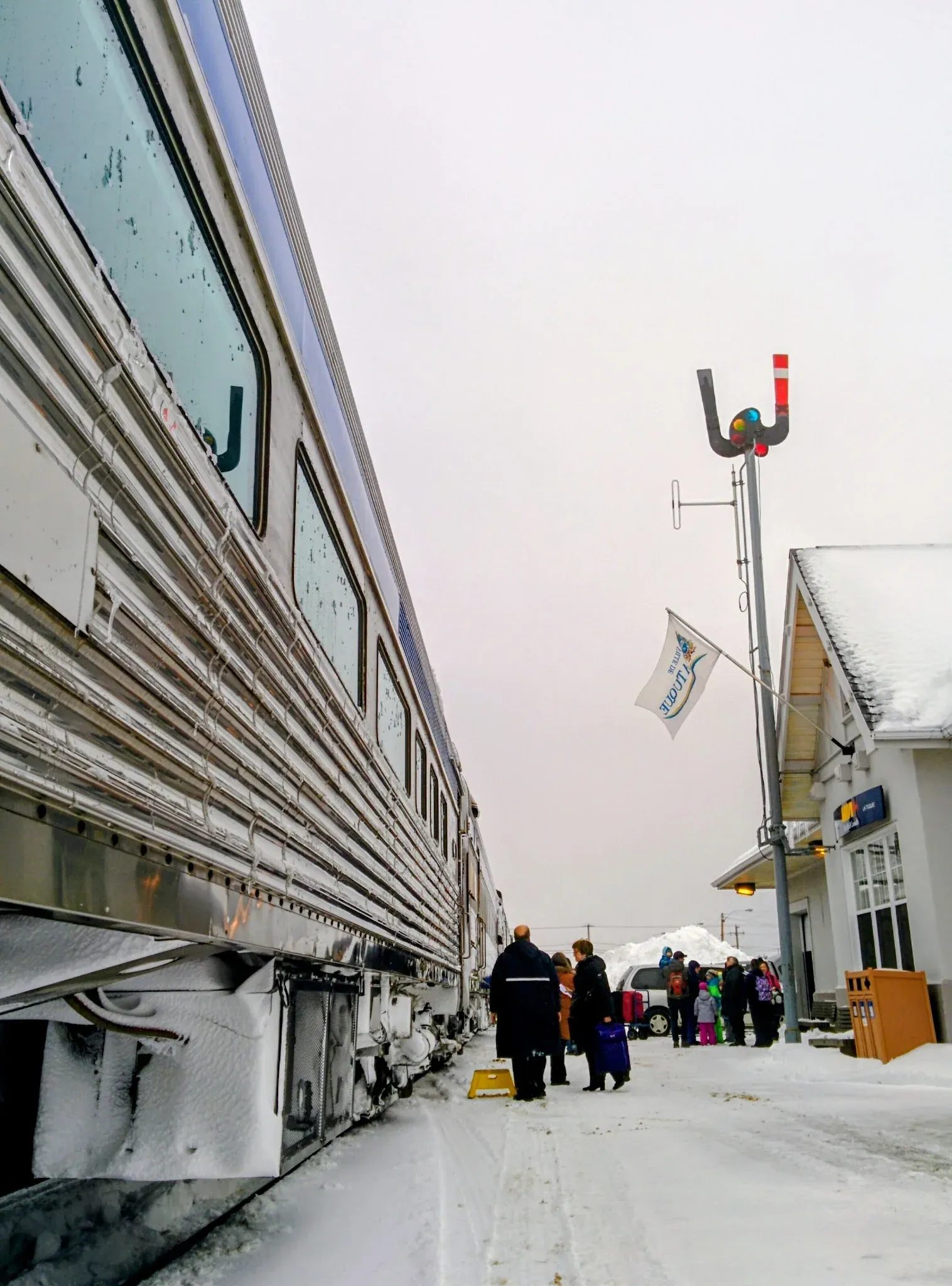 |
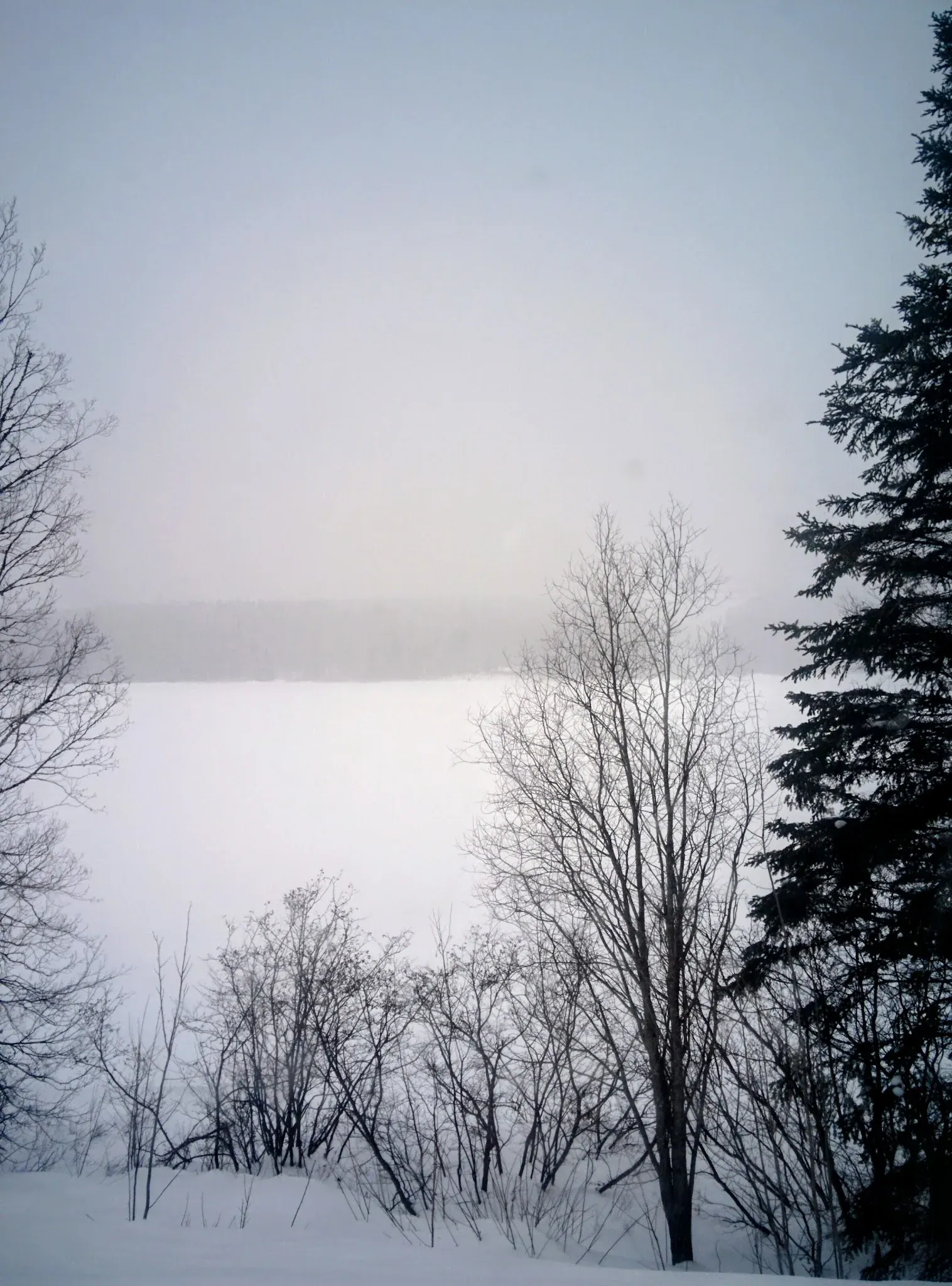
VIA Rail Train 604 La Tuque, Québec. February 2016.
 |
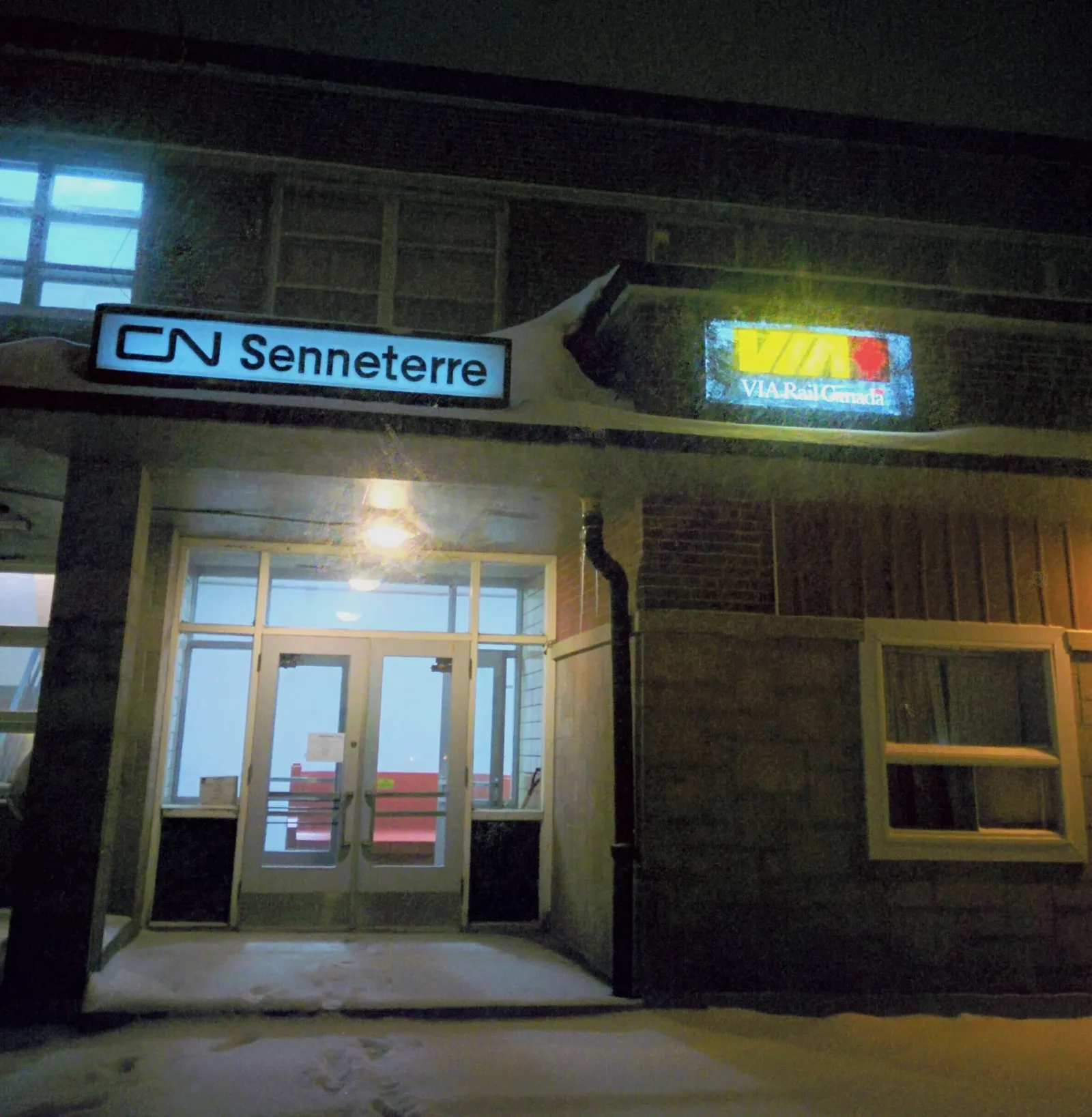
VIA Rail 604 Casey, QC. February 2016.
 |
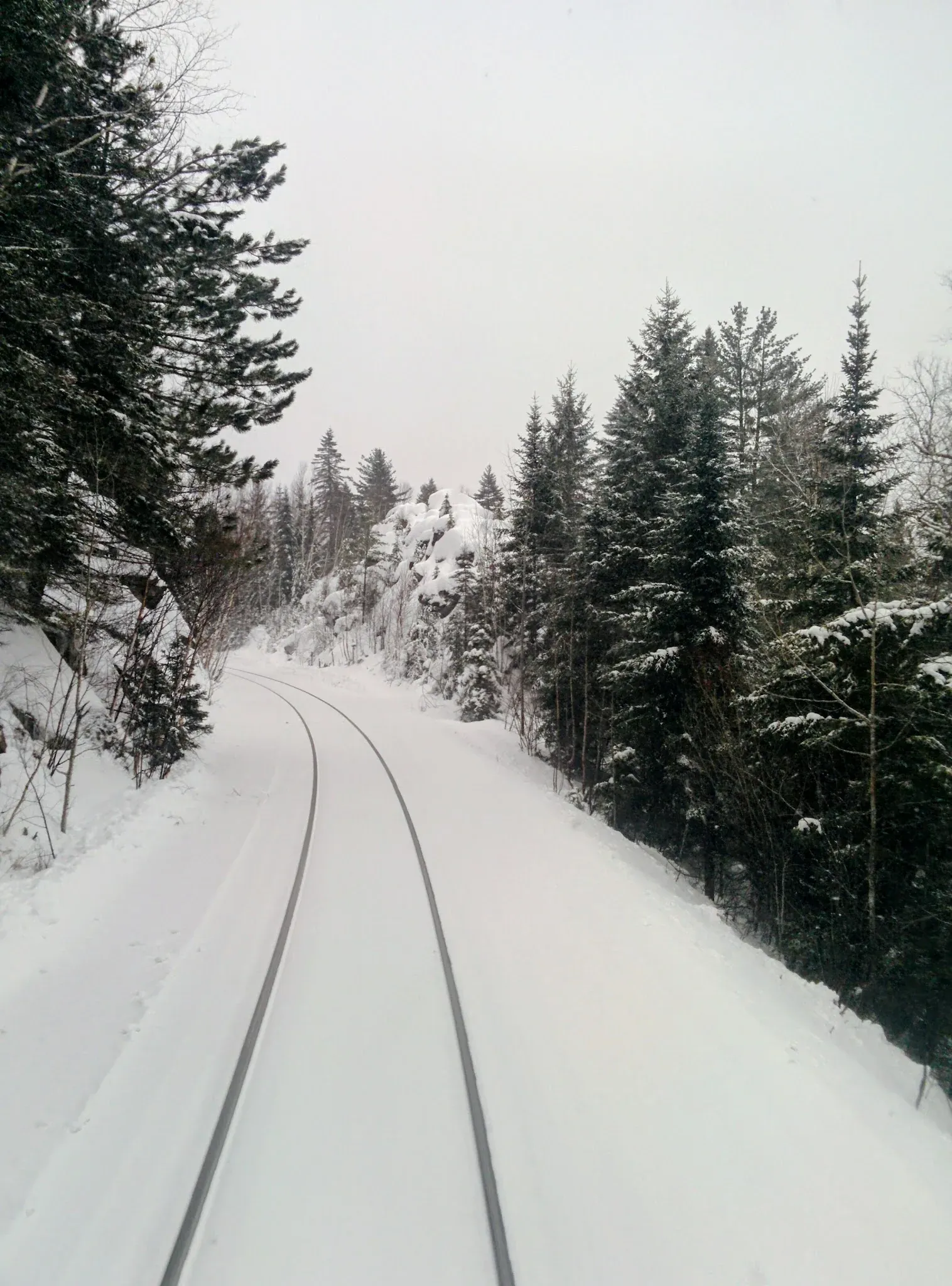
Gare de Senneterre. February 2016.
 |
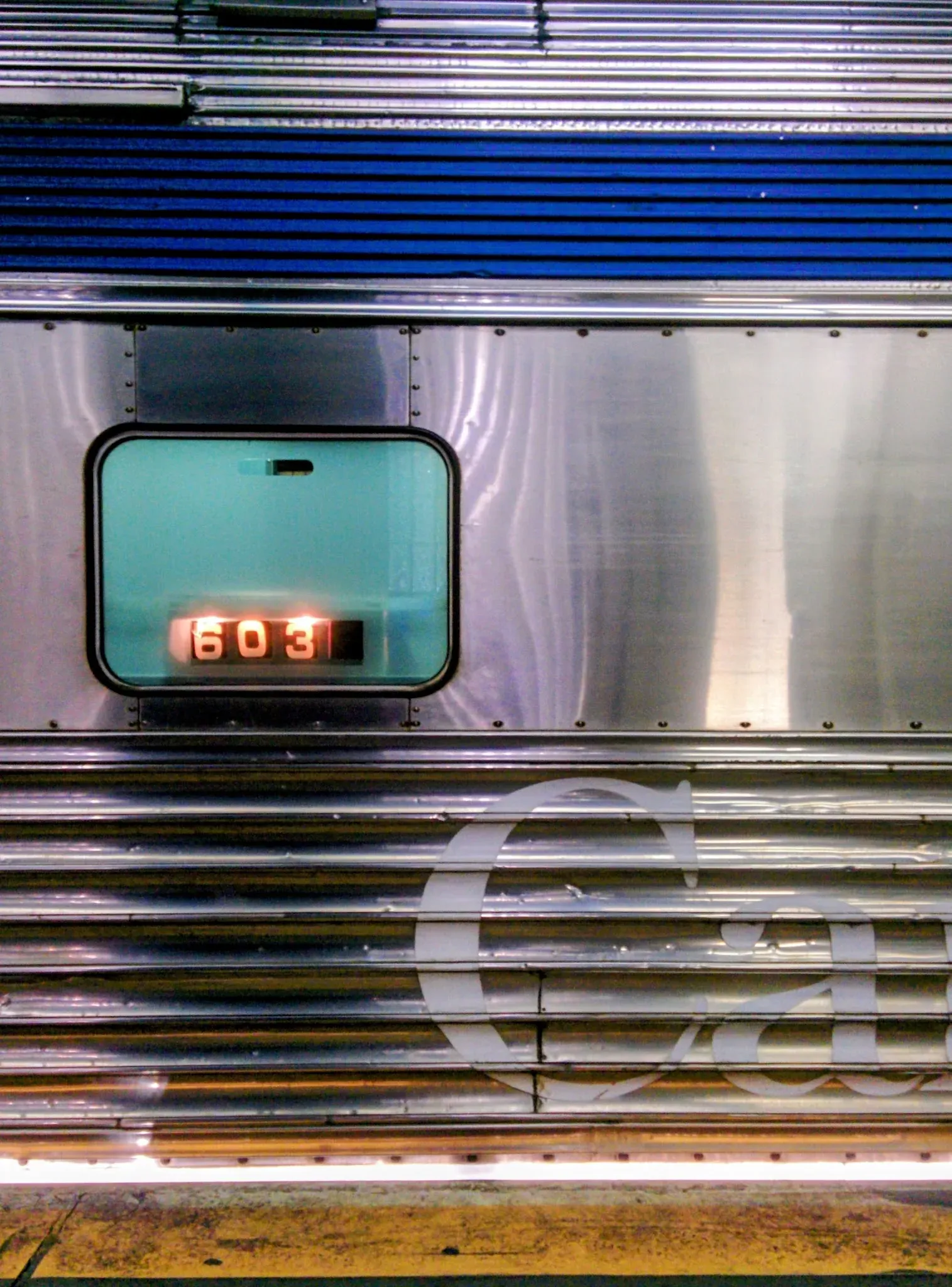
VIA Rail 603 Audy, QC. February 2016.
 |
VIA Rail 603 at Gare Centrale, Montréal QC. February 2016.
Further reading:
Hivernal Voyageur -- VIA Rail #603 Montréal to Senneterre
https://www.christophergraper.com/2016/08/hivernal-voyageur-via-rail-603-montreal.html
3 Place St. Henri
(Curiously, Gene Lee’s liner notes do not speak to Place St. Henri)
Click to Listen
Despite enormous changes in the past 60 years, Montréal remains the cosmopolitan epicentre of culture, art, spectacle and sin – the soul of Canada; bilingual, confident and arguably the only city in North America demonstrably more interested in pleasure than business. Nestled below it all is Gare Centrale, cut deep into the foot of Mont-Royal, the city’s iconic namesake, connecting and welcoming railway travelers in from the cold, offering hearth and entrance to one of the greatest cities in North America.
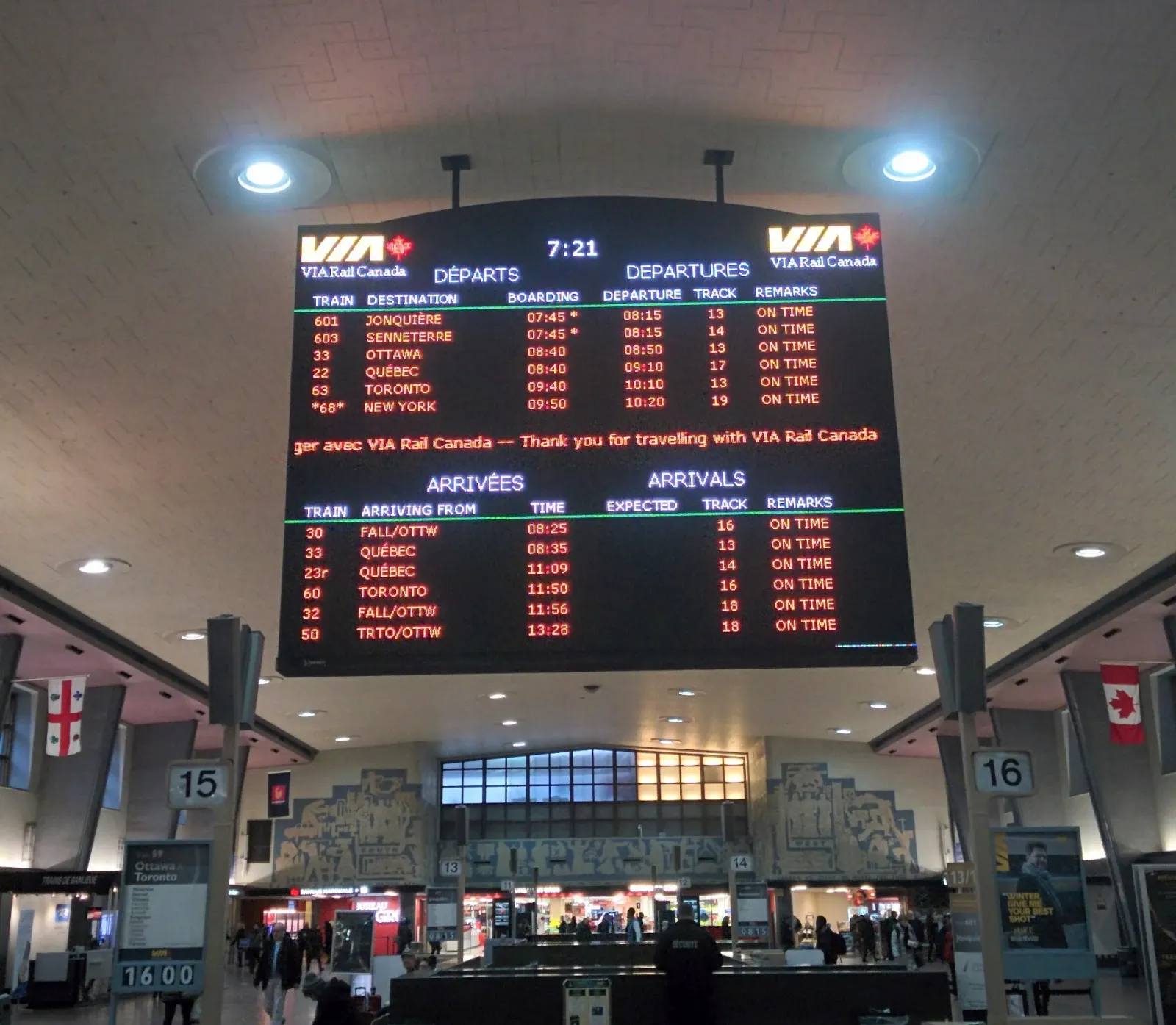 |
Departures and Arrivals Sign at Montréal’s Gare Centrale. February 2016.
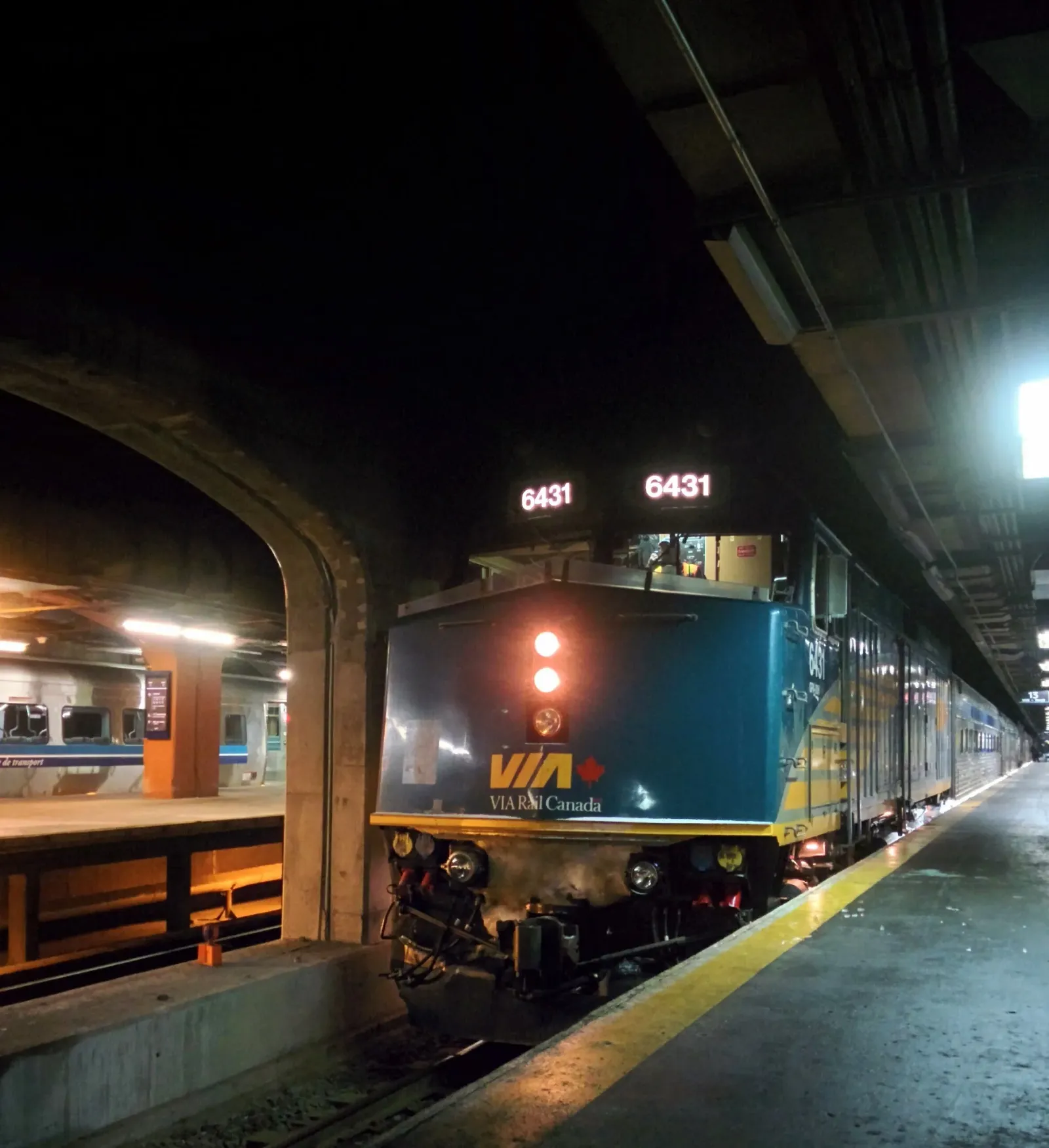 |
VIA Train 603 prepares for departure from Montréal’s Gare Centrale. February 2016.
When Oscar wrote The Canadiana Suite, it was possible to travel directly from Montréal or Ottawa to Vancouver, journeys which today require a connection in Toronto. This change over the years, along with the growth and dynamism of Montréal, Ottawa and Toronto, have increased the importance and frequency of VIA Rail trains in what is now called The Corridor.
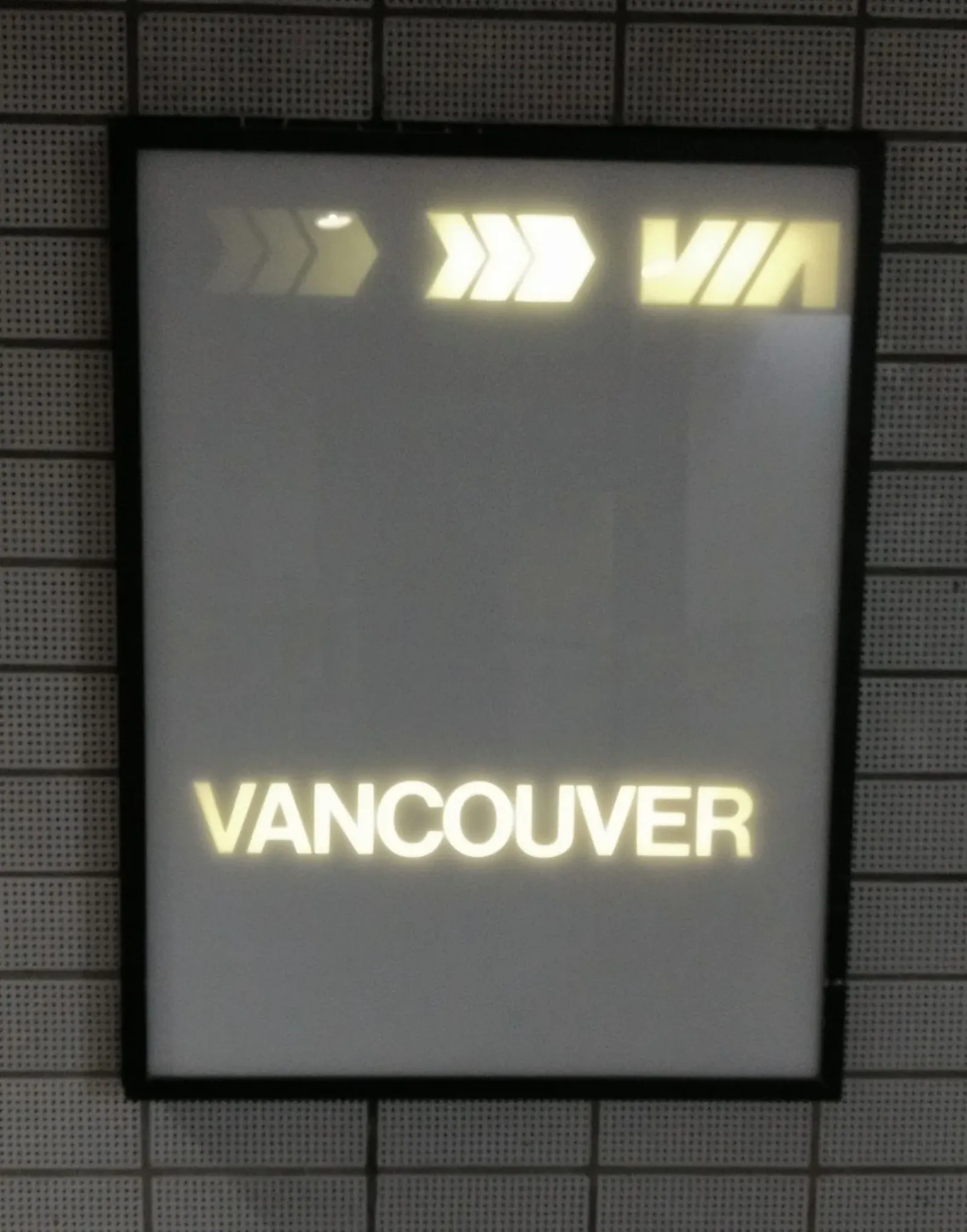 |
Analogue boarding signage at the Gare d’Ottawa, disused from the days when it was possible to travel direct to Vancouver. August 2017.
Despite the frequent delays and unresolved grievances between passenger and freight trains, the train between Montréal and Toronto has become the iconic way to seek passage, a bilingual conduit, upon a thin ribbon of physical connection, the bridge between the cultural divide, and between what are now two distinct, dynamic and marvelous metropoles. This does not happen on the highways, where people are trapped alone in their cars, nor by air, where passengers are strapped into the uniform mediocrity of short-haul flights at overly-congested airports. Traveling on Corridor trains is often the first place on a journey where the people and languages blend convivially and convincingly.
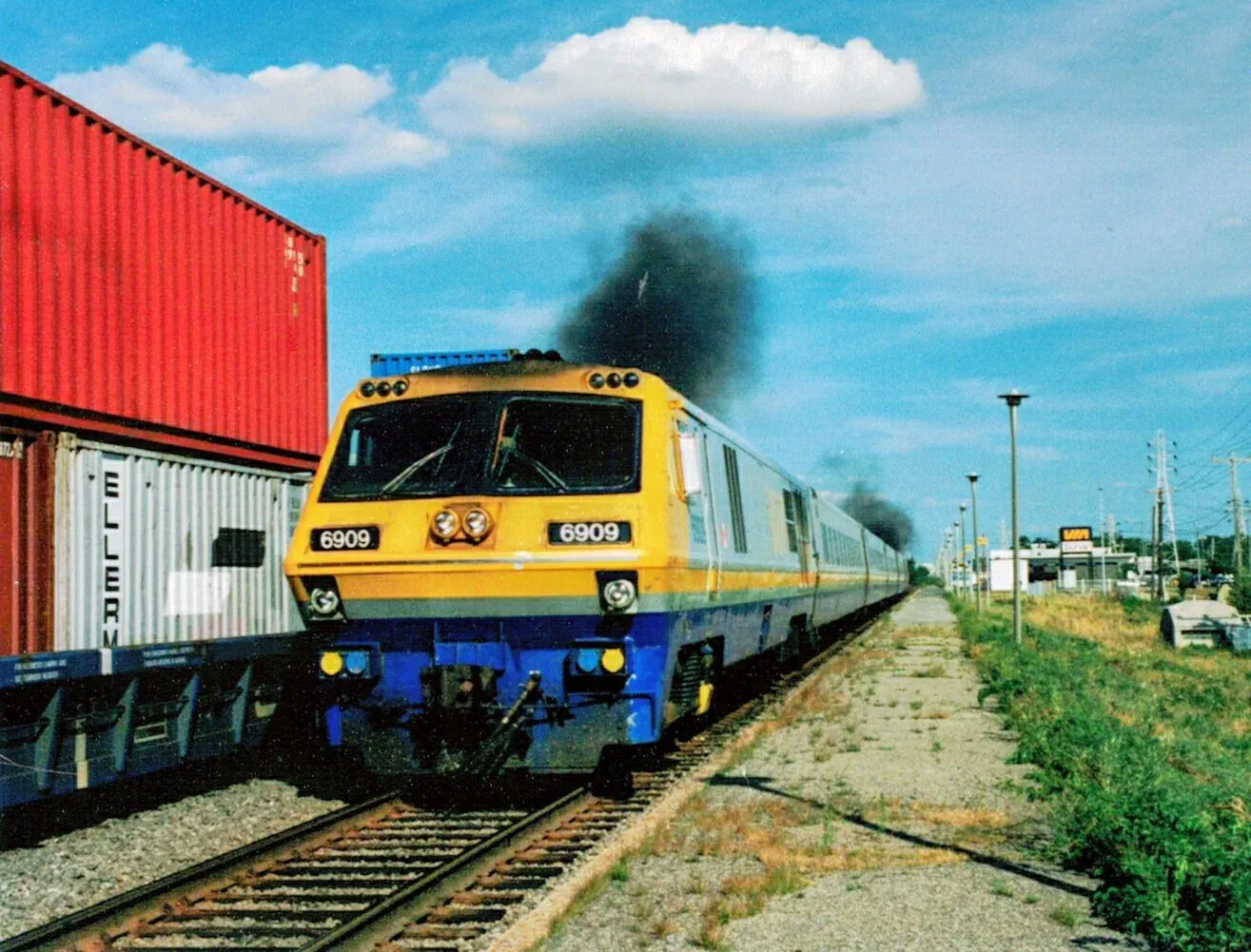 |
LRC Locomotive 6909 leads VIA Rail Train 67 at Dorval before continuing its 3 hour and 59 minute trip to Toronto. Today the trip takes 5+ hours. Summer 1992.
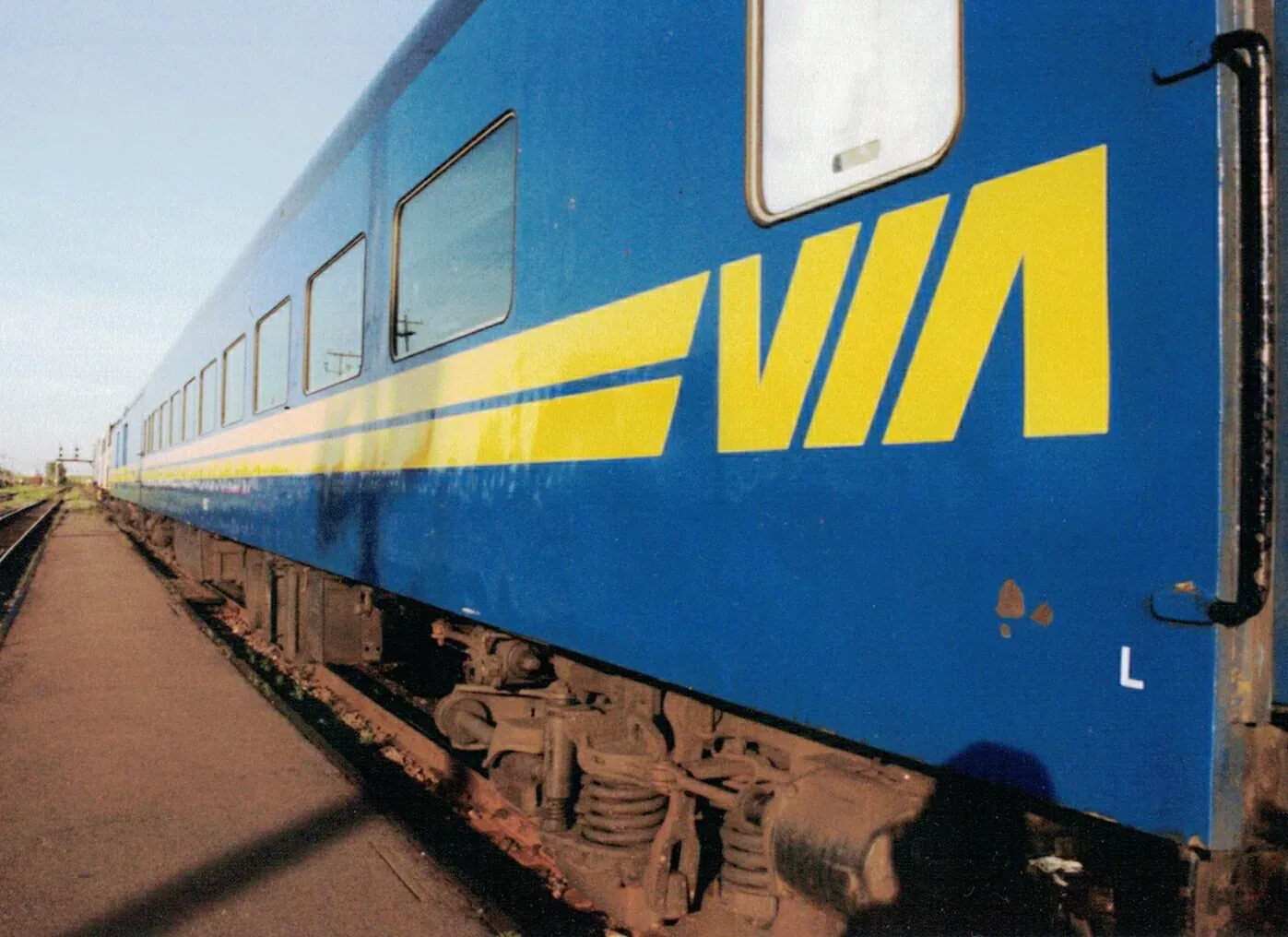 |
VIA’s long retired Blue and Yellow equipment at St Lambert, PQ. Summer 1992.
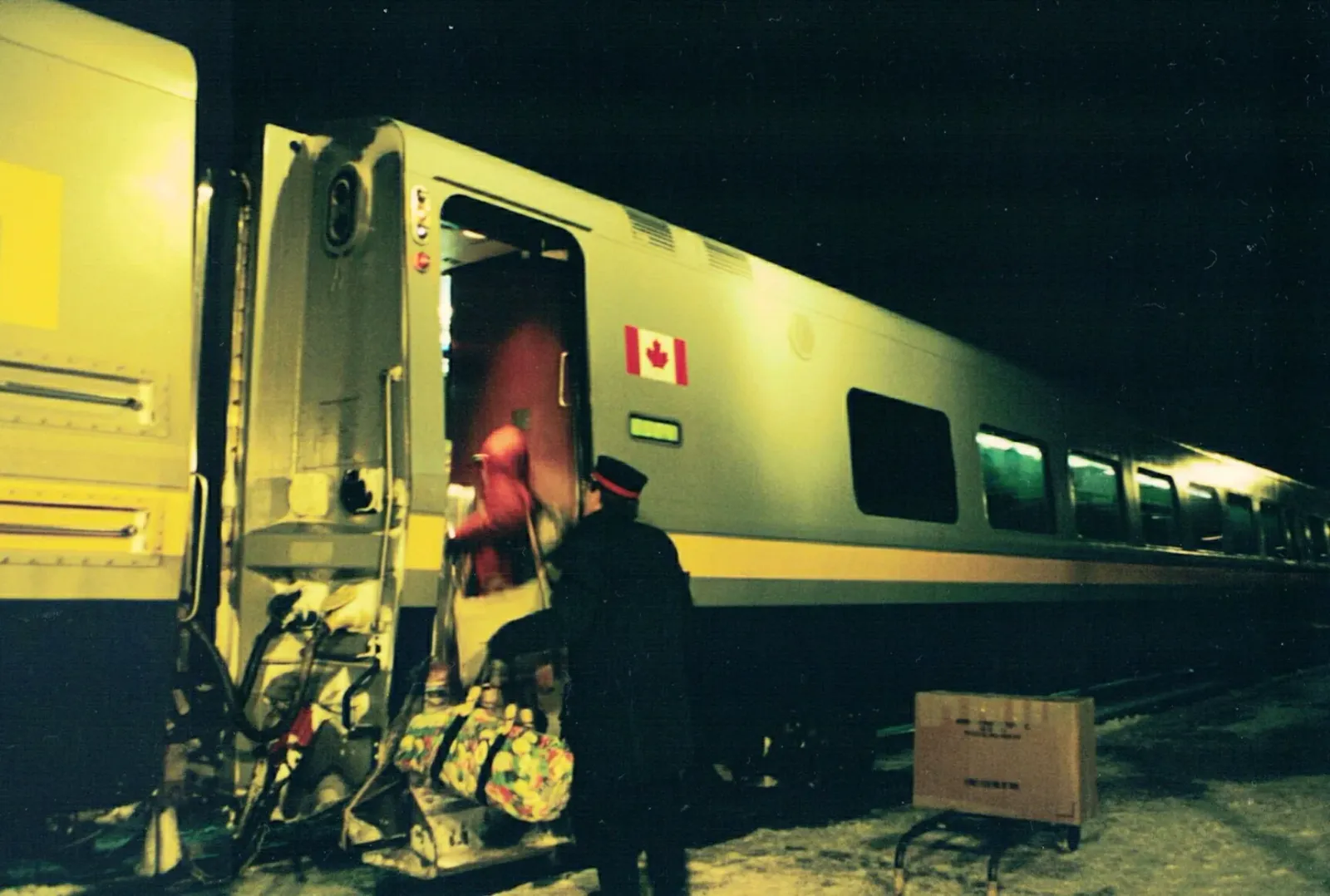 |
A station agent assists a passenger boarding LRC equipment in the snow at Dorval, PQ. Winter 1992.
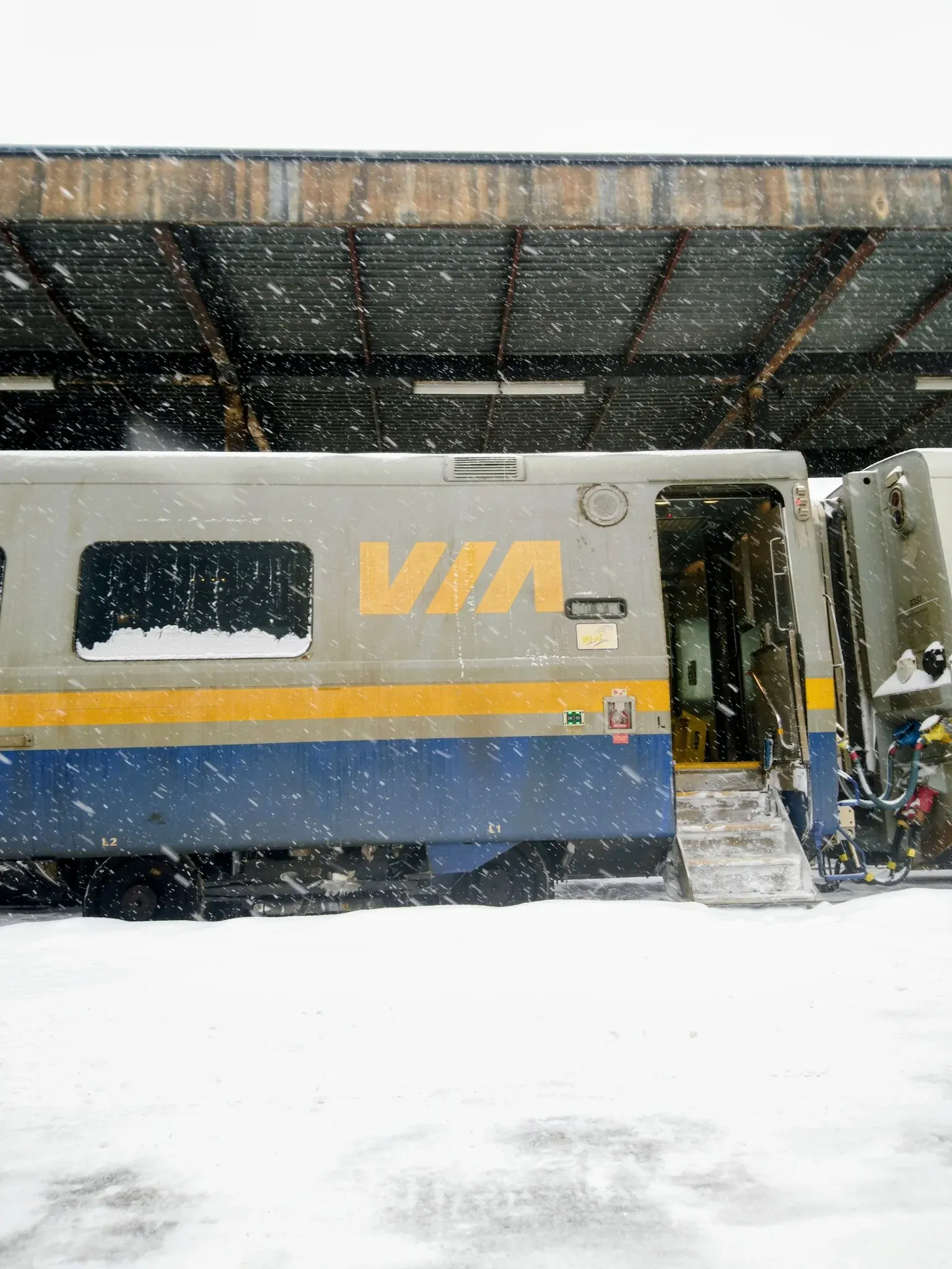 |
LRC equipment in a heavy snow storm laying over between trips at Ottawa Station. February 2019.
4 Hogtown Blues
“As for Hogtown Blues-—well, a lot of Canadians dislike Toronto, as many Americans dislike New York, and for similar reasons. They say the city is all business and hustle, with no heart, and they call it "Hogtown.” "But I think of Toronto lovingly," Oscar said. "I tried to capture an impression of it by using an expansion type blues. It is fairly simply stated at the start. Using the harmonic content of the melodic line, I tried to give a feeling of the expansion this city is going through, and attempted to use the solos to typify the moods of the place at various times.”
Click here to listen:
Toronto is rarely called Hogtown these days, except with a kind of nostalgic irony for a time and a place that no longer exists. Toronto’s exponential growth since the release of The Canadiana Suite is foreshadowed in the liner notes, and Toronto today is dynamic and diverse, bursting at the seams with people from all around the world, who have chosen Canada, and Toronto, as their home.
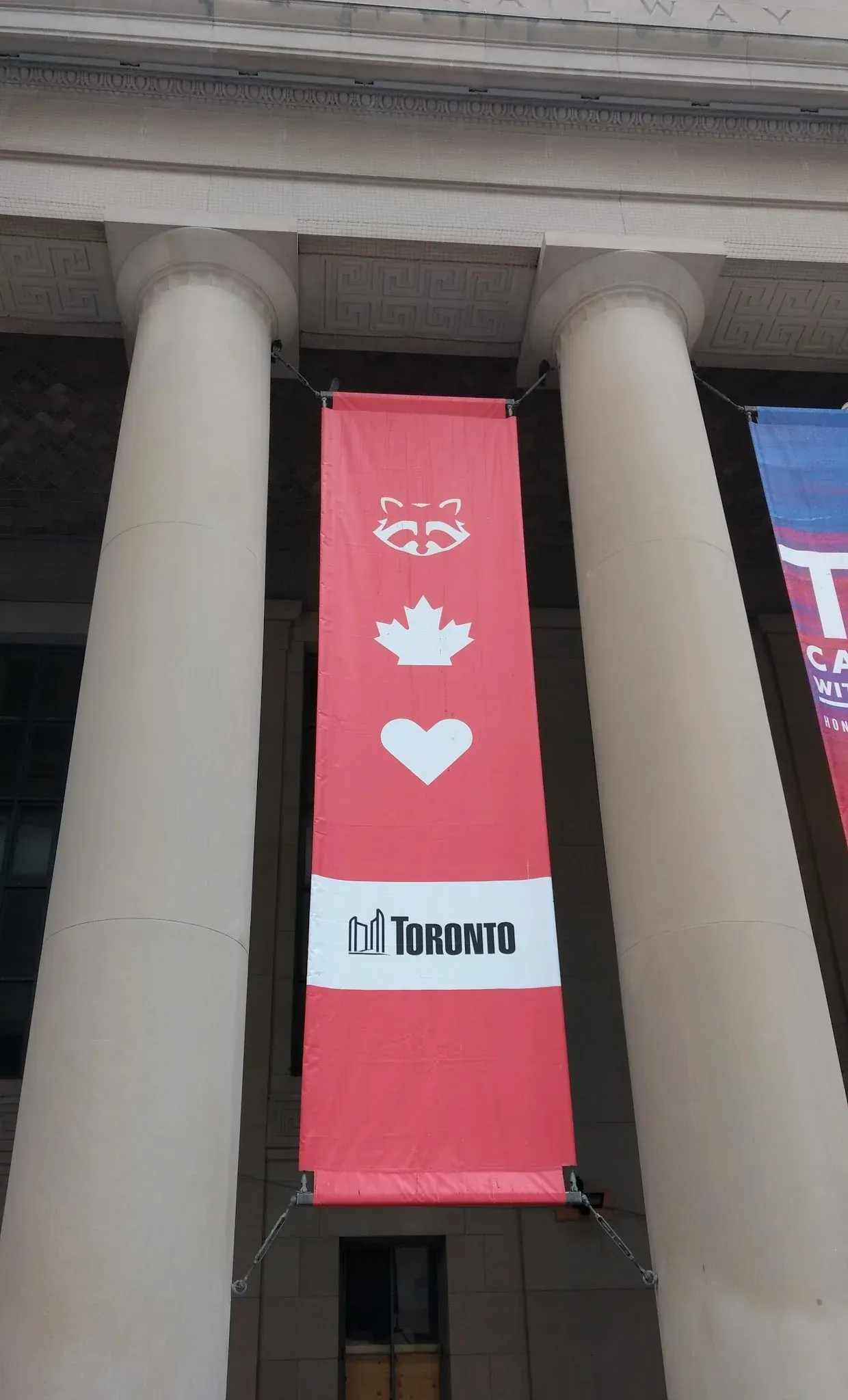 |
Trashpanda Town Blues. July 2017.
Hustle is still the name of the game here, and the railways are no exception. Toronto’s Union Station is a regional transport hub, and hosts over 350 departures each day, and all those trains travel in and out of Toronto Union Station through a huge series of multi-track interlockings, manually controlled by towers at either end of the terminal – John St on the west end and Cherry Street on the east. Unchanged since the 1930’s, Toronto’s modern day railway hustle still relies upon analogue technology dating back a century:
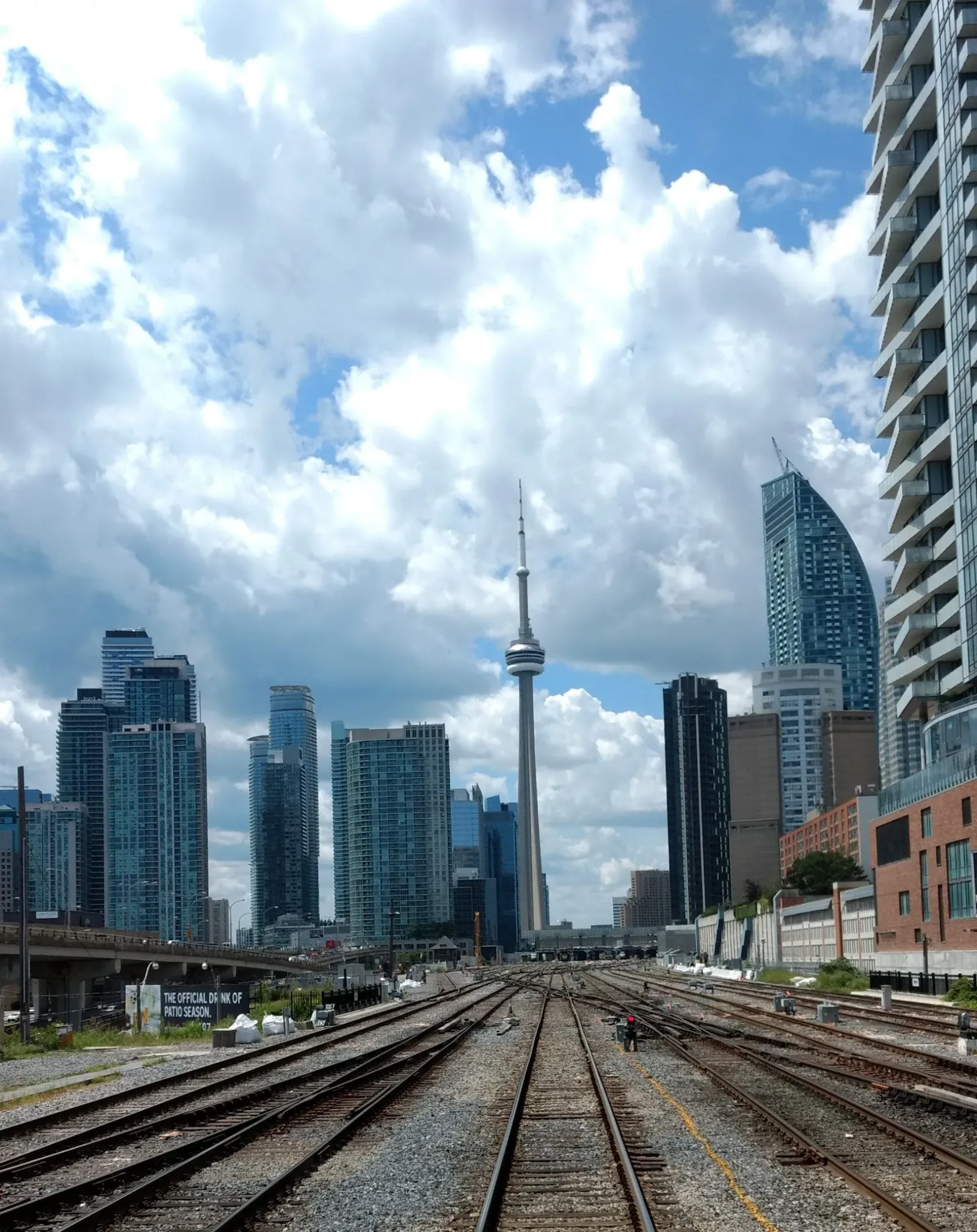 |
Entering Toronto Union Station approaching the Cherry Street Interlockings, with the iconic CN Tower being iconic in the background. August 2017.
Indeed, these distinctive interlockings were the same that bore witness to all passenger railway arrivals into Toronto, including those which Oscar and his Dad would have traversed as their trains arrived in the bustling metropolis.
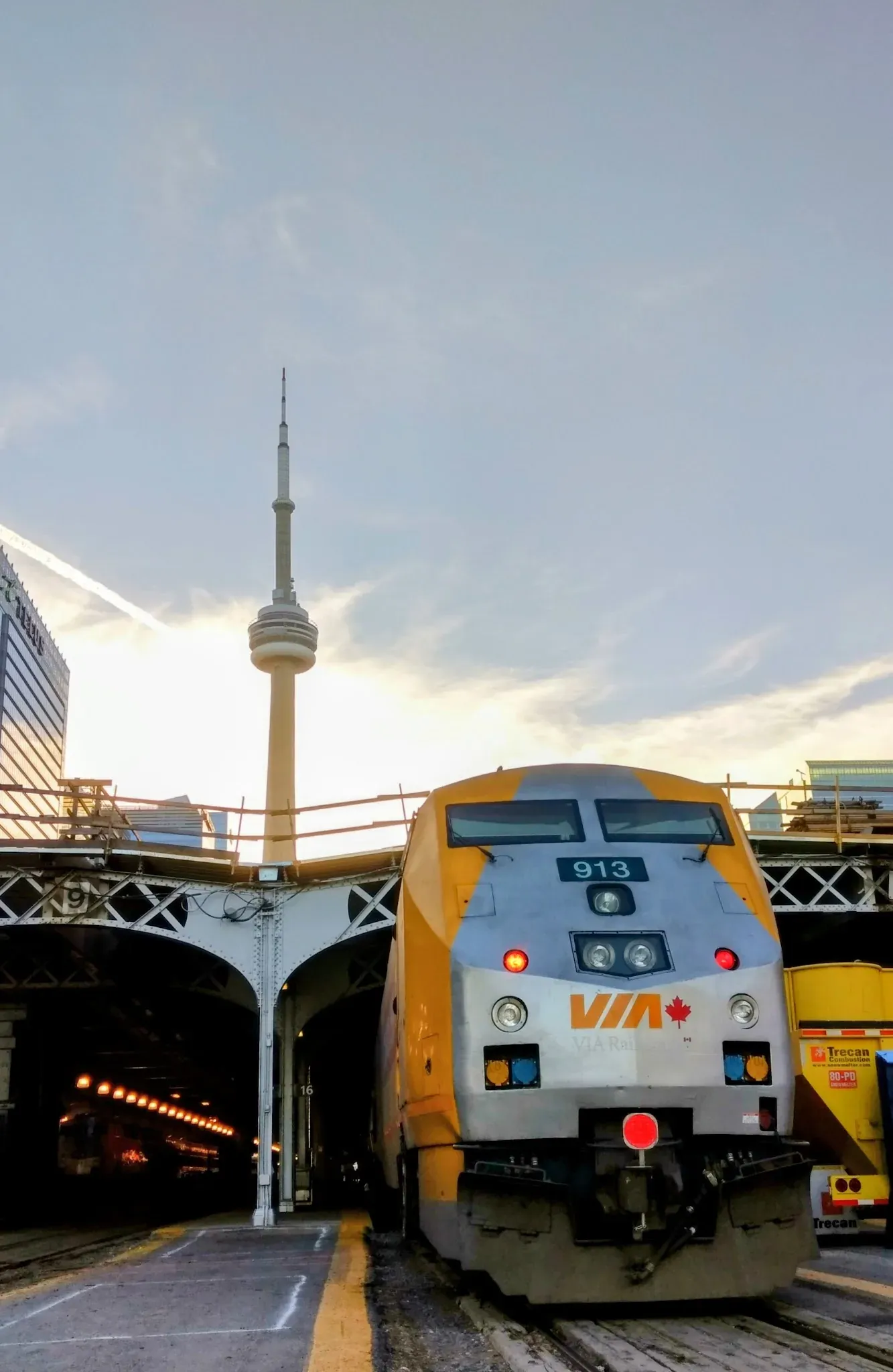 |
VIA 913 awaiting its next departure from Toronto Union Station
To my ear, the pace and the flow of the introduction to Hogtown Blues is reminiscent of the rhythm and clatter of those interlockings at Cherry and John Street, the ubiquitous clank, thud, rock, sway and roll which has greeted every passenger train arrival at Toronto Union Station for nearly a century.
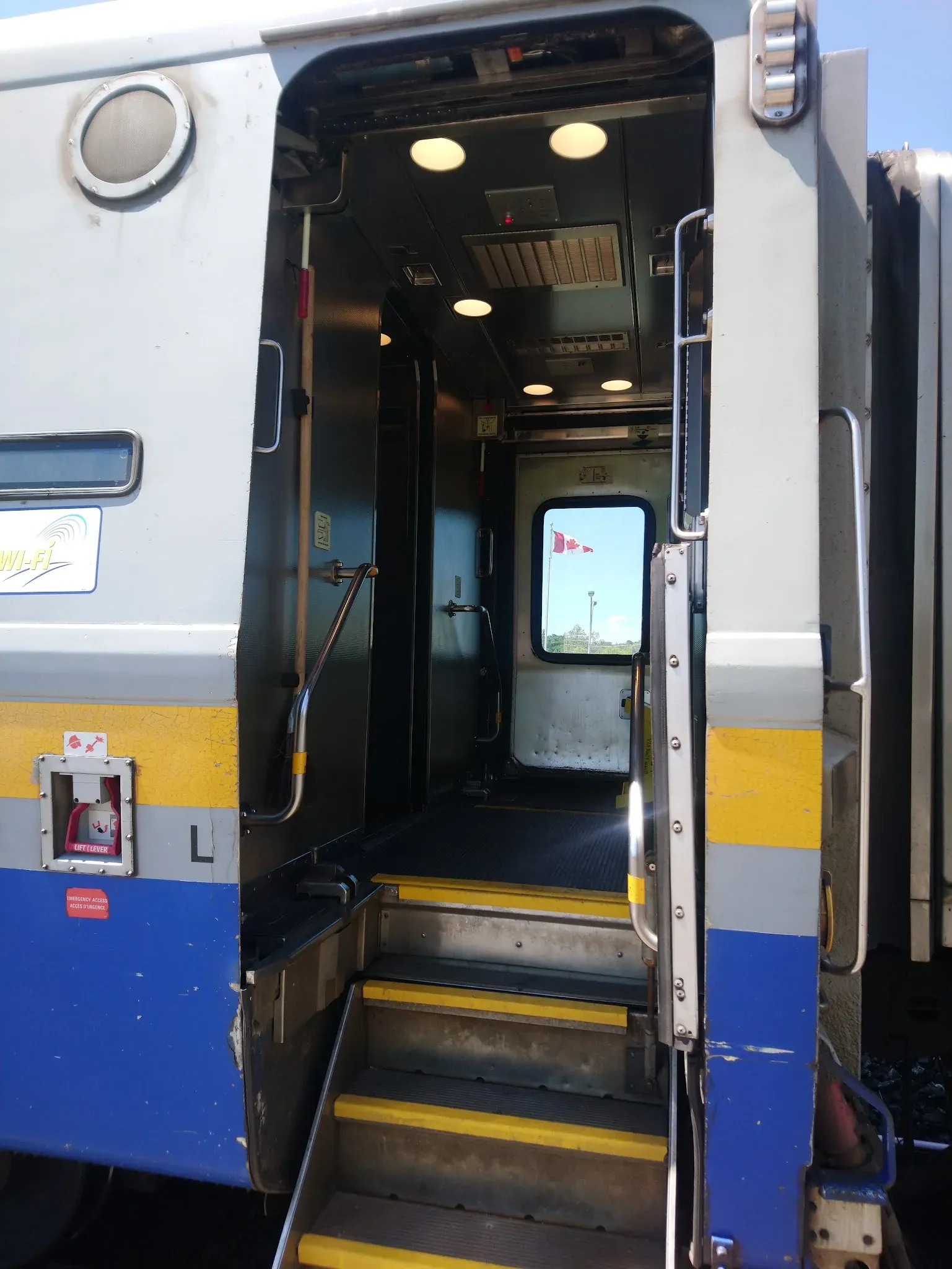 |
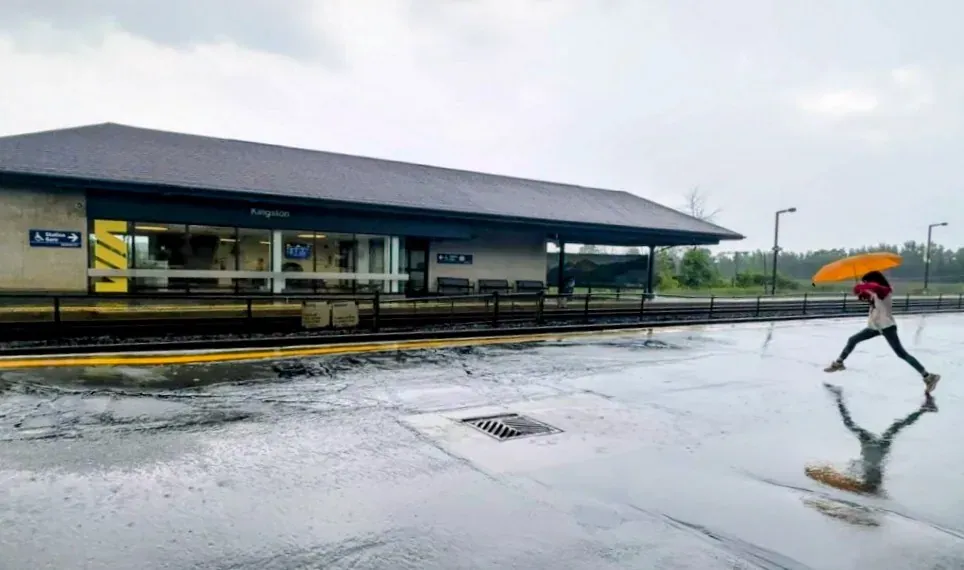
The Corridor hustle takes a patriotic pause at Kingston, ON. July 2019.
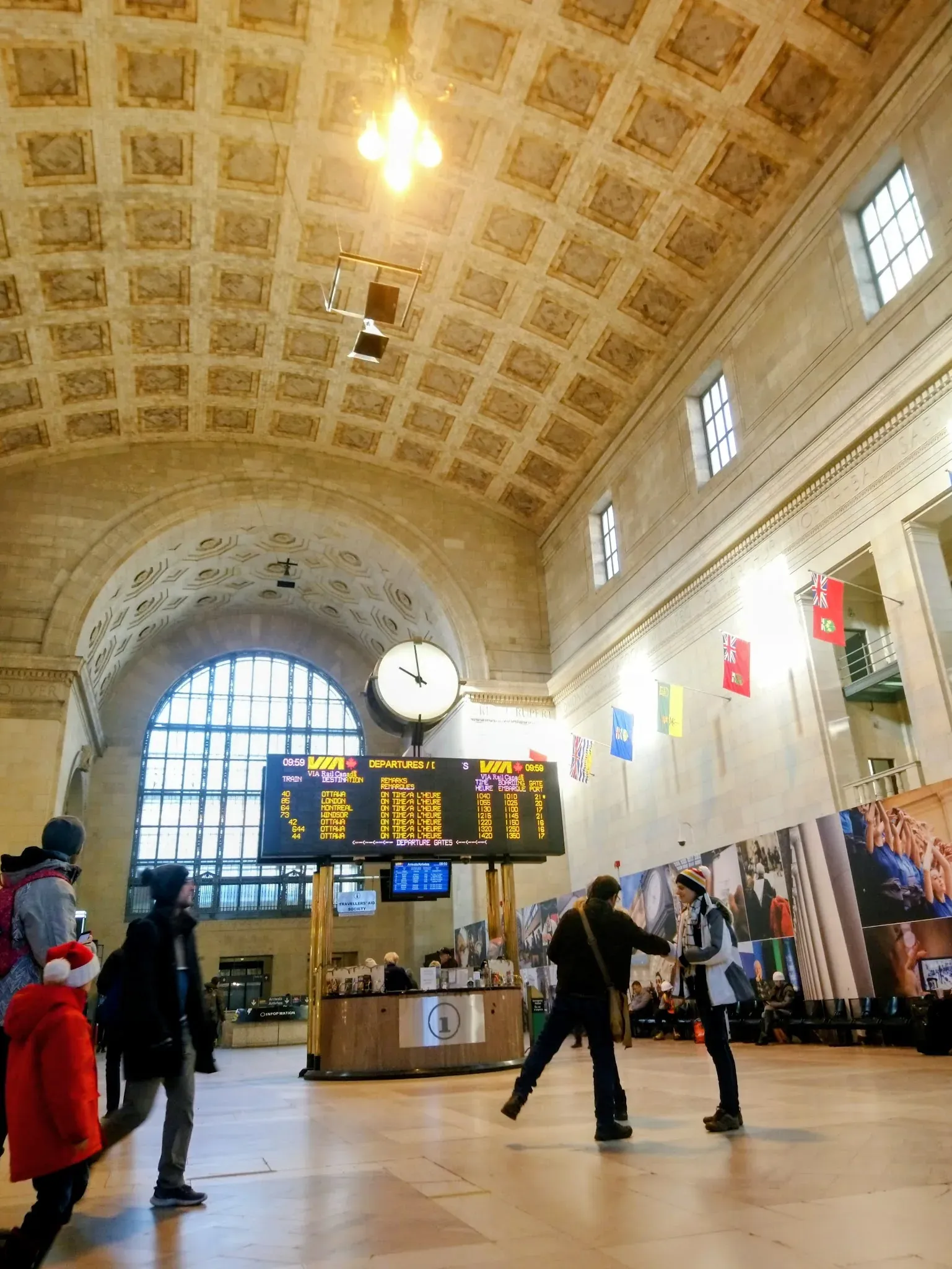 |
The Grand Hall at Toronto Union Station. December 2019.
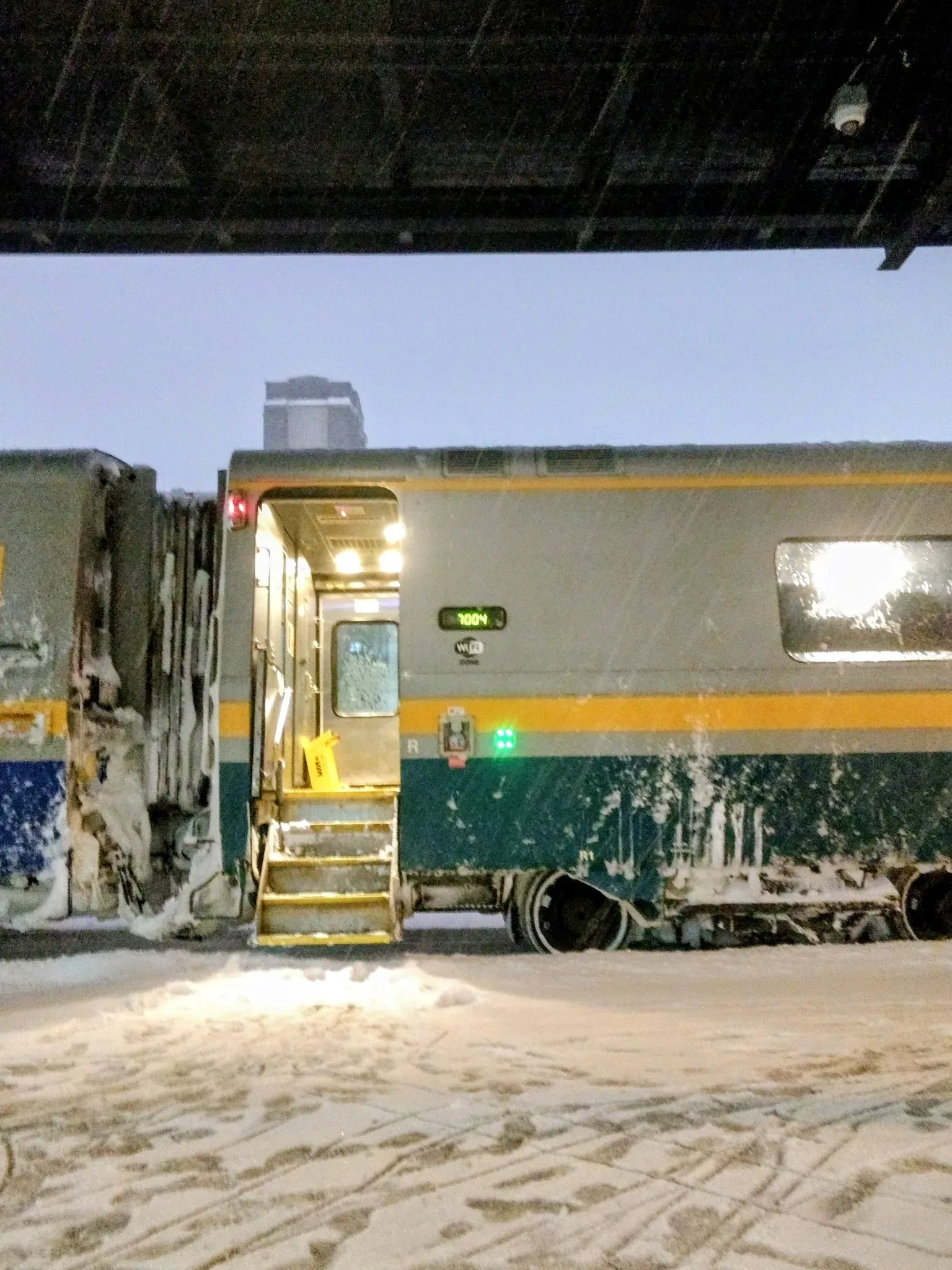 |
Snowy morning at London, ON as VIA 70 trudges its way from Windsor to Toronto during heavy snowfall. January 2018.
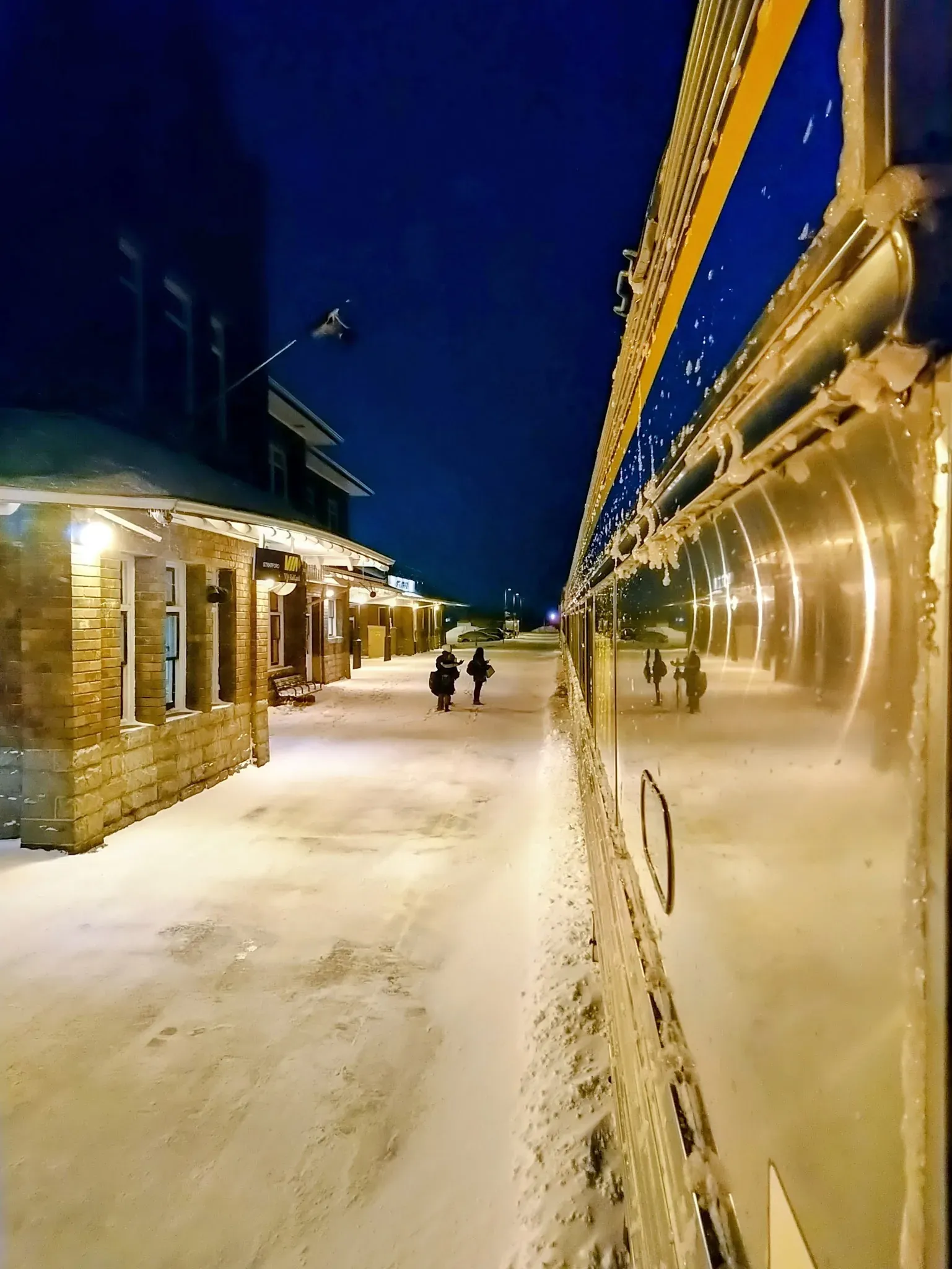 |
A snowy stainless-steel shimmer on VIA 88 at Stratford, ON. February 2019.
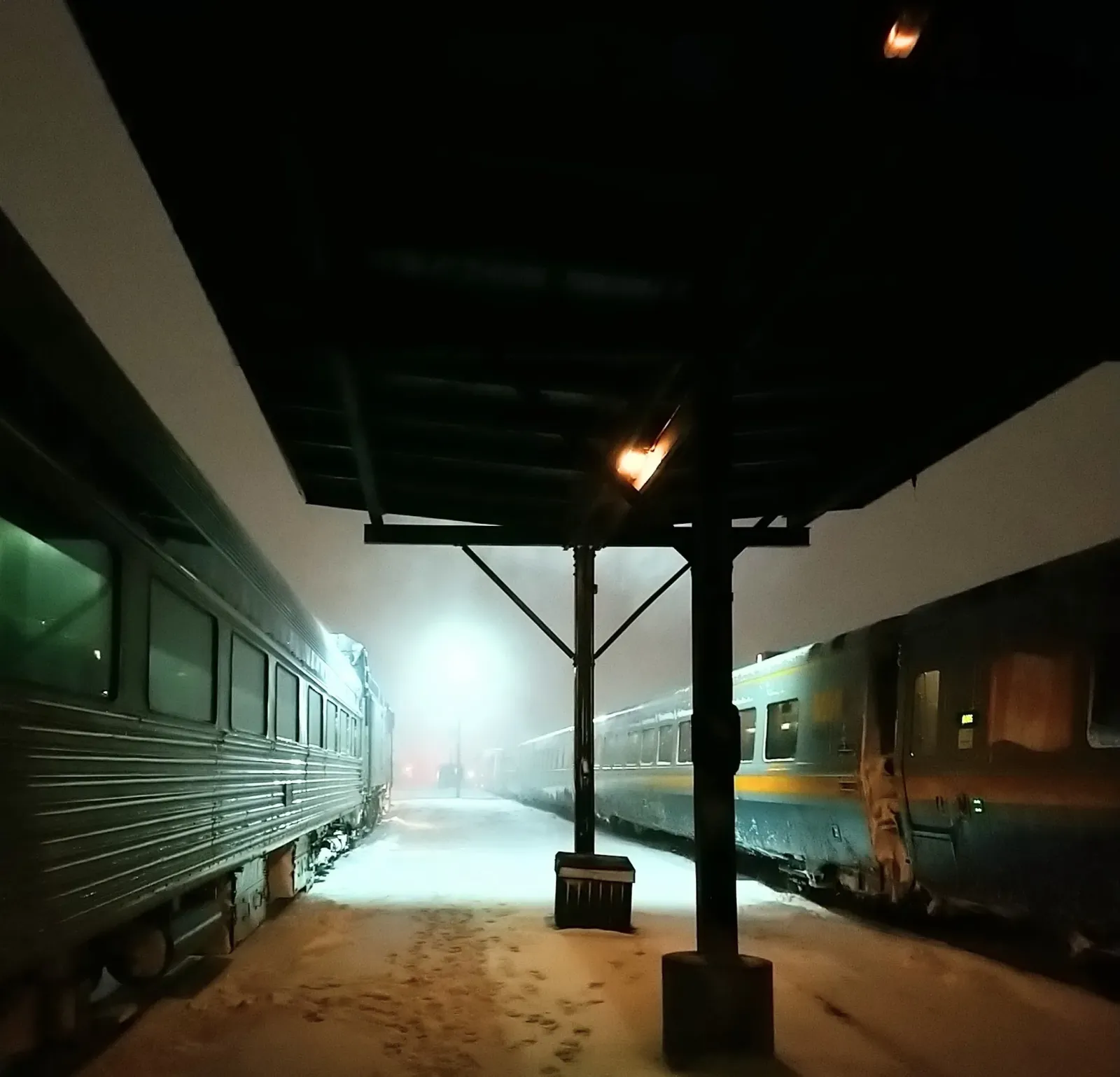 |
VIA 88 and 82 at London,ON bravely weathering a massive winter storm. February 2019.
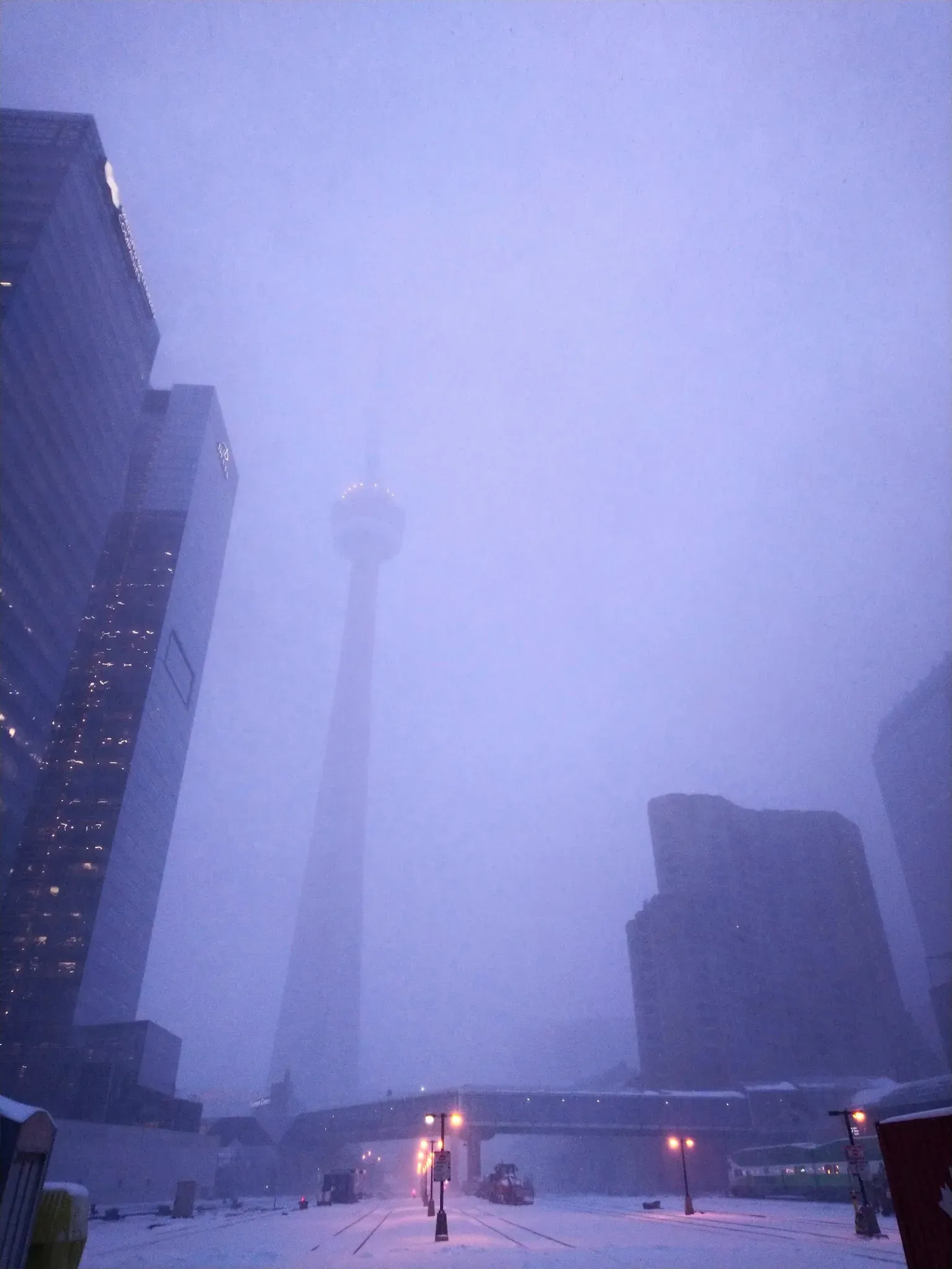 |
Snow day at Toronto Union Station. February 2019.
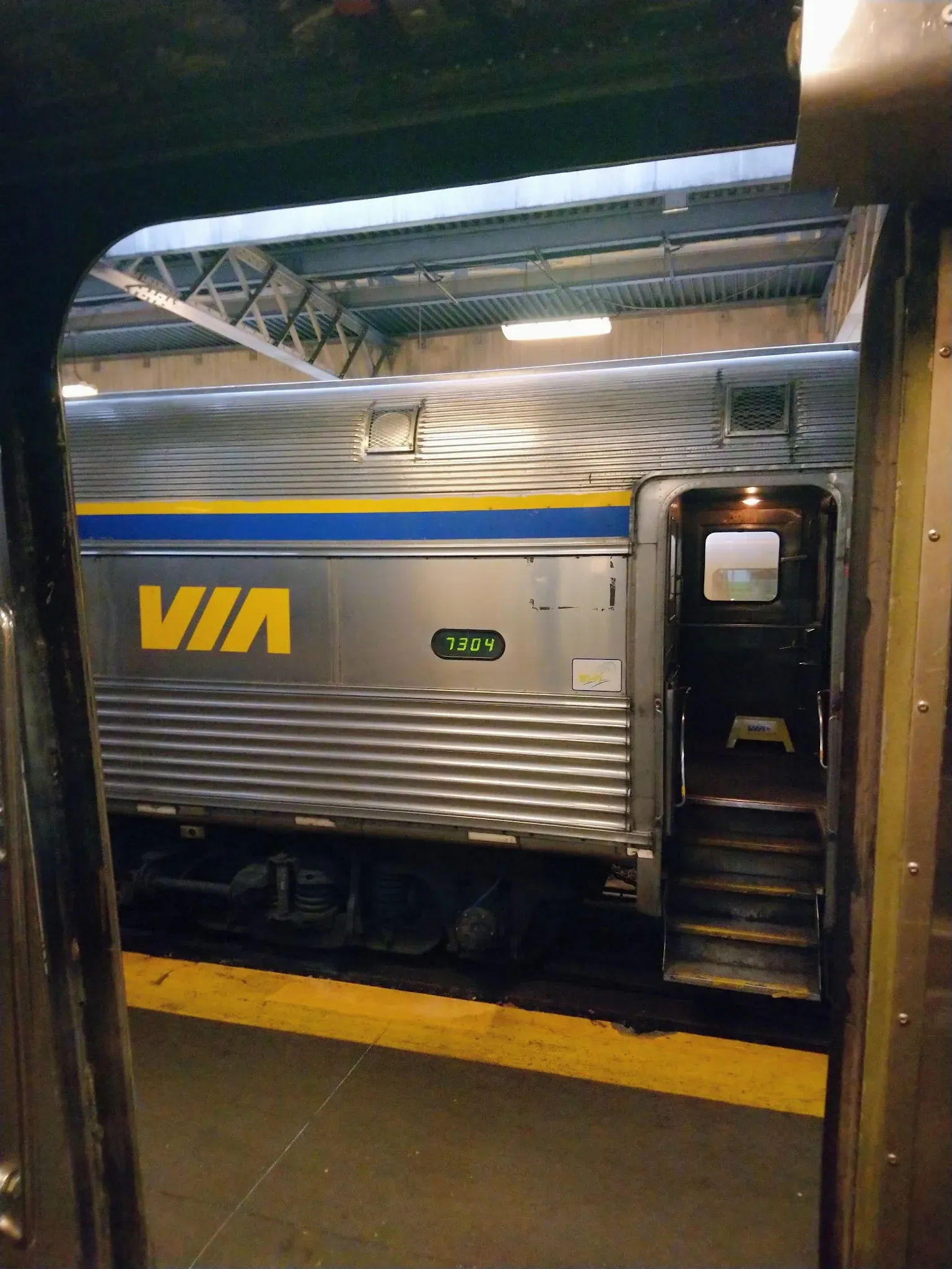 |
VIA 73 awaiting passengers at Toronto Union Station. November 2018.
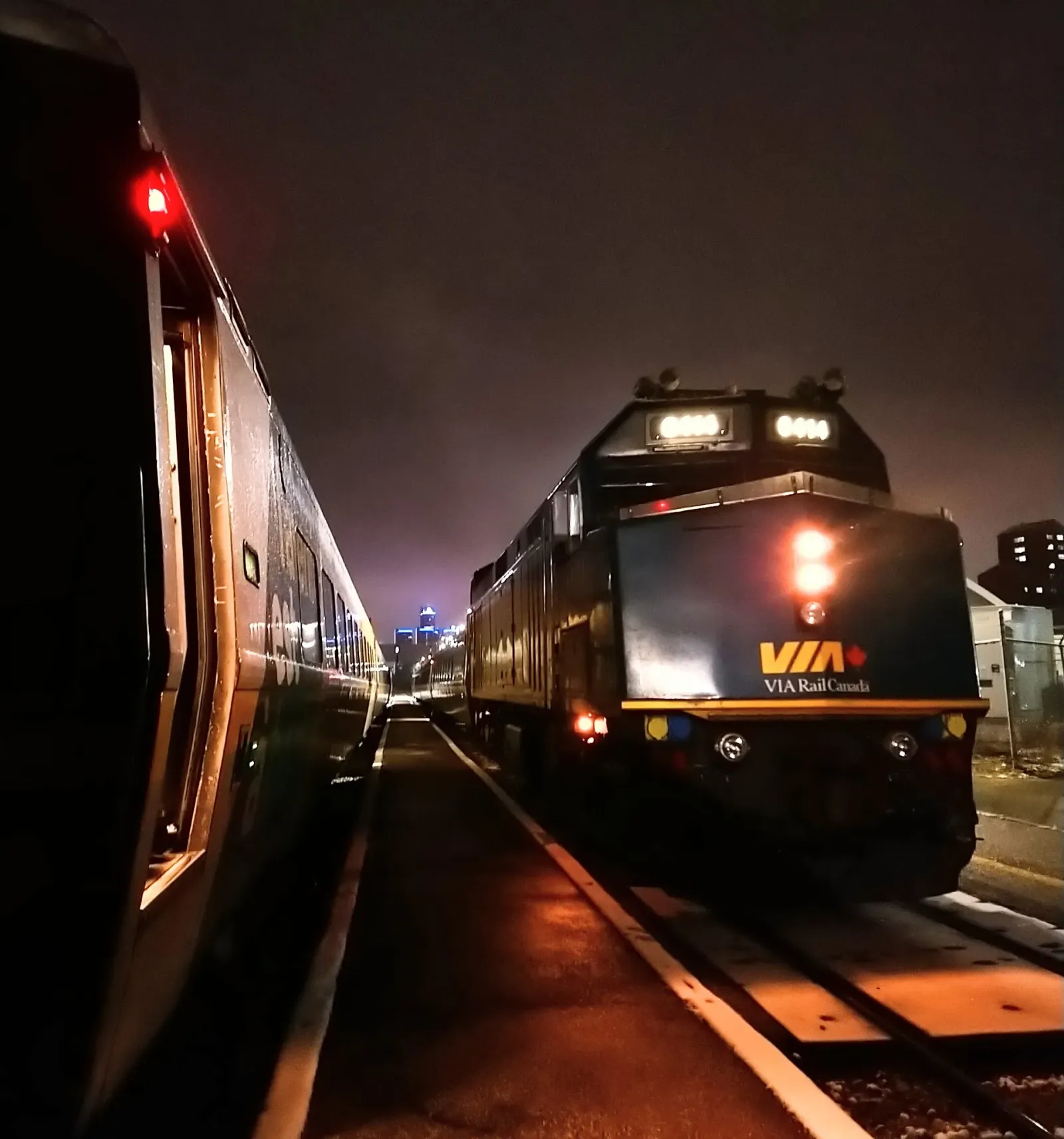 |
VIA 70 and 72 staged for early morning departures at Windsor, ON, with the Detroit skyline illuminating the background. November 2018.
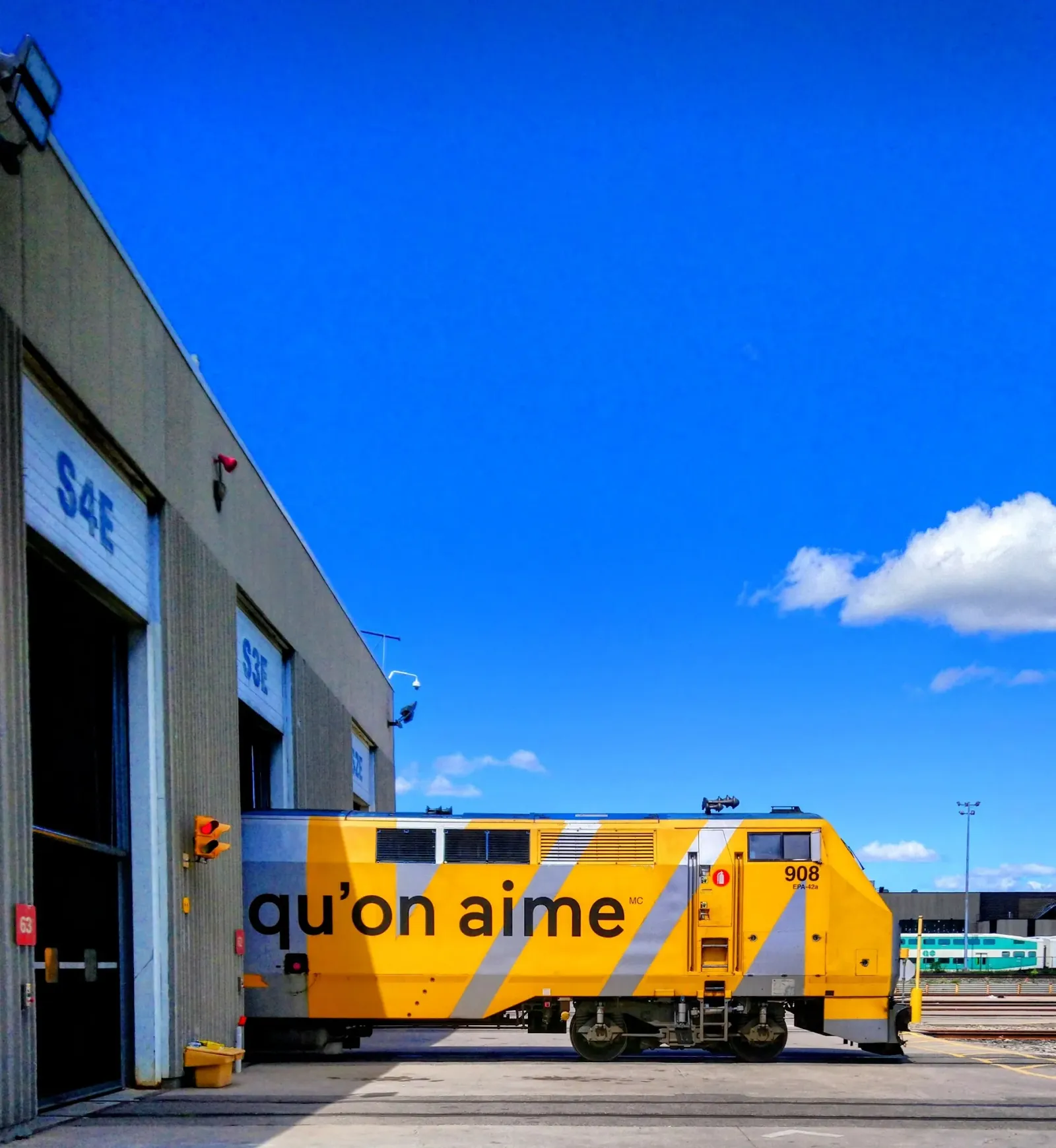 |
VIA 906 peeking its nose out of the Toronto Maintenance Centre. December 2020.
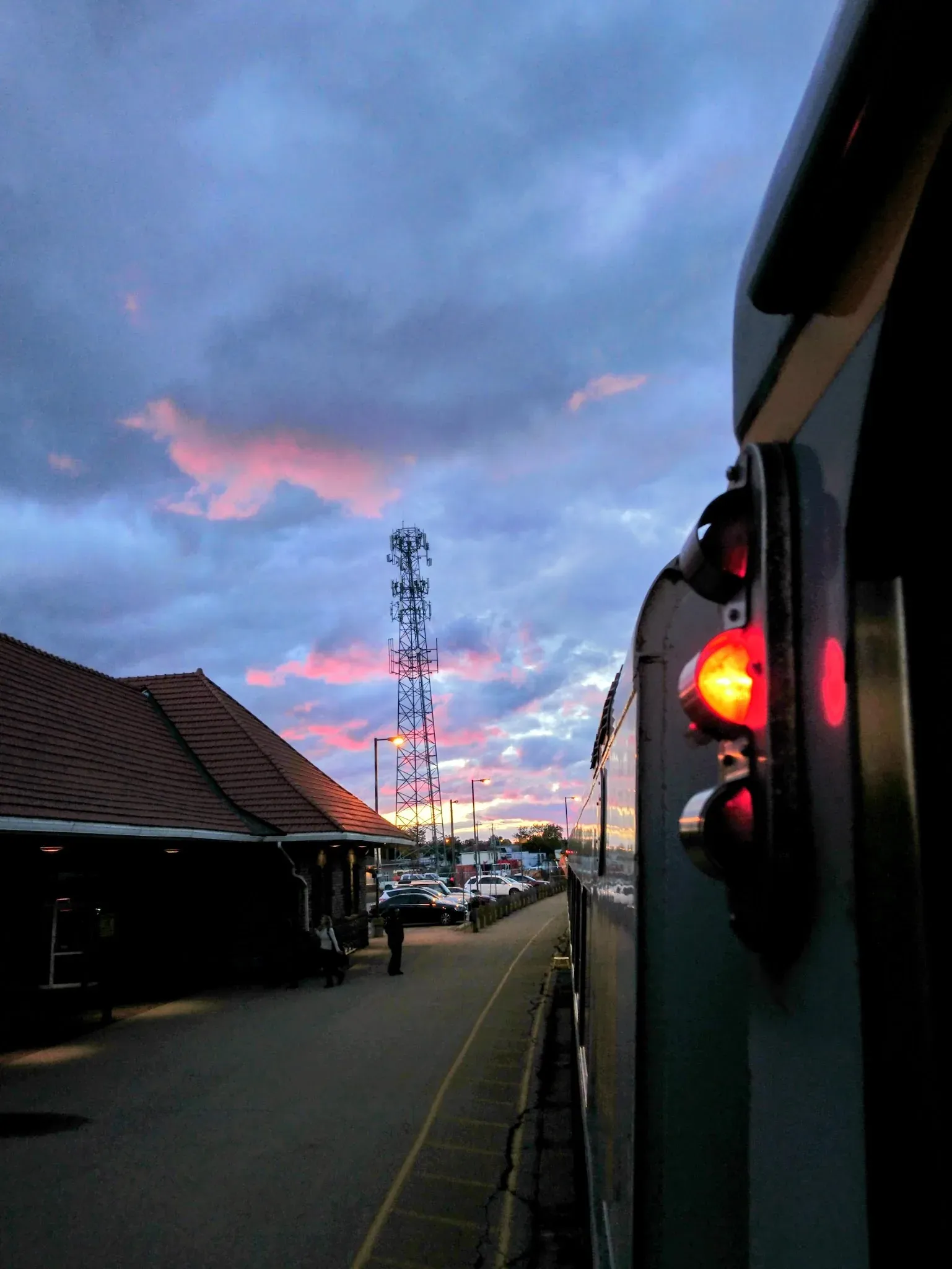 |
Sun sets upon the commuter hustle at Brantford, ON on Train 75. October 2018.
5 Blues Of The Prairies
“This selection brings us to the end of Side One— and the end of Eastern Canada. From here on, you're starting to get into the west, and the musical transition is made suddenly with Blues of the Prairie.” "Here, too, a blues form is used,” Oscar said. "But this obviously refers to the expansiveness I saw in the prairies. The lope is to give the impression of horses and cowboys. It is set at dusk. We tried to give a rolling feeling to the music, which doesn't have the dynamic peaks in the melody that you'll find in some of the other sections.”
Click to listen:
Toronto is a long way from Winnipeg, and between the two an incredible forestial spectacle of igneous and metamorphic rock, evergreen and deciduous trees and lake after lake after lake unfolds over two days through northern Ontario and the formidable Canadian Shield.
So does Northern Ontario and the Canadian Shield sing the Hogtown Blues, or the Blues of the Prairies?
Upon departure from Toronto, we leave the hustle and bustle behind us and head north, first through the seemingly endless suburbs, and then on to cottage country in the Muskokas, where at last Toronto’s corpulence begins to fade, its noise begins to quiet and the natural, untouched beauty of the Canadian Shield begins to overwhelm our perception.
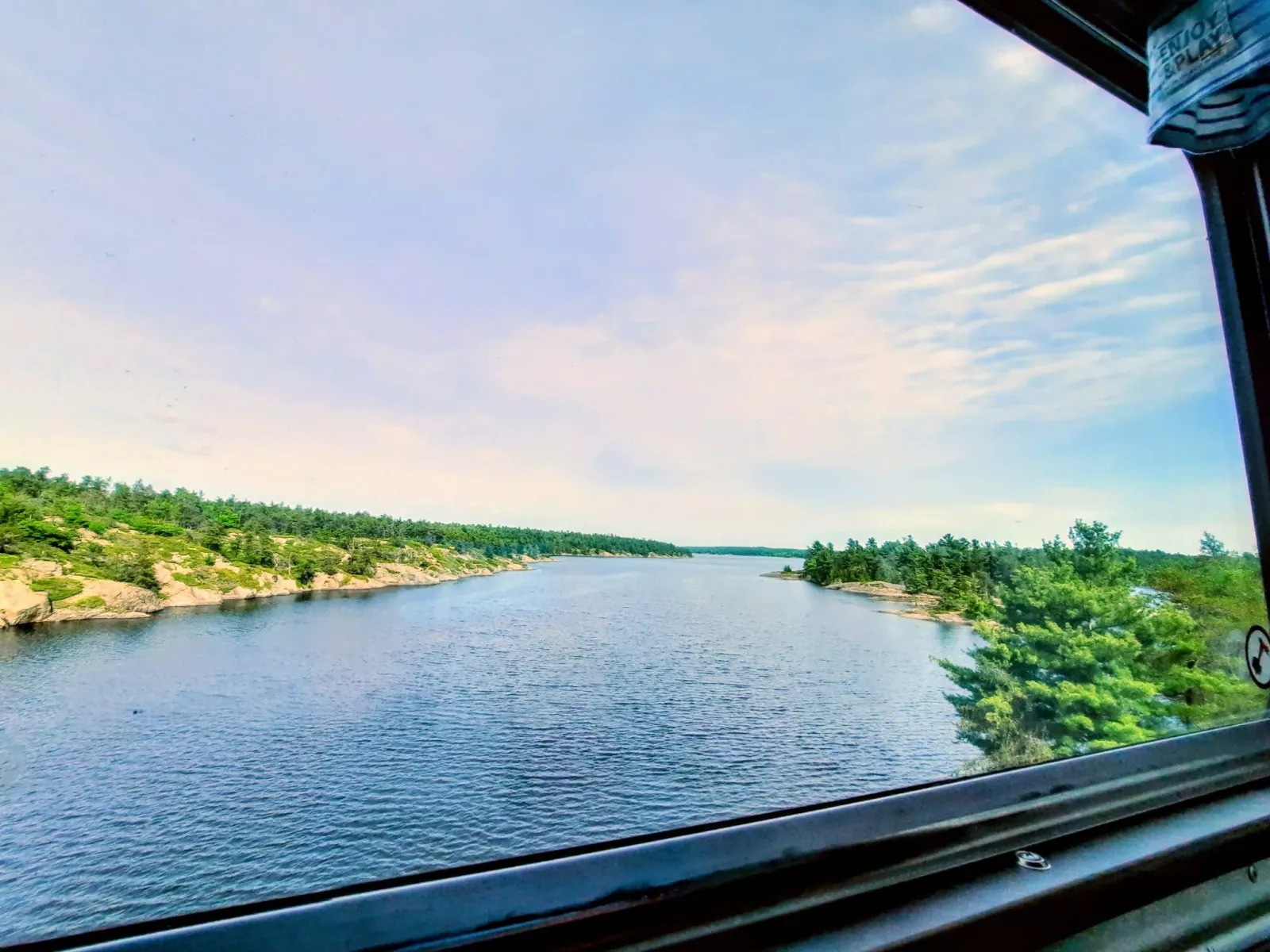 |
Leaving the big city behind, and returning to the natural splendour of Canada, as VIA Train 1 makes its way through the Muskokas north of Toronto. May 2024.
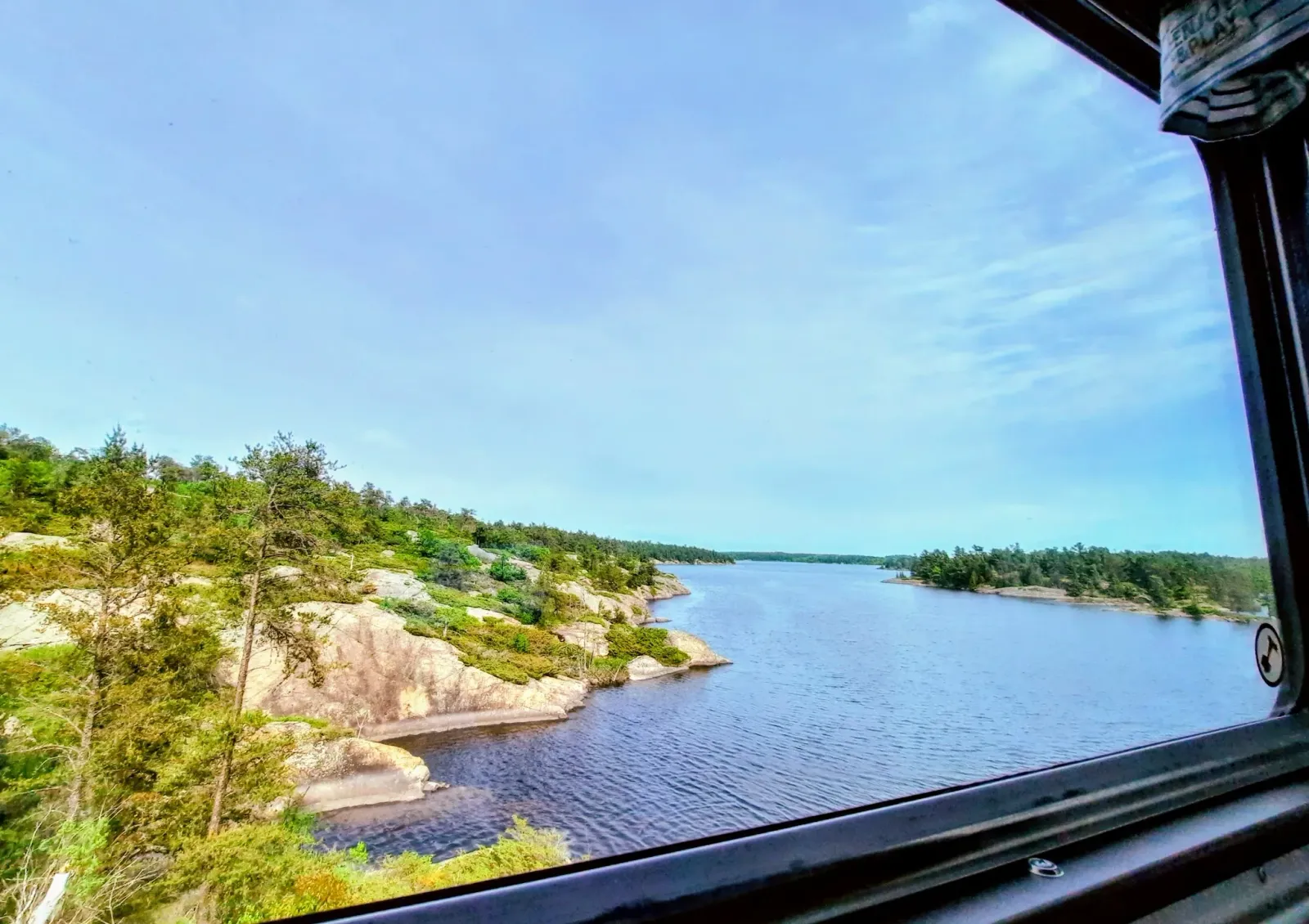 |
VIA Rail Train 1 The Canadian takes us far away from Toronto's hustle, transporting us out of the big city through the forestial majesty of the Muskokas. May 2024.
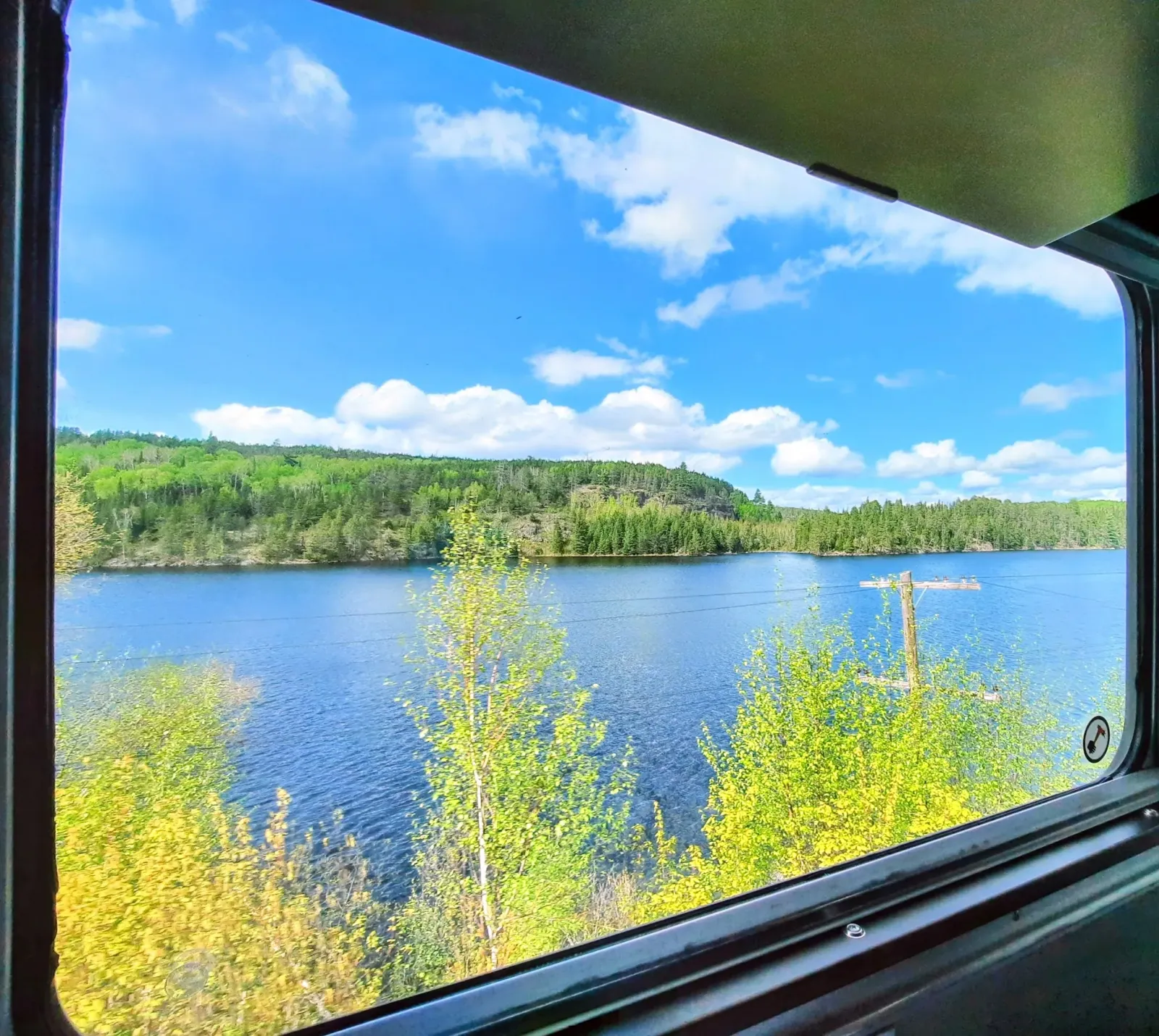 |
Stunning lakeside views from Train 1 in North Ontario. 2024.
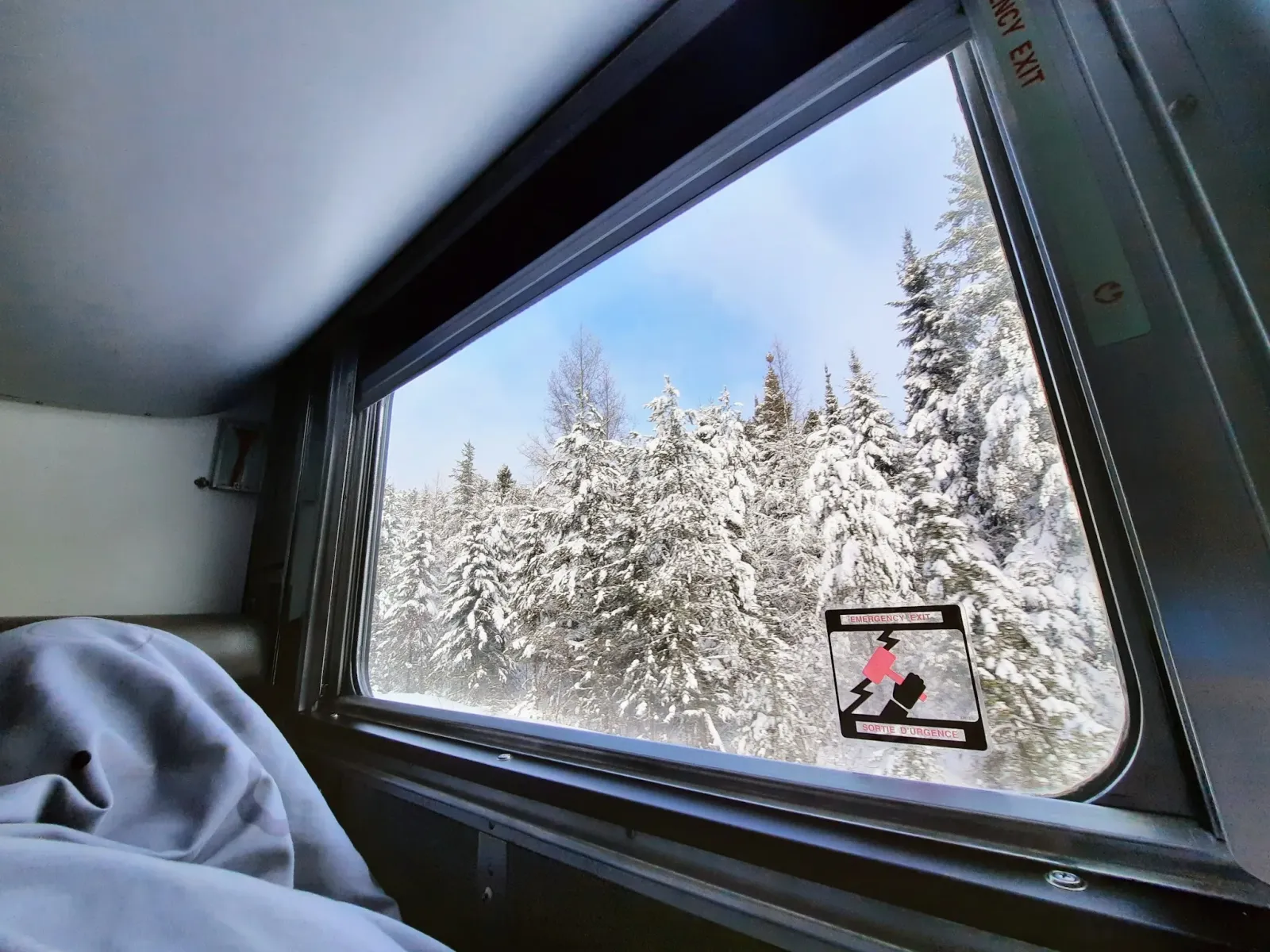 |
The still life of the winter forest, as seen from your railcar window on Train 1 through Northern Ontario. March 2024.
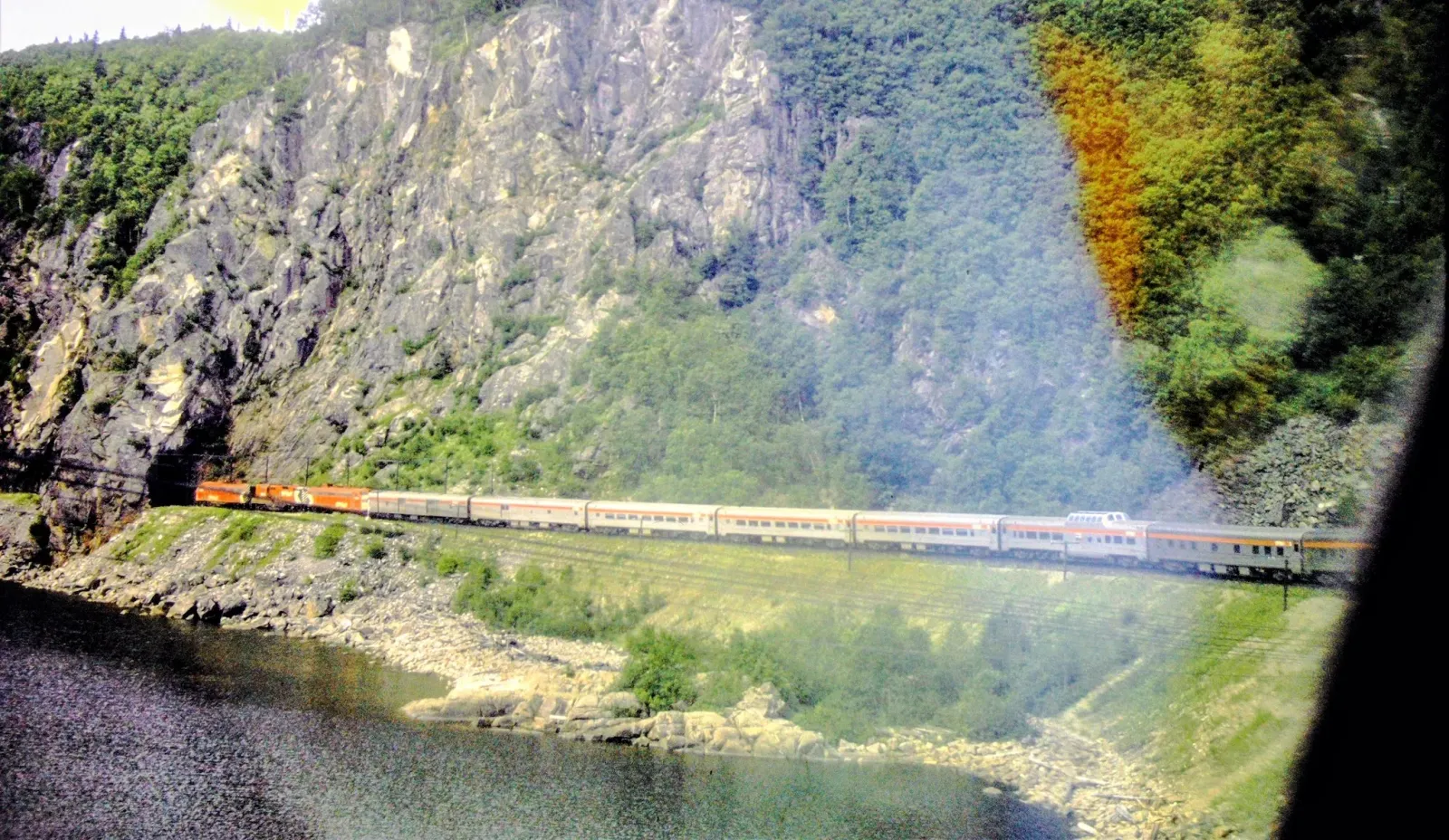 |
The CPR Canadian on the shores of Lake Superior near Shriber, ON on the original, pre-1990 route of the Canadian. August 1974. Photo by Bill Graper.
For the purposes of this essay, I've included the Canadian Shield conceptually with the Blues of the Prairies, drawing an imaginary line in the forest, somewhere between Muskoka and Capreol, where the spectre of the big city is assuredly behind us, with the vast expanse of Canadian West before us.
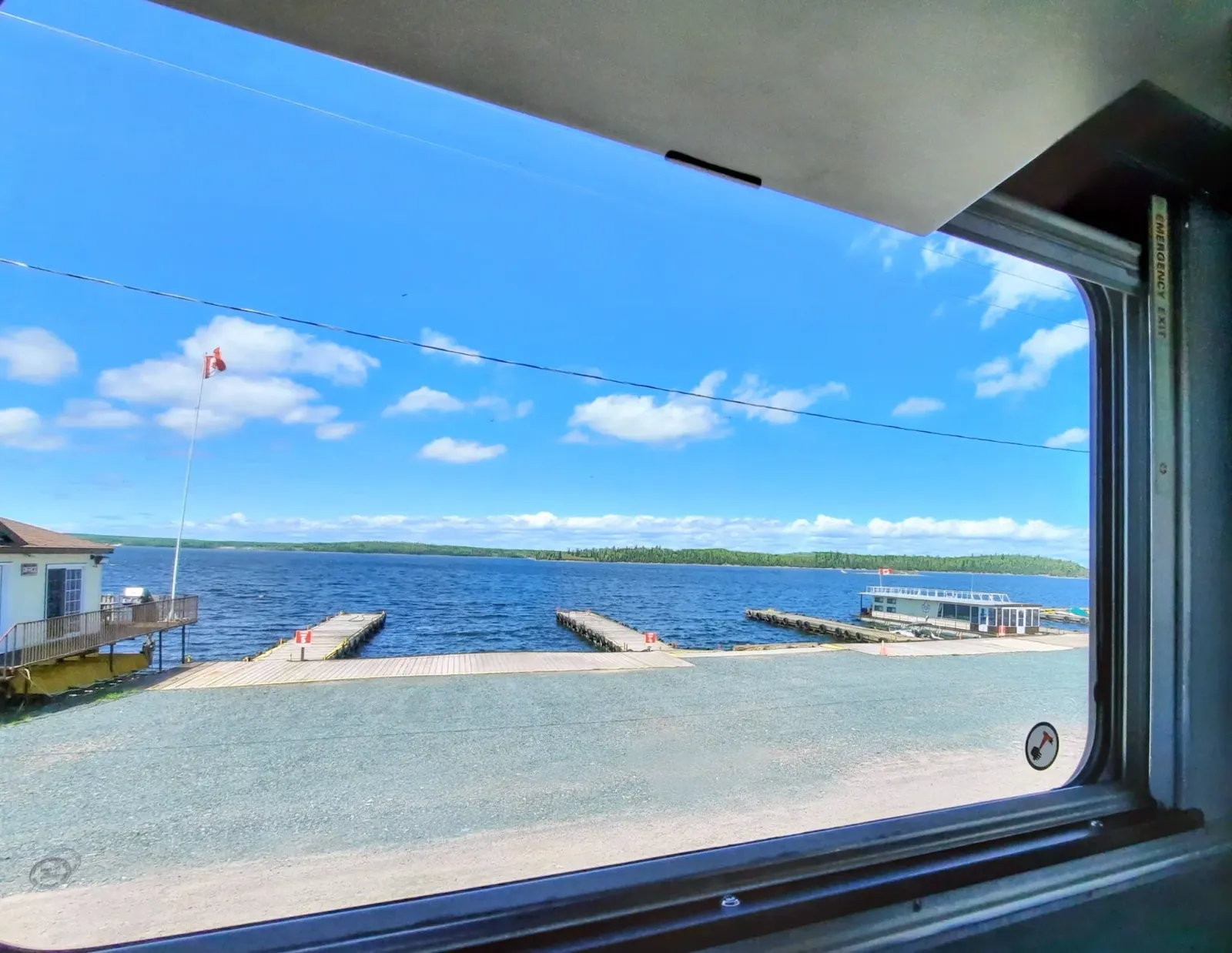 |
Lakeside views at Hudson, ON. May 2024.
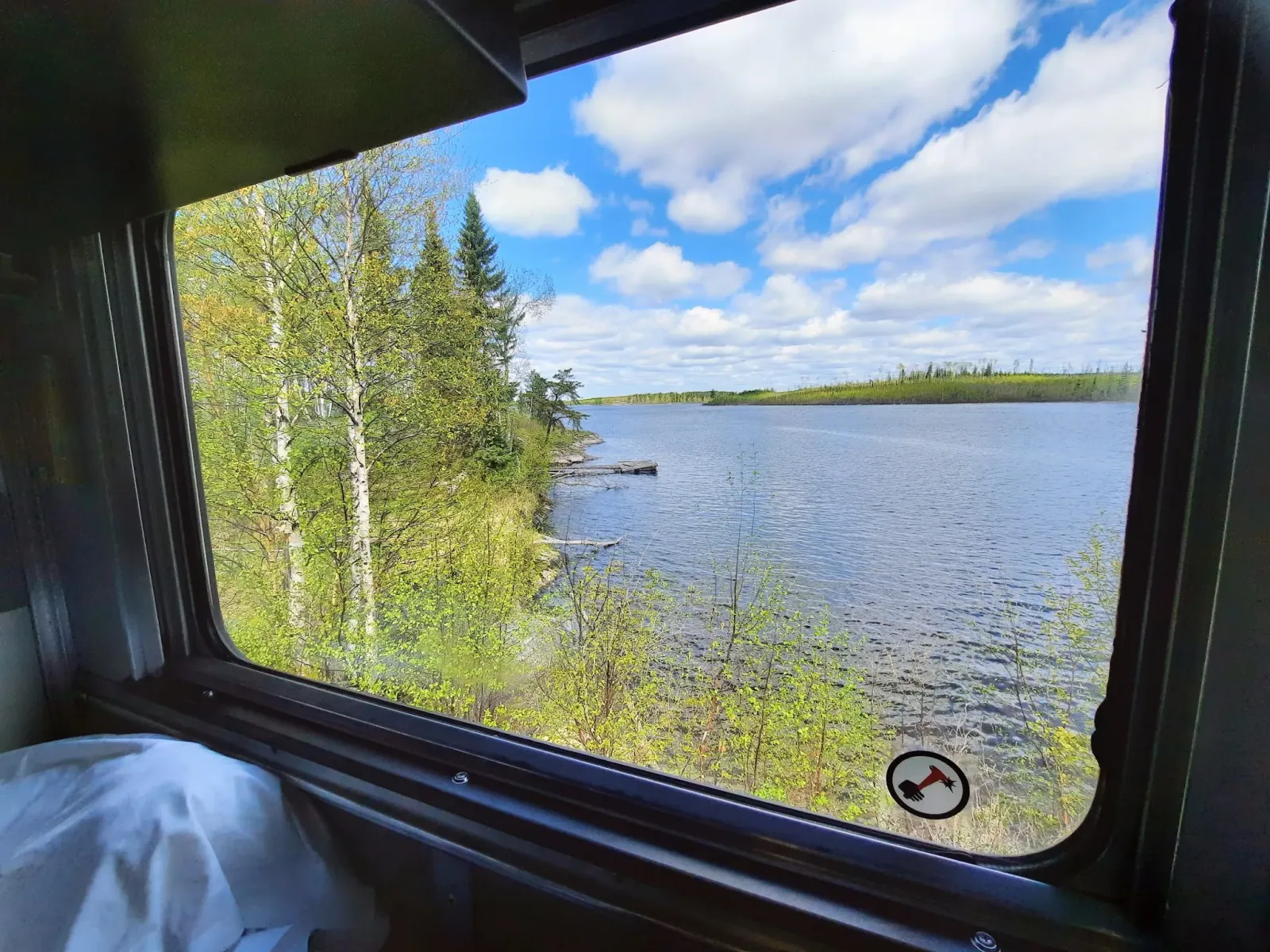 |
The splendour of the Canadian Shield. 2024.
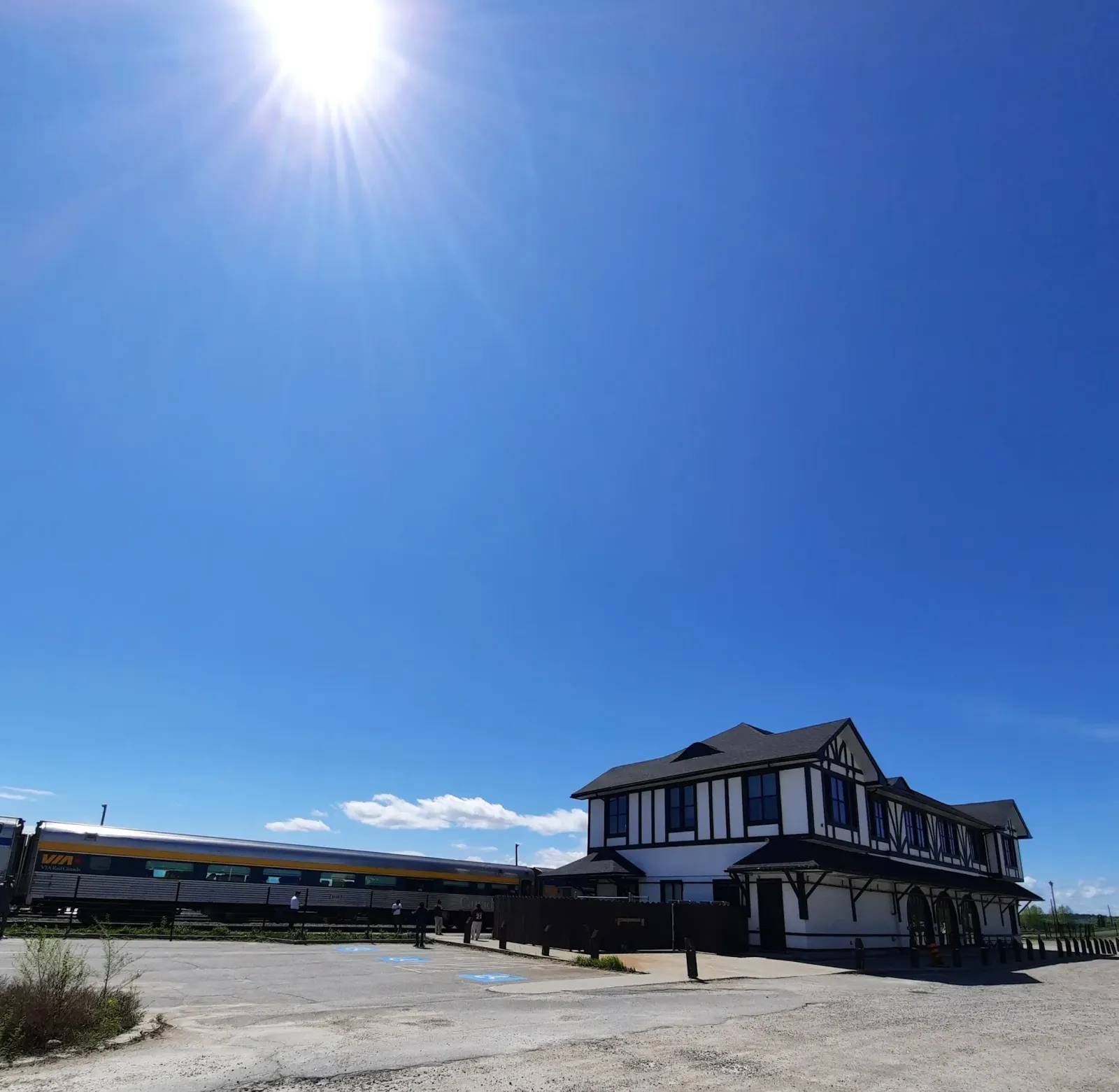 |
The big skies begin – smoke break and refuel at Sioux Lookout, ON. May 2024.
Winnipeg is the frigid prairie metropolis, and welcomes those who brave the long journey by rail with warmth and prairie grit, a cultured and friendly refuge after days of travel through wonderfully desolate and beautiful expanses of Canada.
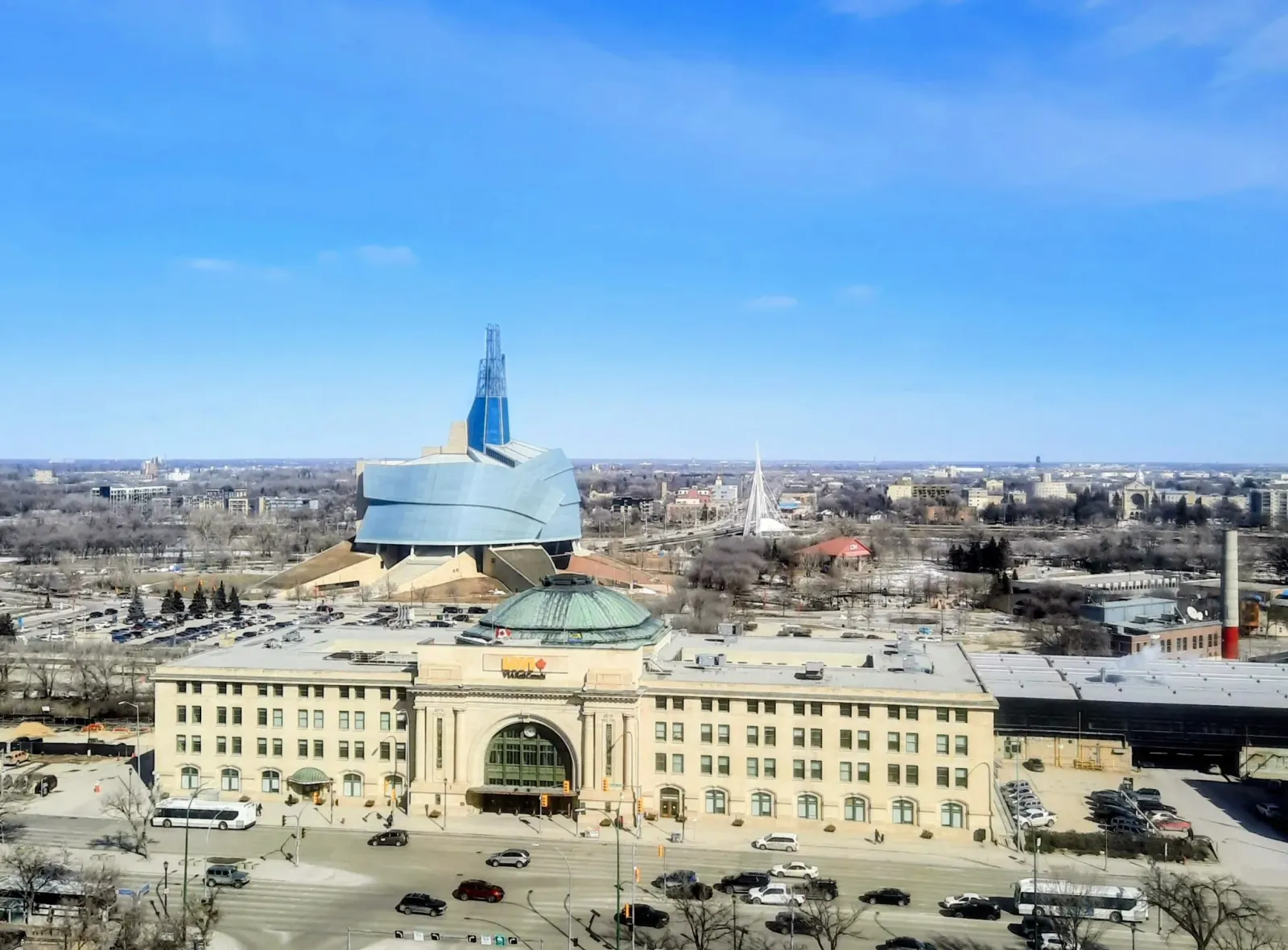 |
Winnipeg Union Station from above, with the Canadian Museum for Human Rights in the background. May 2024.
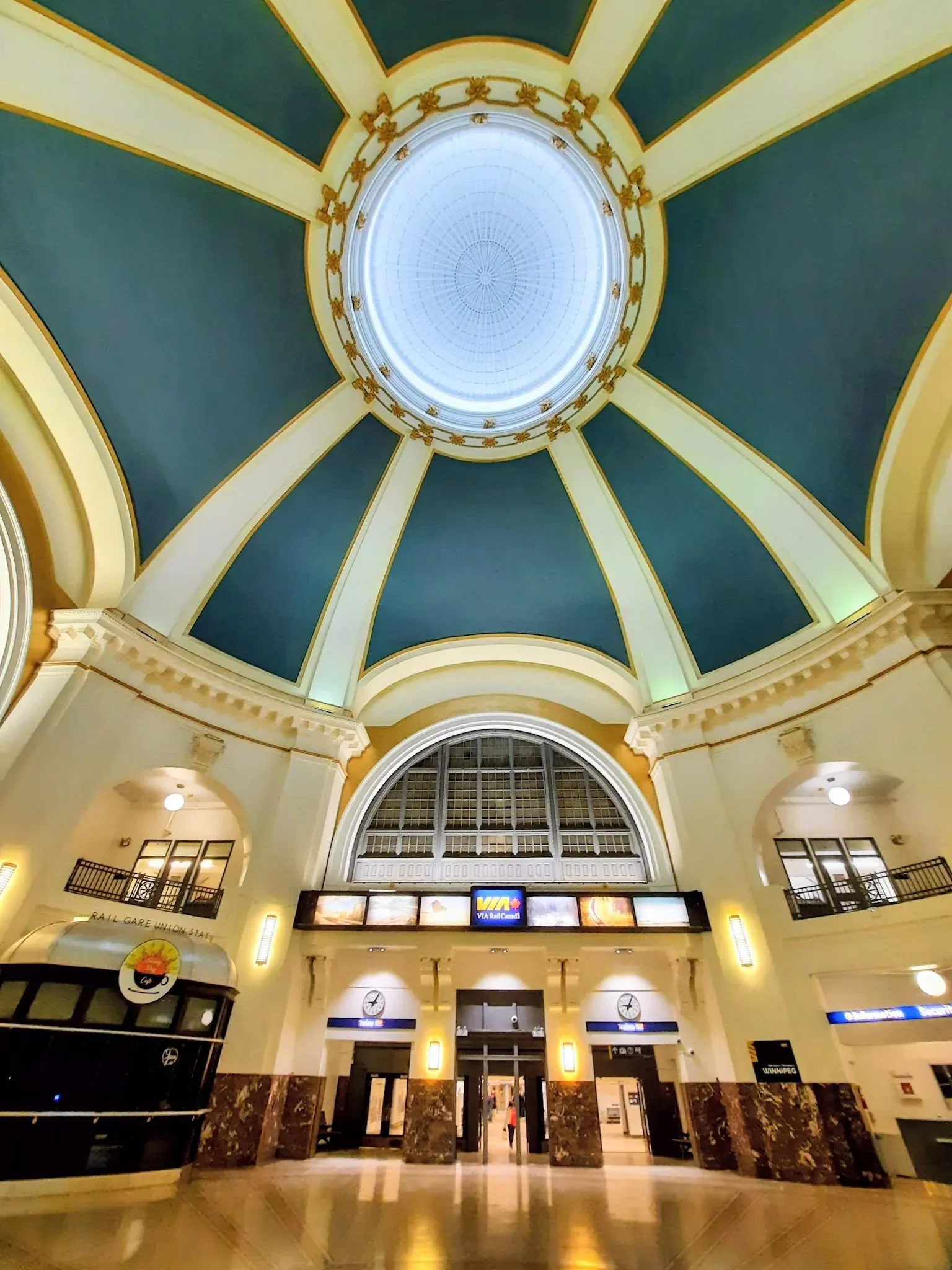 |
Stunning Beaux-Arts interiors of the Winnipeg Union Station. April 2024.
Upon arrival at Winnipeg Union Station, the traveler is warmly greeted by the architectural grandeur of the depot, built in the Beaux-Arts style and representing the spirit and ambition of its noble inhabitants. Although there are fewer trains operating today, Winnipeg remains an important regional hub for essential service trains to Churchill and the mid-way point for The Canadian between Toronto and Vancouver.
Counterintuitively perhaps, considering the reduction of train service in North America, it is technically, if inconveniently, still possible to travel by rail from the Canadian sub-artic at Churchill, MB to Vancouver, Halifax, New York, Florida and California by connection at Winnipeg.
Further Reading:
2021-07-17 Forestial Otherworld -- VIA Rail 185/186 Sudbury to White River Junction
https://www.christophergraper.com/2026/03/2021-07-17-trip-report-via-rail-185186.html?m=1
6 Wheatland
“Wheatlands needs no textual explanation. You can see the shimmering of the wheat in the wind within a few bars of the opening. This is awesomely flat country where, they say, if you stand on a railway embankment six feet high, you can see 50 miles.”
Click to listen:
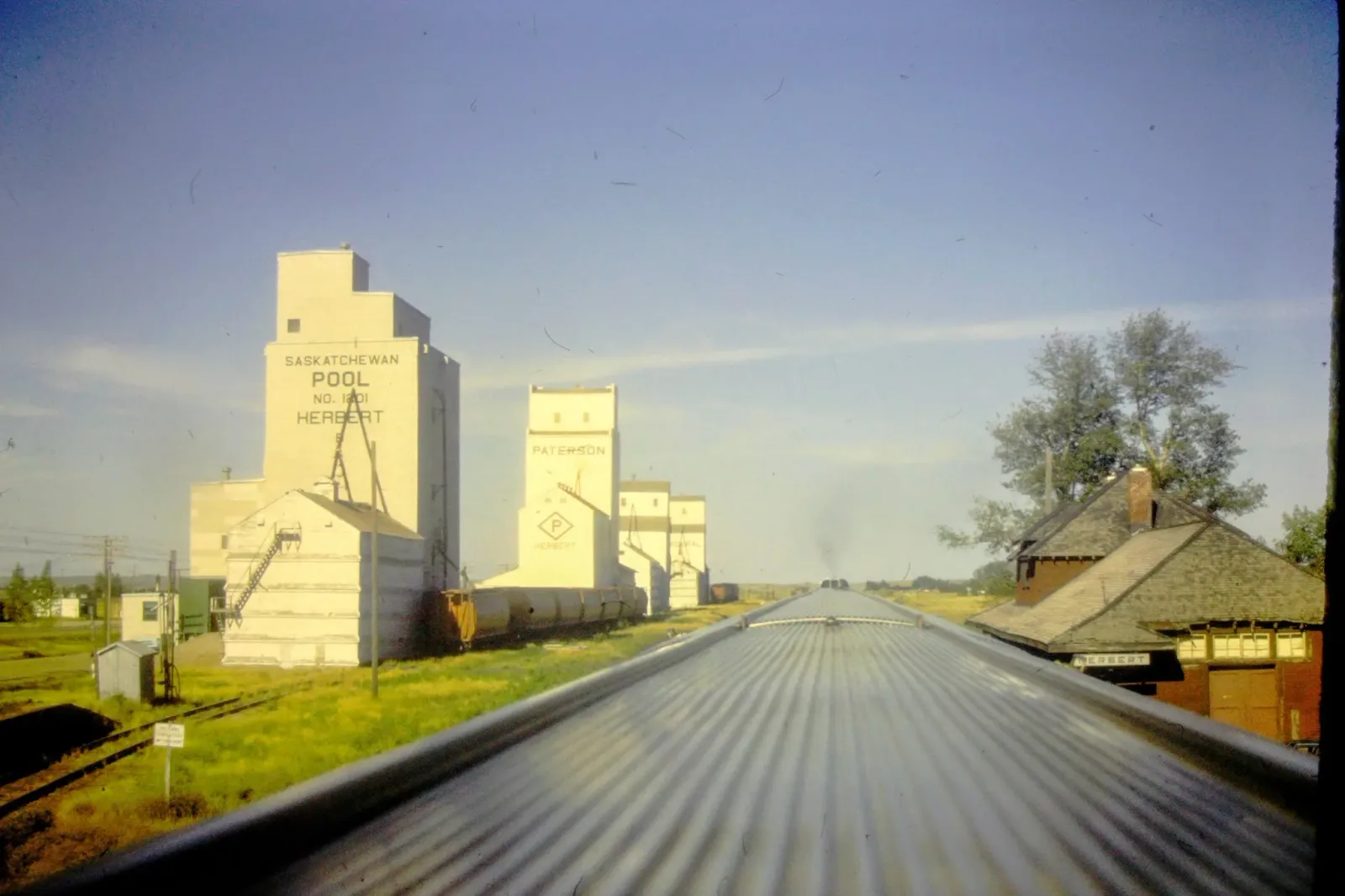 |
Herbert, SK. August 1974. Photo by Bill Graper
Upon departure from Winnipeg, the journey across Manitoba and Saskatchewan is generally straight, fast and flat. Despite the reference in the liner notes of the Canadiana Suite, I don't particularly remember seeing any railway embankments six feet high, nor bridges nor overpasses, nor anything else capable of lifting perception above the fertile soil, except of course the iconic grain elevators and the less iconic but significantly massive potash tailing mounds – a sturdy, pragmatic, prairie perspective, ensuring we stay well-grounded in a place where one could seemingly float away into a huge sky that goes on for days. That big sky is the showstopper of the prairies, with the land and the shimmering wheat and the general agricultural bounty well-framing the experience.
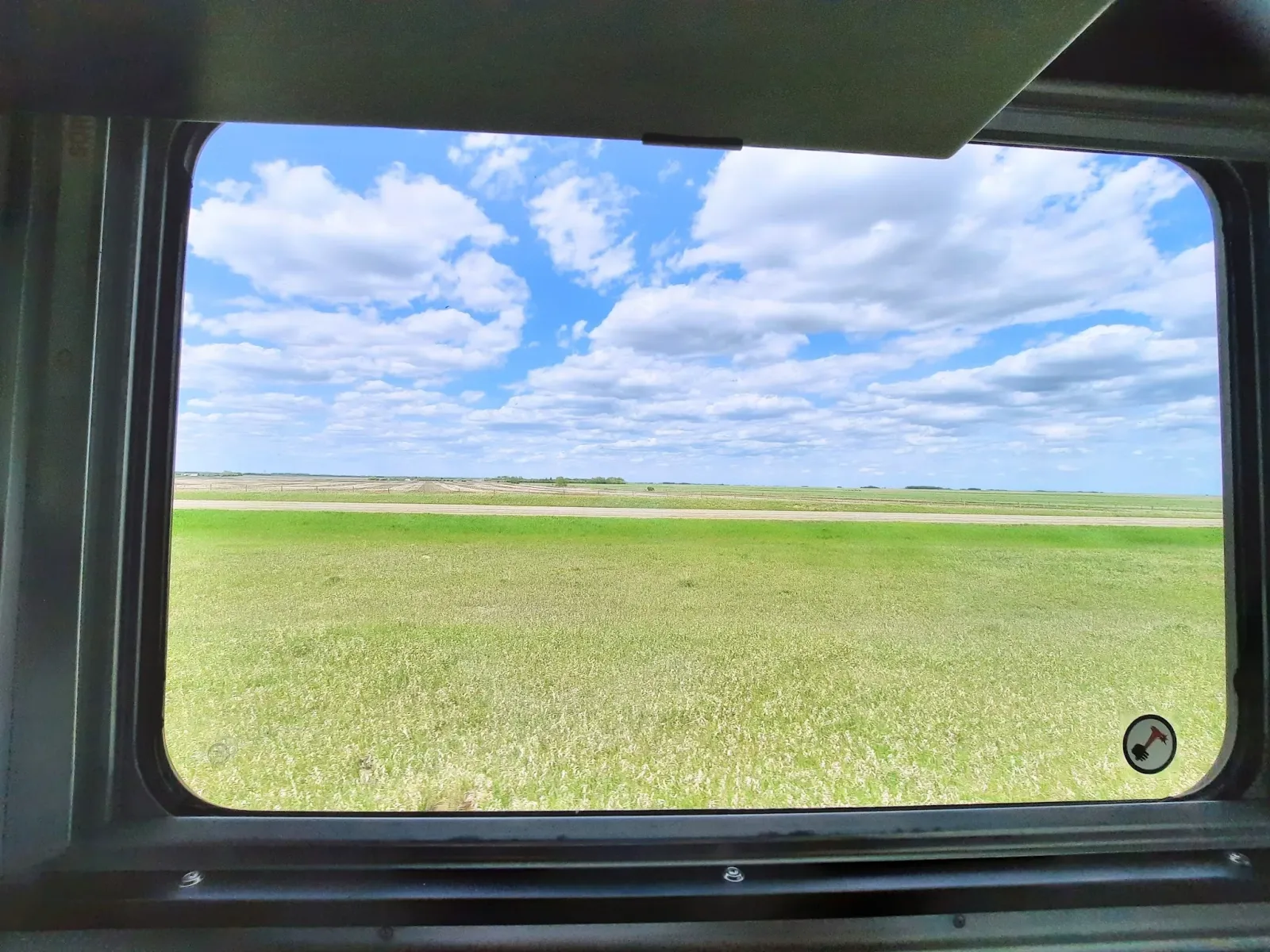 |
Beautiful spring day on the Canadian Prairies. May 2024.
Not too many trains run in Saskatchewan anymore, but what Saskatoon lacks in train frequency it makes up for in architectural interest, with Saskatoon’s terminal boasting an admirable example of the International Style, built in 1964.
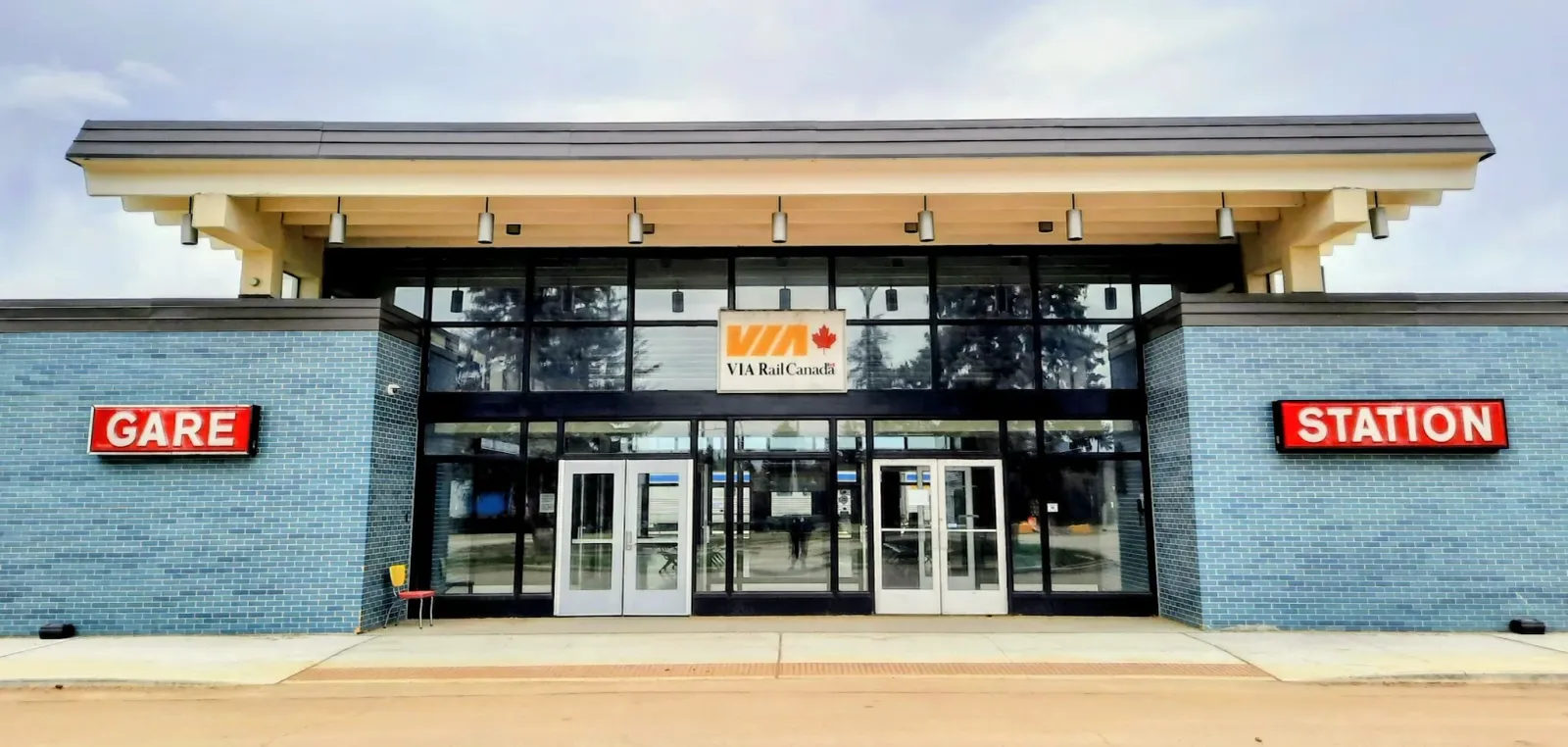 |
Saskatoon Station. March 2024.
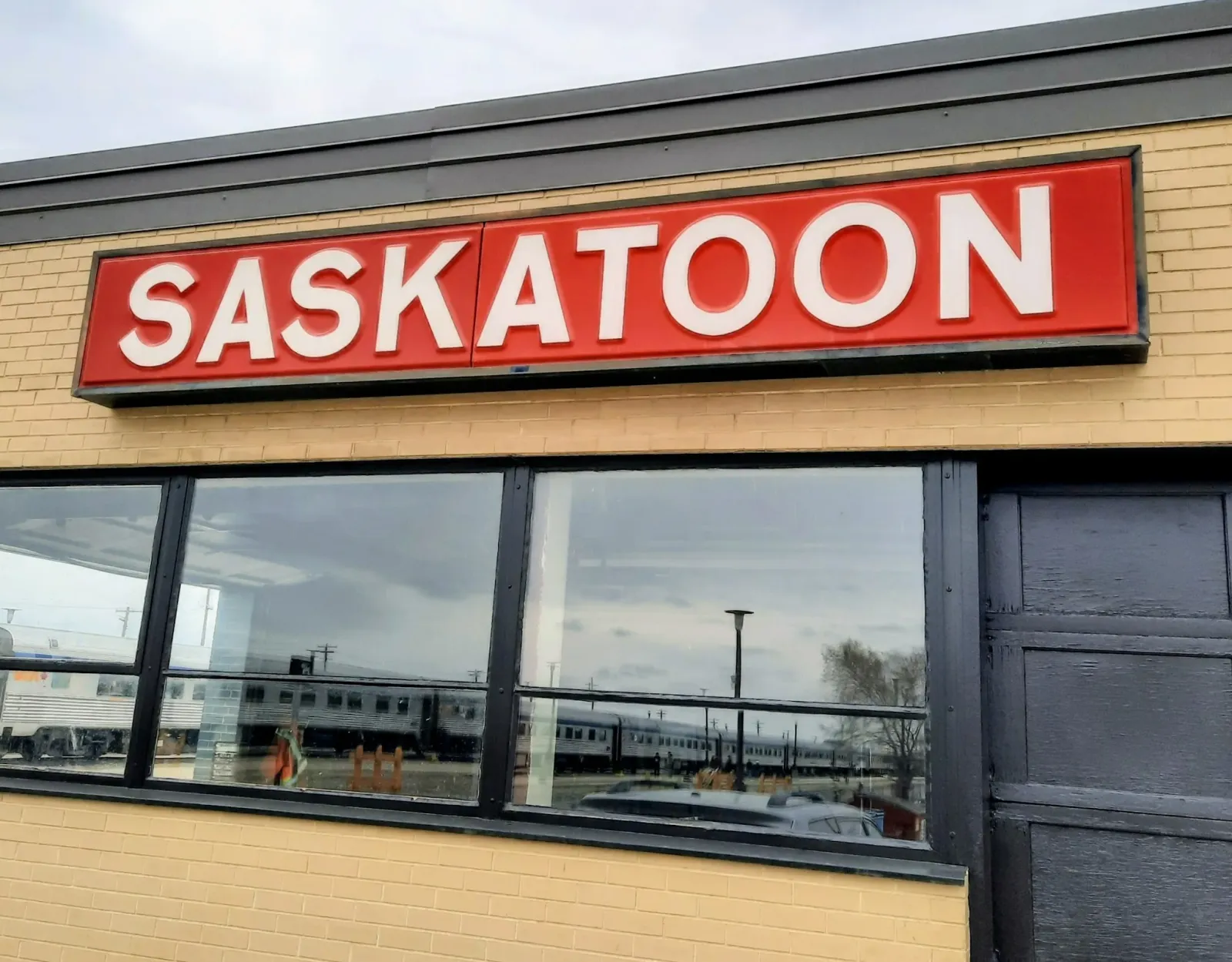 |
Original 1964 Signage at Saskatoon Station, with the reflection of arriving VIA #1 shimmering in the window. March 2024.
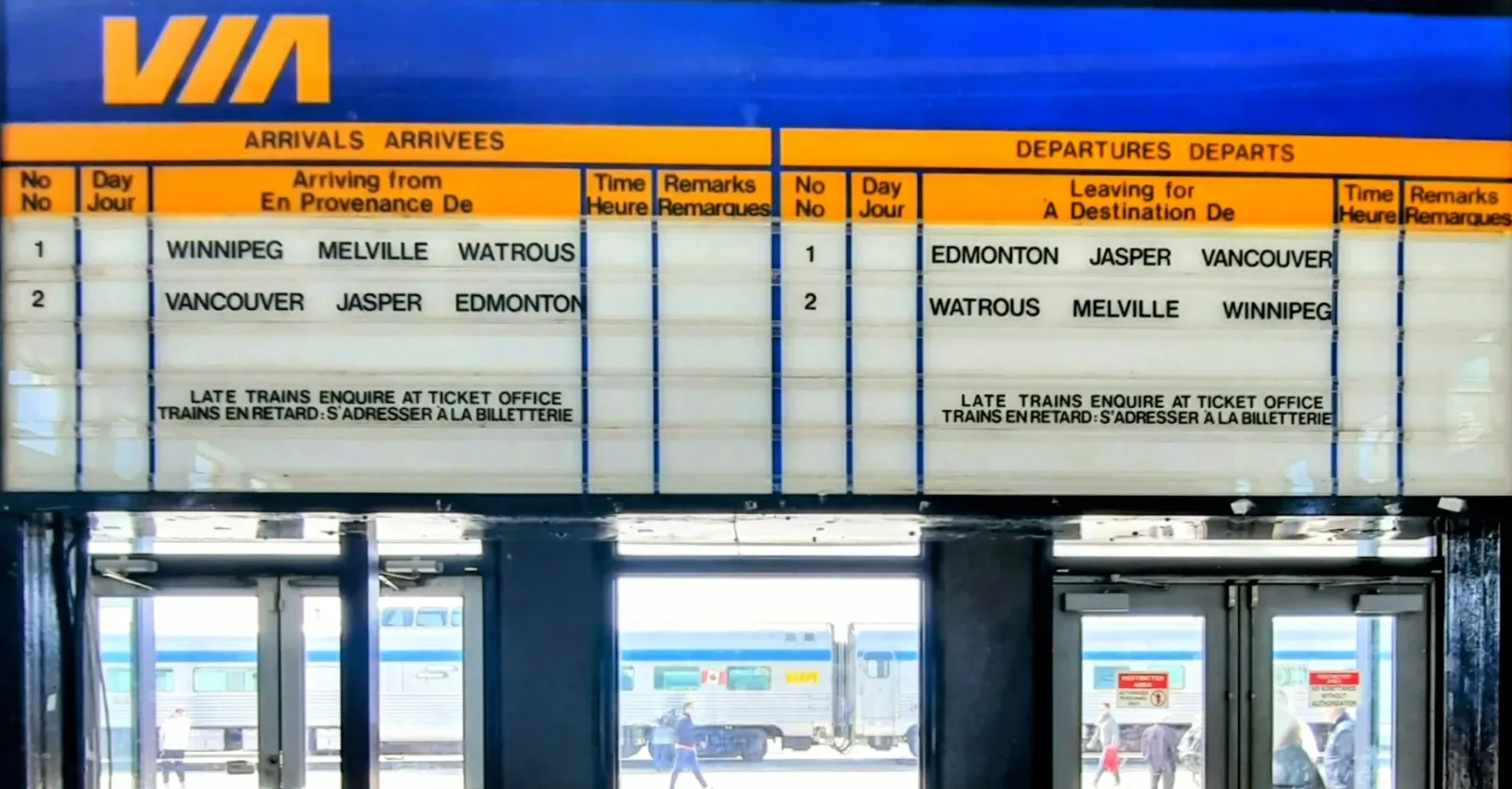 |
Arguably the prettiest and most limited Arrival and Departure board in the VIA Rail system, at Saskatoon Station. May 2024.
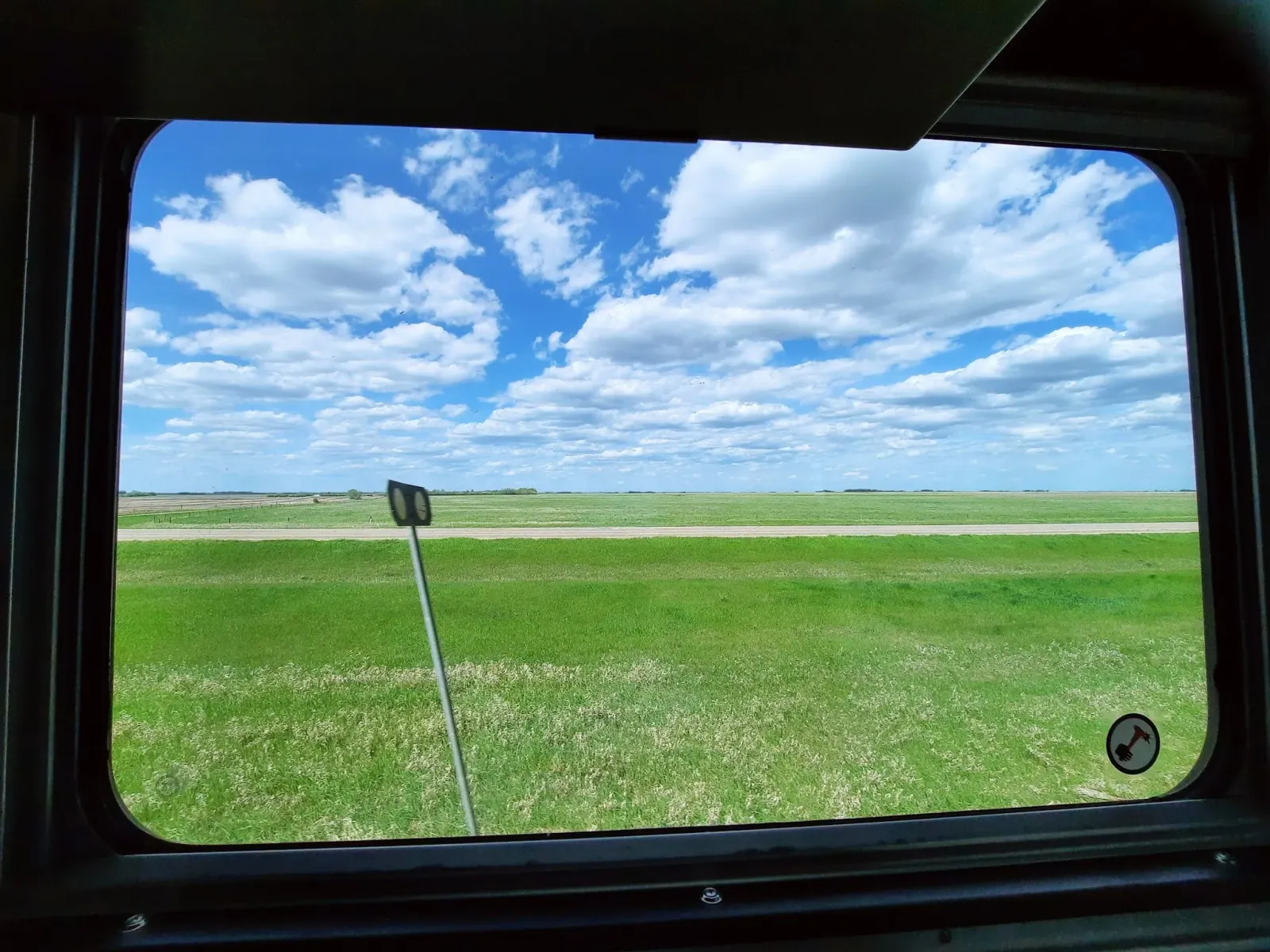 |
Drifting off into those huge prairie skies. May 2024.
7 March Past
“March Past describes the parade that precedes the Calgary Stampede, one of North America's biggest rodeo events. Oscar got the impressions that gave rise to it from watching the parade on television. "This is a happy time Canada feeling," he said.”
Click to listen:
Regrettably Western Canada is severely underserved by passenger trains. The iconic original ‘southern’ route of the Canadian through Calgary and Banff was discontinued in the 1990s, leaving Calgary and its Stampede Parade without rail service, along with so many other destinations in Canada. So how are we to think of March Past today?
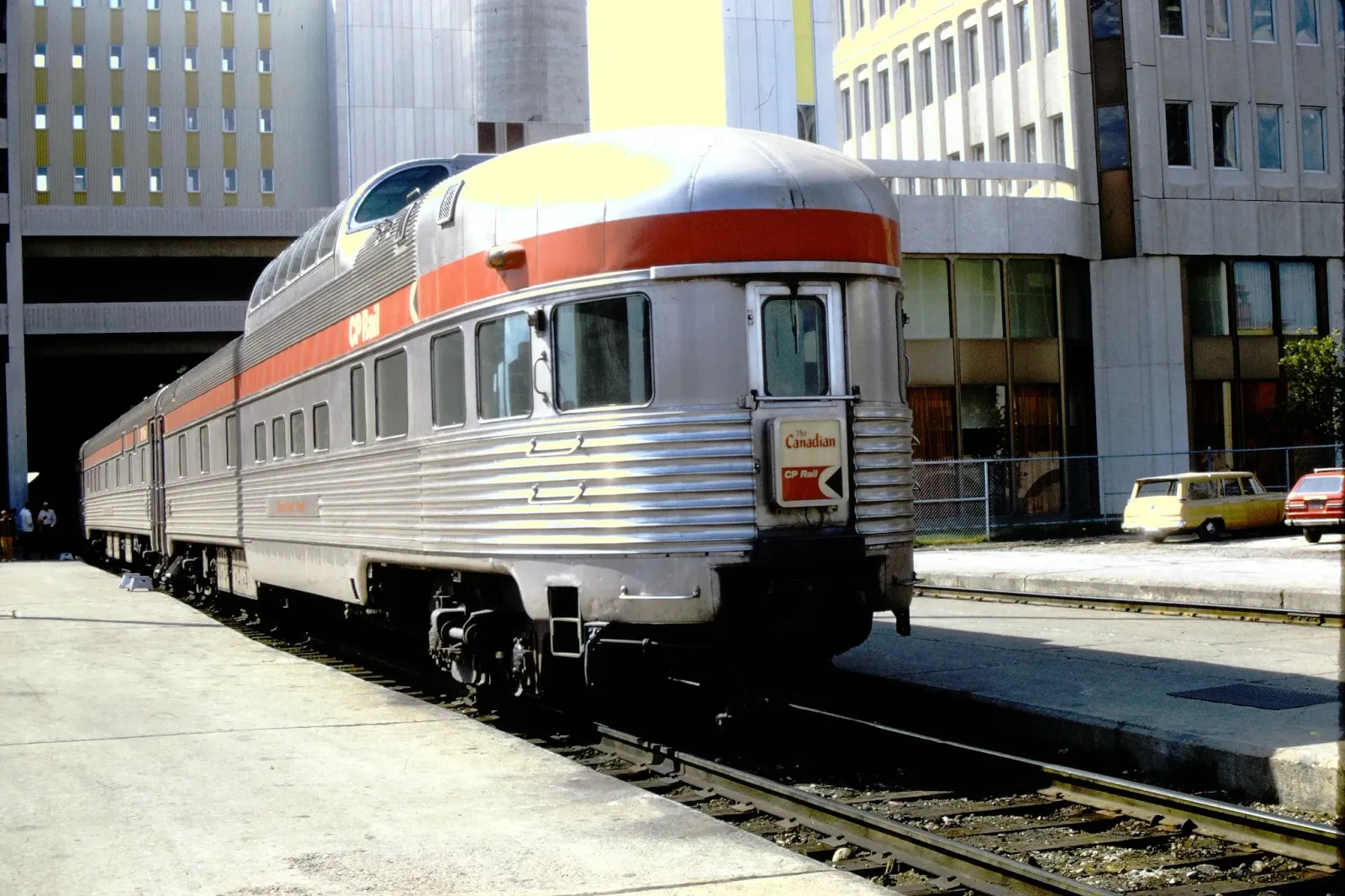 |
The CPR Canadian at Calgary Station. August 1974. Photo by Bill Graper.
In one sense, we are regrettably marching past Alberta itself – with Edmonton and Jasper the only large communities served by rail, passengers no longer stop-over but rather simply keep marching past.
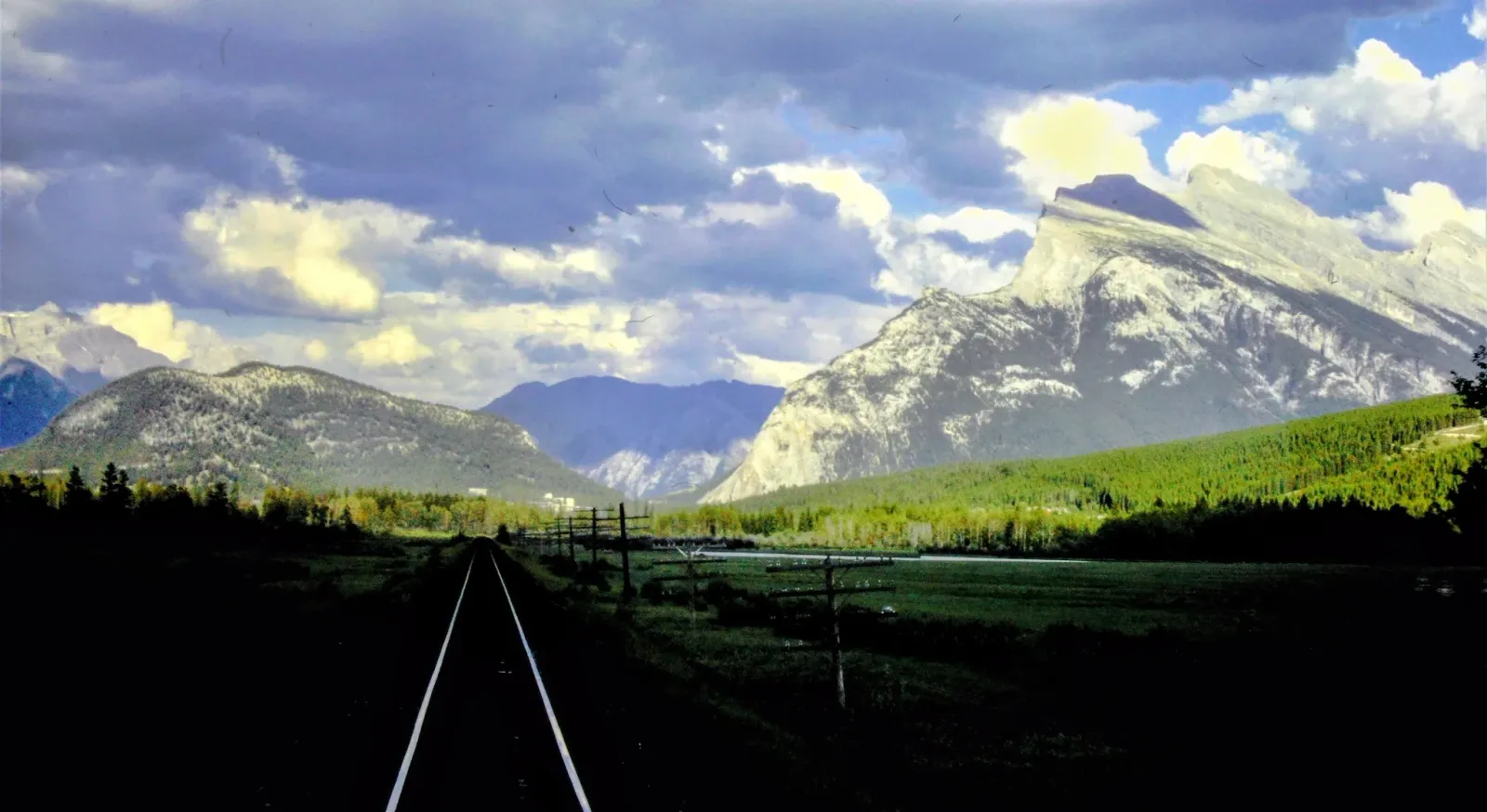 |
The CPR Canadian on the original, pre-1990 route through Banff National Park. August 1974. Photo by Bill Graper.
In another sense, Alberta represents the beginning of our ascent into the Rocky Mountains, the gateway to an incredible mountain odyssey, and the marching past of the first peaks which come into view, an enchanting contrast following days of fascinatingly flat prairie and grassland in Manitoba, Saskatchewan and eastern Alberta.
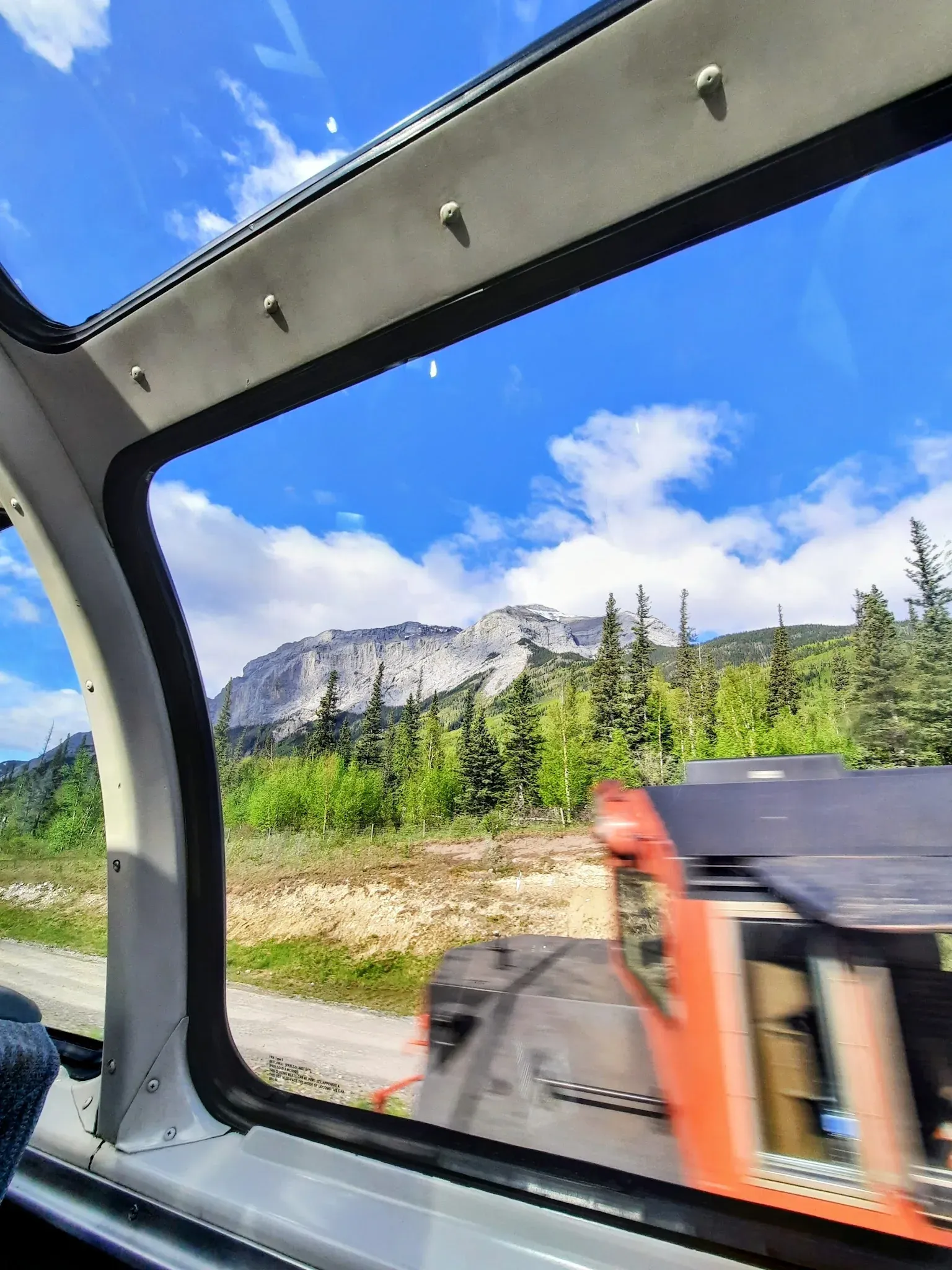 |
The March Past of CN freight trains. May 2024.
And in another sense, there is the march past of the ubiquitous cargo trains, supply chain of the nation, sometimes over 200 cars long, weaving their way through the Rockies on their own mountainous odyssey, loaded with cargo from everywhere and going to everywhere, now, upon a thin, narrow passage of connection and commerce, just beyond reach of our sleeping car window.
March Past also includes the distinctive ching-ching of the thumb cymbals, evocative to my ear of the zing of the rails produced when rolling at high speed, especially in the heat of the summer, on long flat stretches of track as found in Alberta. Here again, it can be said that the attentive ear of the child finds the rhythm, the harmony and the melody of the railway journey.
8 Land Of The Misty Giants
“There are more impressive mountain ranges in the world than the Canadian Rockies. The Andes are bigger; but the Andes are a cold and ruthless blue. No range in the world has as much color, and none is more beautiful, than the Rockies. Oscar has portrayed them in Land of the Misty Giants. "Here," he said, "the feeling of the music is somewhat like that of the Eastern provinces, except that the scene as you approach is much more imposing. Yet there is an almost ethereal quality to the Rockies. That's what I tried to show, and that's the reason for the title”
Click to listen:
Our journey to the Land of the Misty Giants begins in Jasper, idyllic Rocky Mountain tourist town, point of both diversion and transfer on our way westward to the Pacific Ocean.
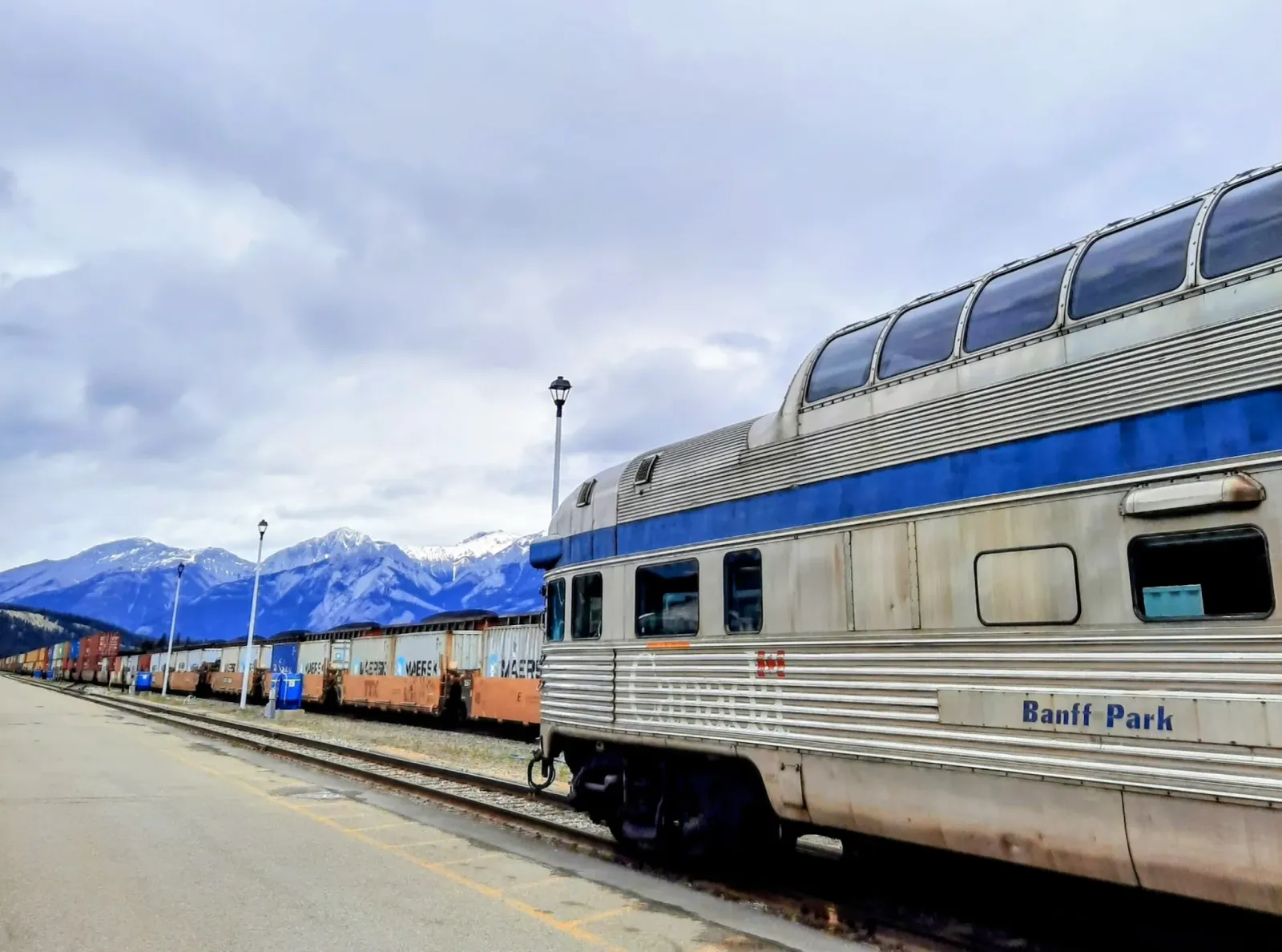 |
VIA Rail Train 5 at Jasper, AB. May 2024
VIA Rail’s Canadian – trains 1 and 2– and The Skeena – trains 5 and 6 – part ways just west of Jasper in the Yellowhead Pass, traversing the Continental Divide and forging their respective paths towards the Pacific.
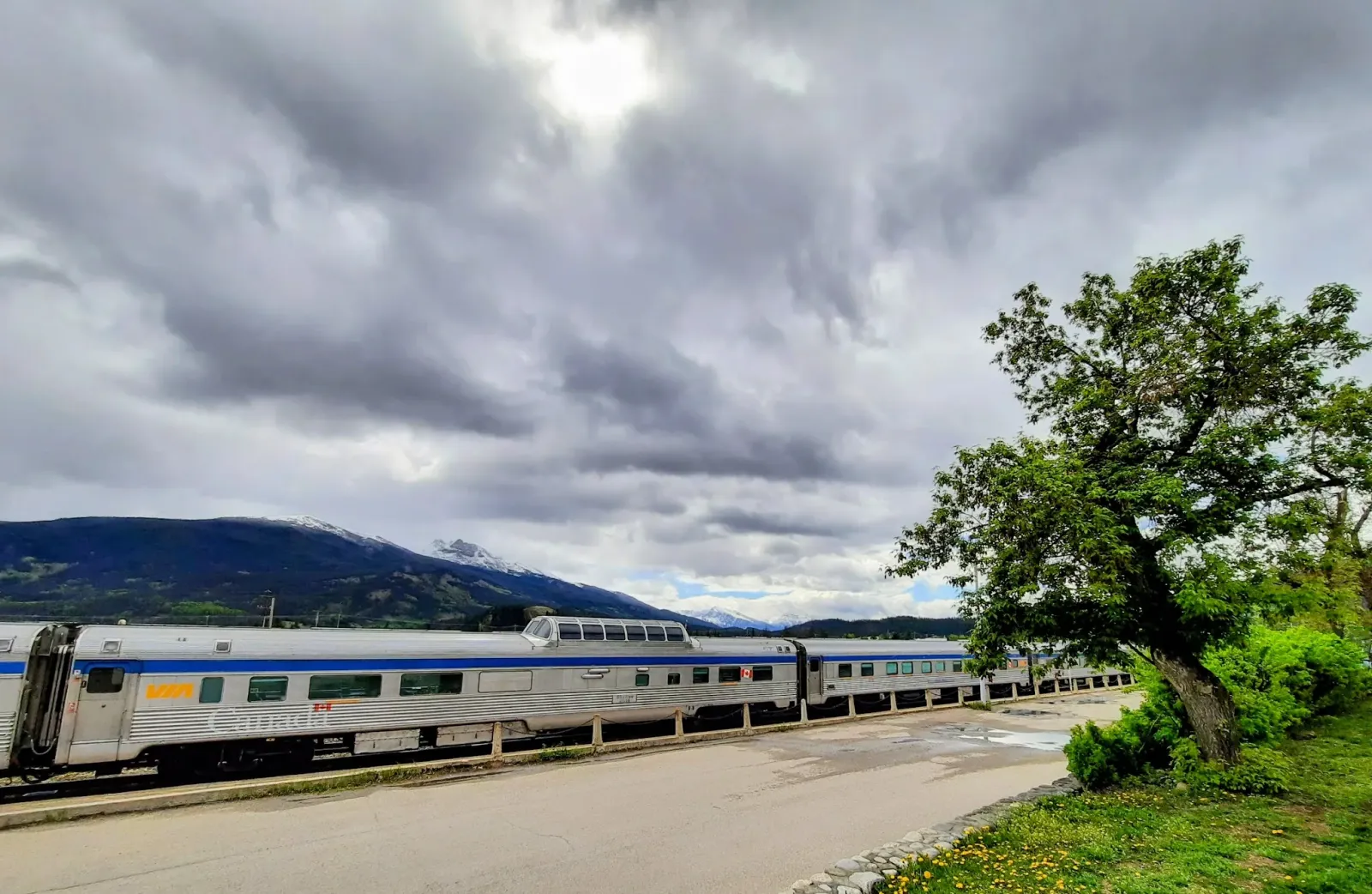 |
VIA Rail Train 1 at Jasper, AB. May 2024.
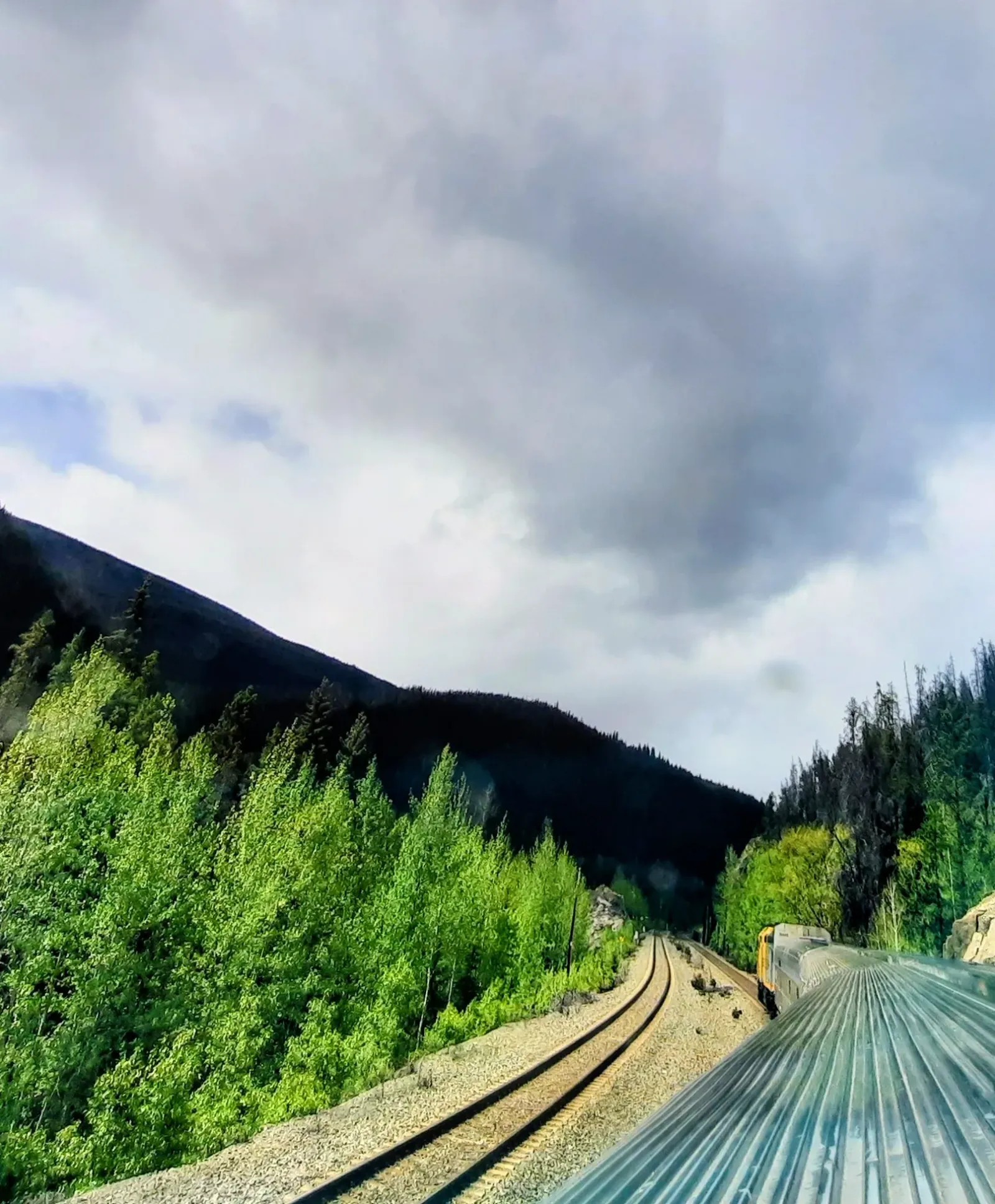 |
VIA Rail Train 5 makes its way through the Yellowhead Pass, near the BC-Alberta border. May 2024.
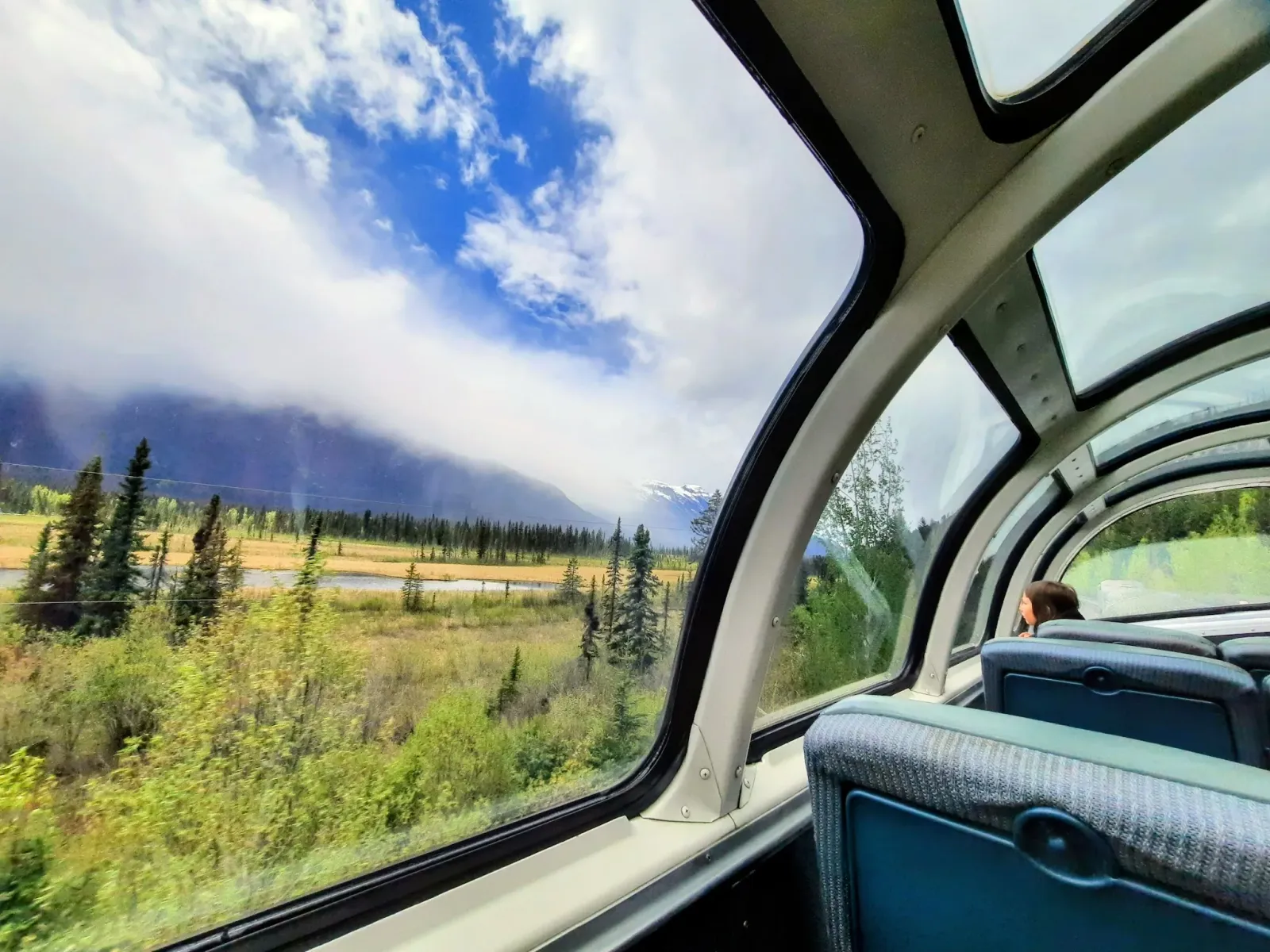 |
Stunning views from the dome car on Train 5 through the Yellowhead Pass. May 2024.
The Canadian, on its route from Toronto to Vancouver, makes its way south from the Yellowhead Pass, through Kamloops, the Fraser River Canyon, to Hope and on to meet the Pacific Ocean at Vancouver.
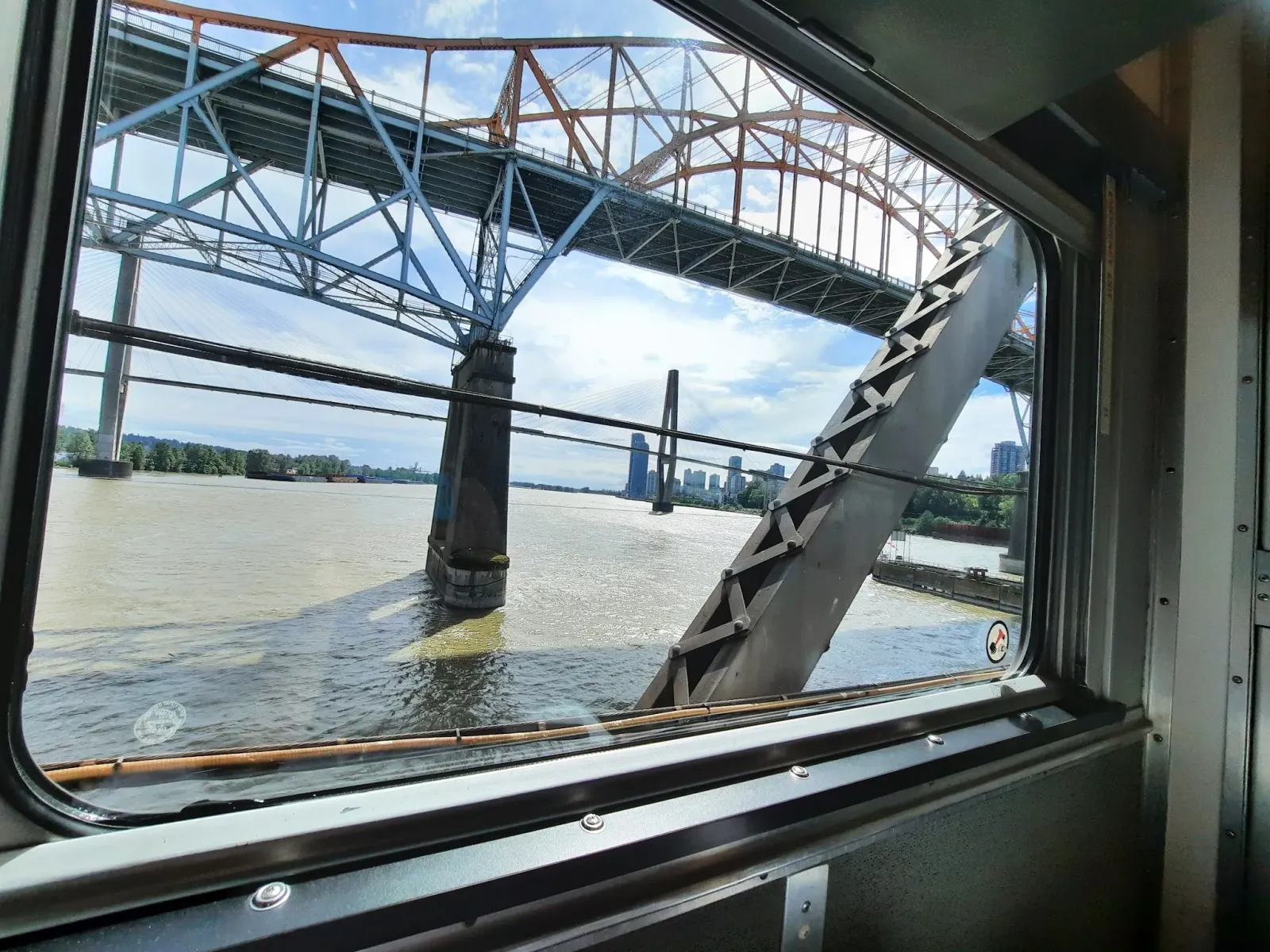 |
Crossing the Fraser River at New Westminster, BC. June 2024.
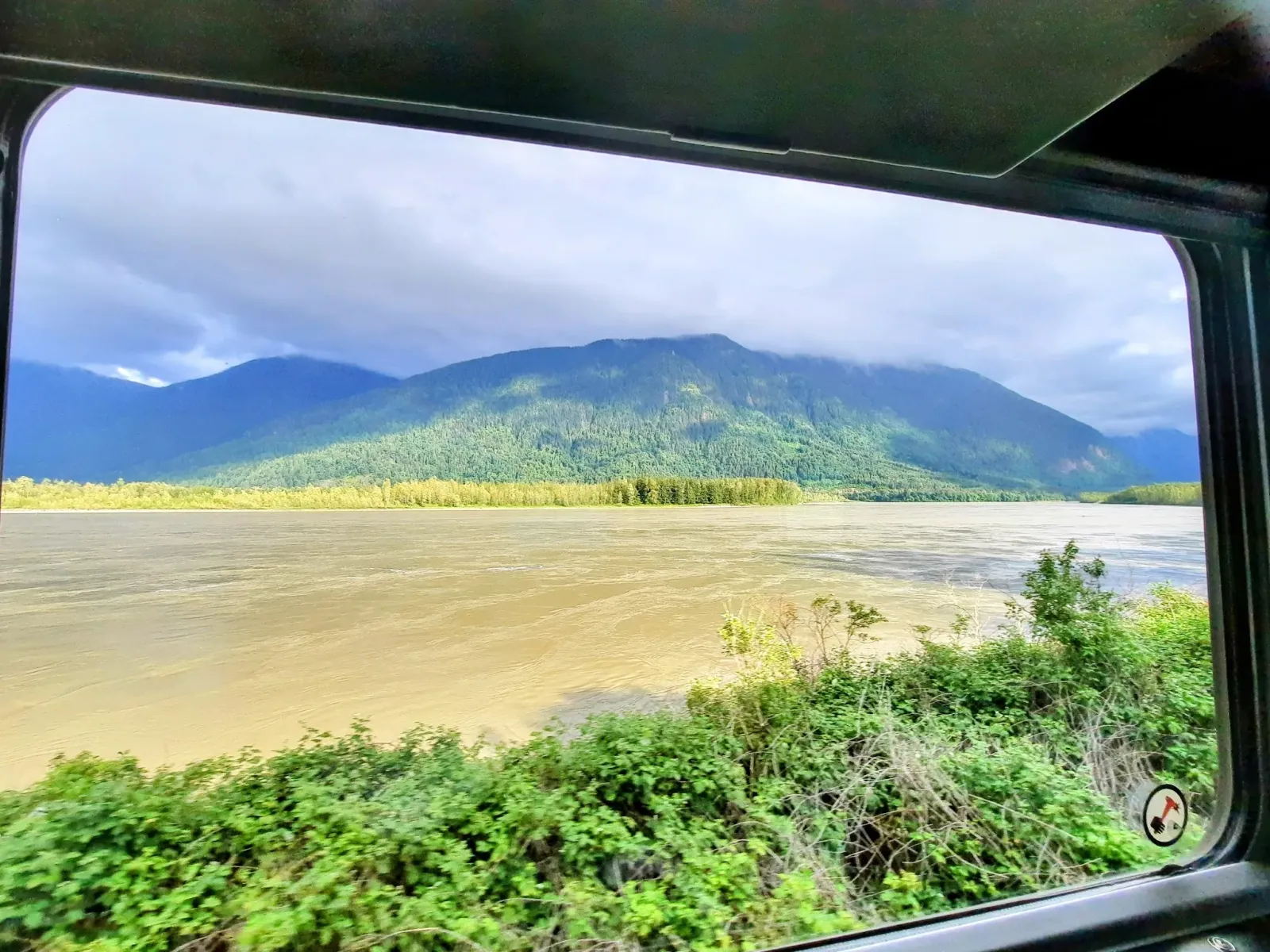 |
VIA Train #2 hugging the shores of the Fraser River. June 2024.
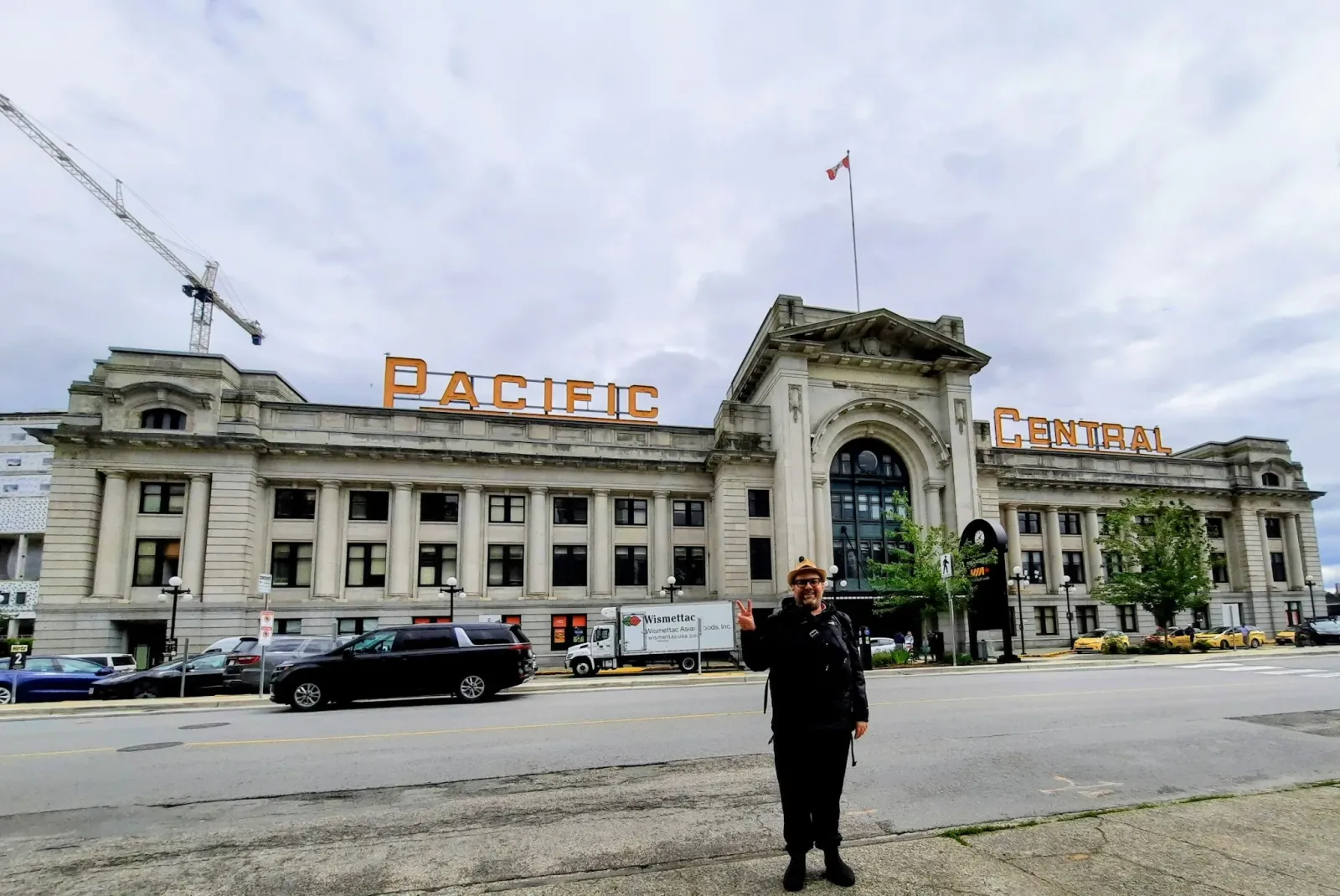 |
The author, out-standing and framed by the grandeur of Vancouver's Pacific Central Station. June 2024.
Meanwhile, The Skeena heads northwest from Jasper, traveling all day through the Rockies before arriving at Prince George, where passengers will overnight before descending the next day to sea level at Prince Rupert, ocean port city in Northern BC located not far from the Alaska border. Passengers traveling from Edmonton to Prince Rupert will rise from an elevation of 671m at Edmonton to 1164m at Obed Summit just east of Jasper, before steadily descending to 1060m at Jasper, 575m at Prince George and finally arriving at sea level at Prince Rupert.
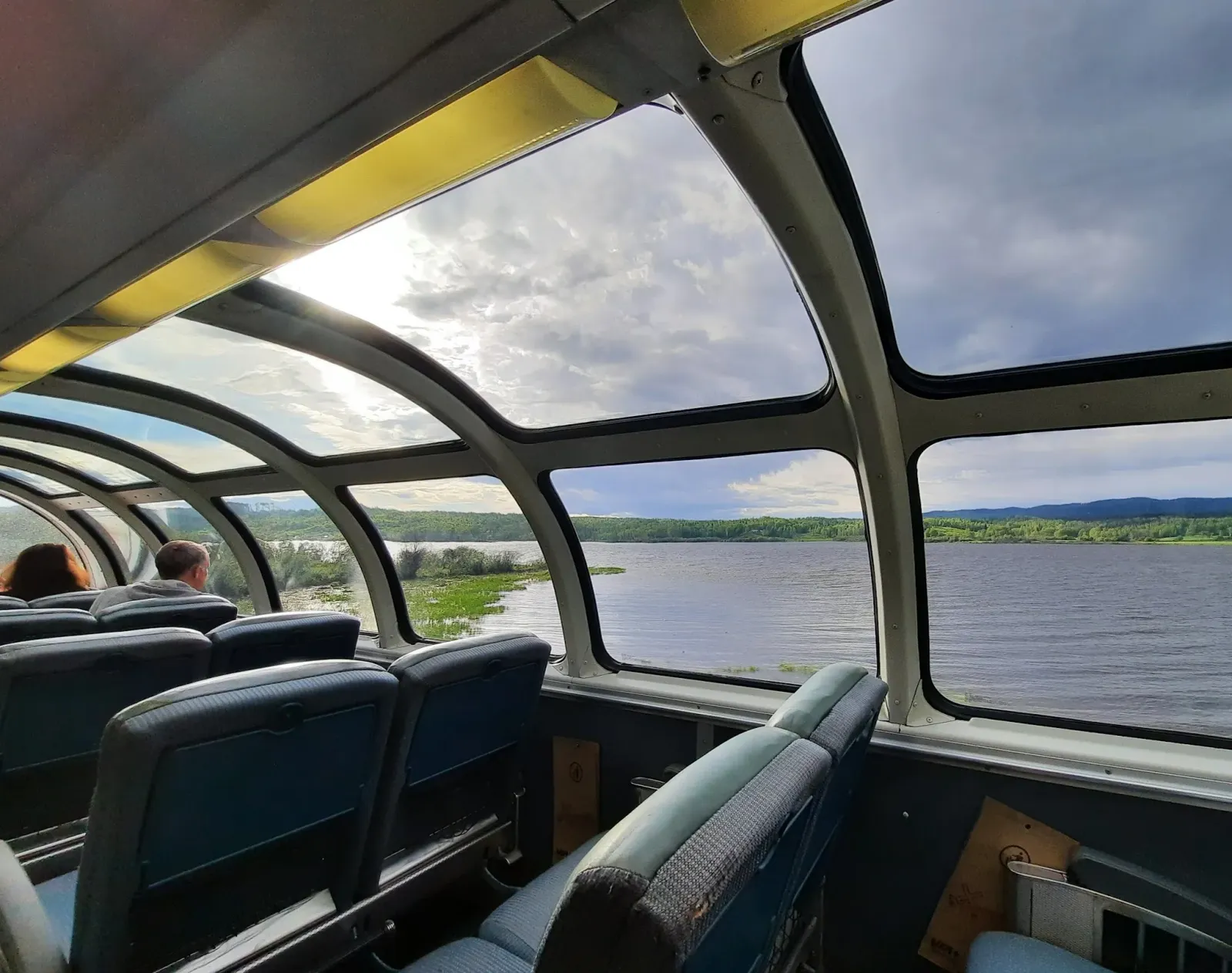 |
Stunning views from the dome car on Train 5 near Fort Fraser, BC. May 2024.
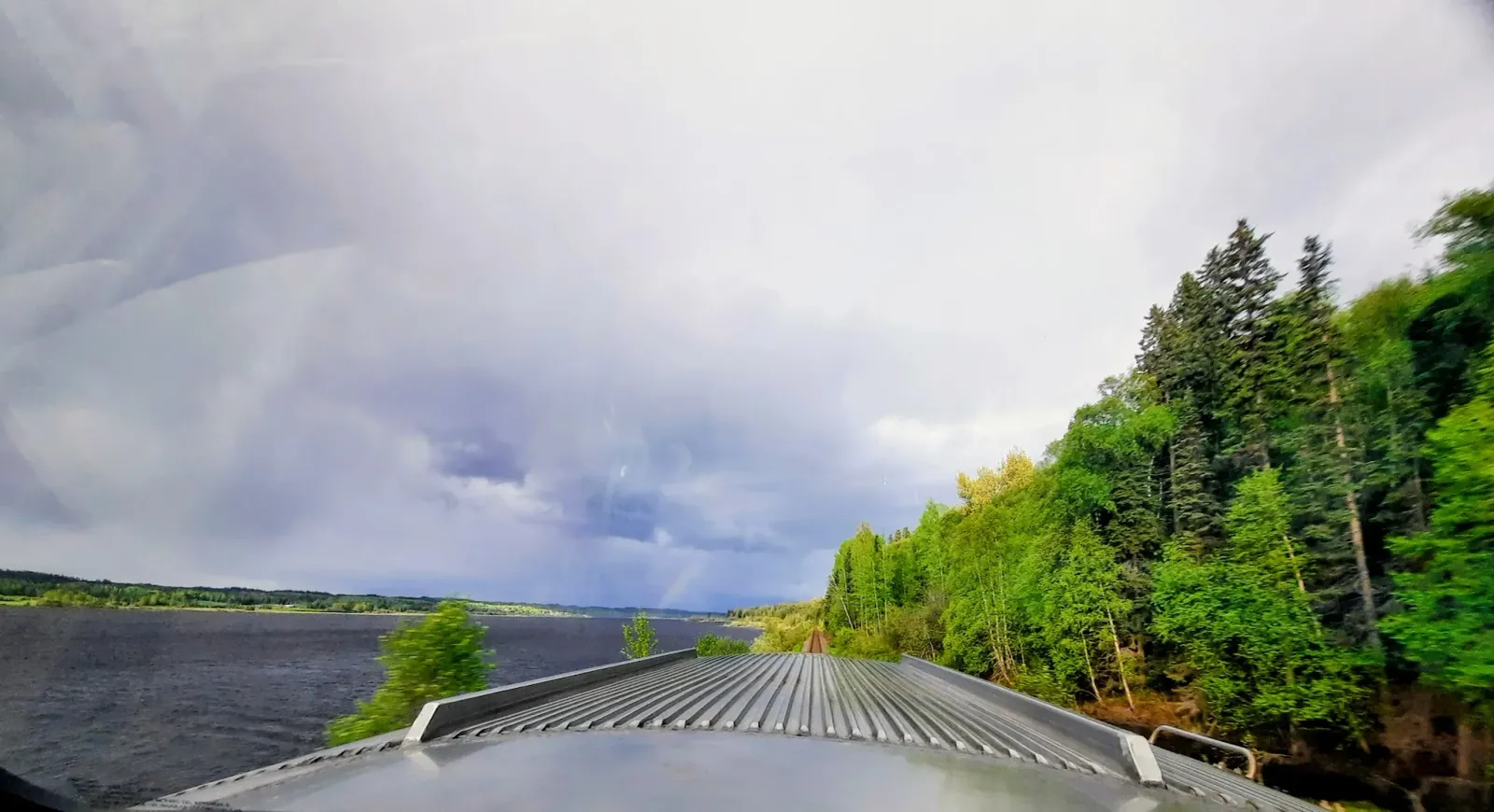 |
A rainbow hails our passing as seen from the dome car of Train 5 as we make our way through Northern BC. May 2024.
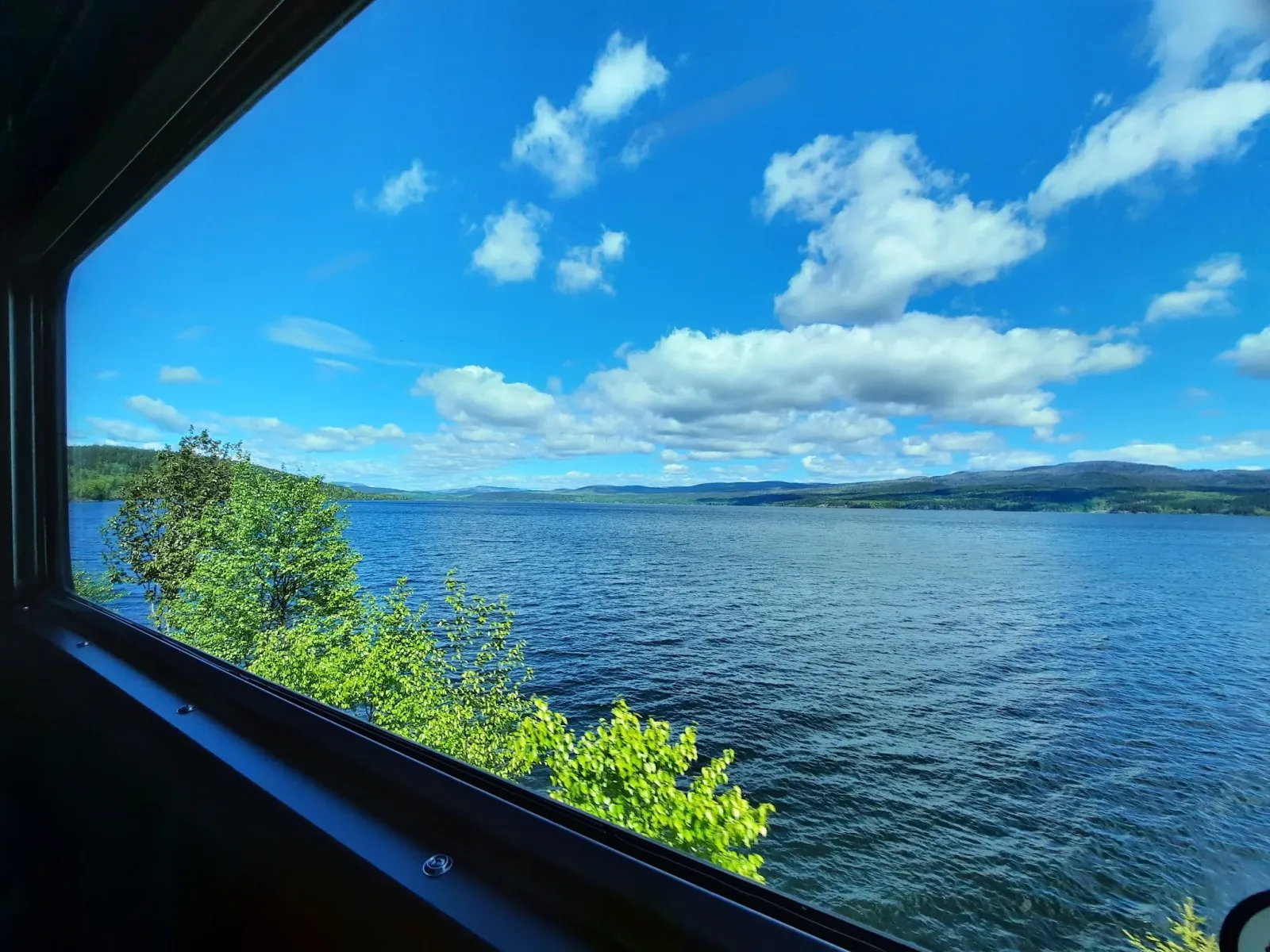 |
VIA Train 5 hugs the shores of Fraser Lake near Fraser, BC. May 2024.
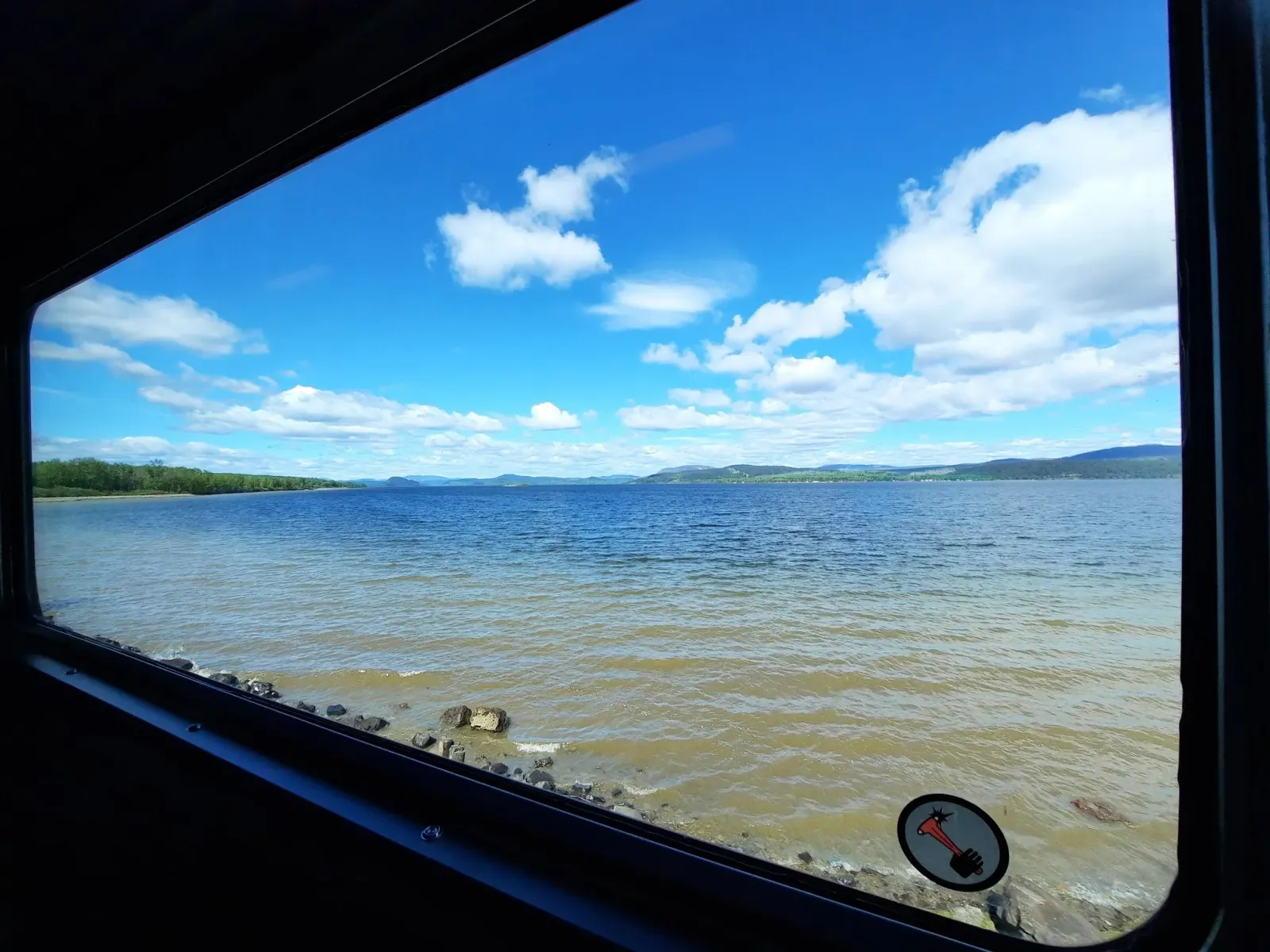 |
Stunning views from VIA Train 5 along Fraser Lake, near Lejac, BC. May 2024.
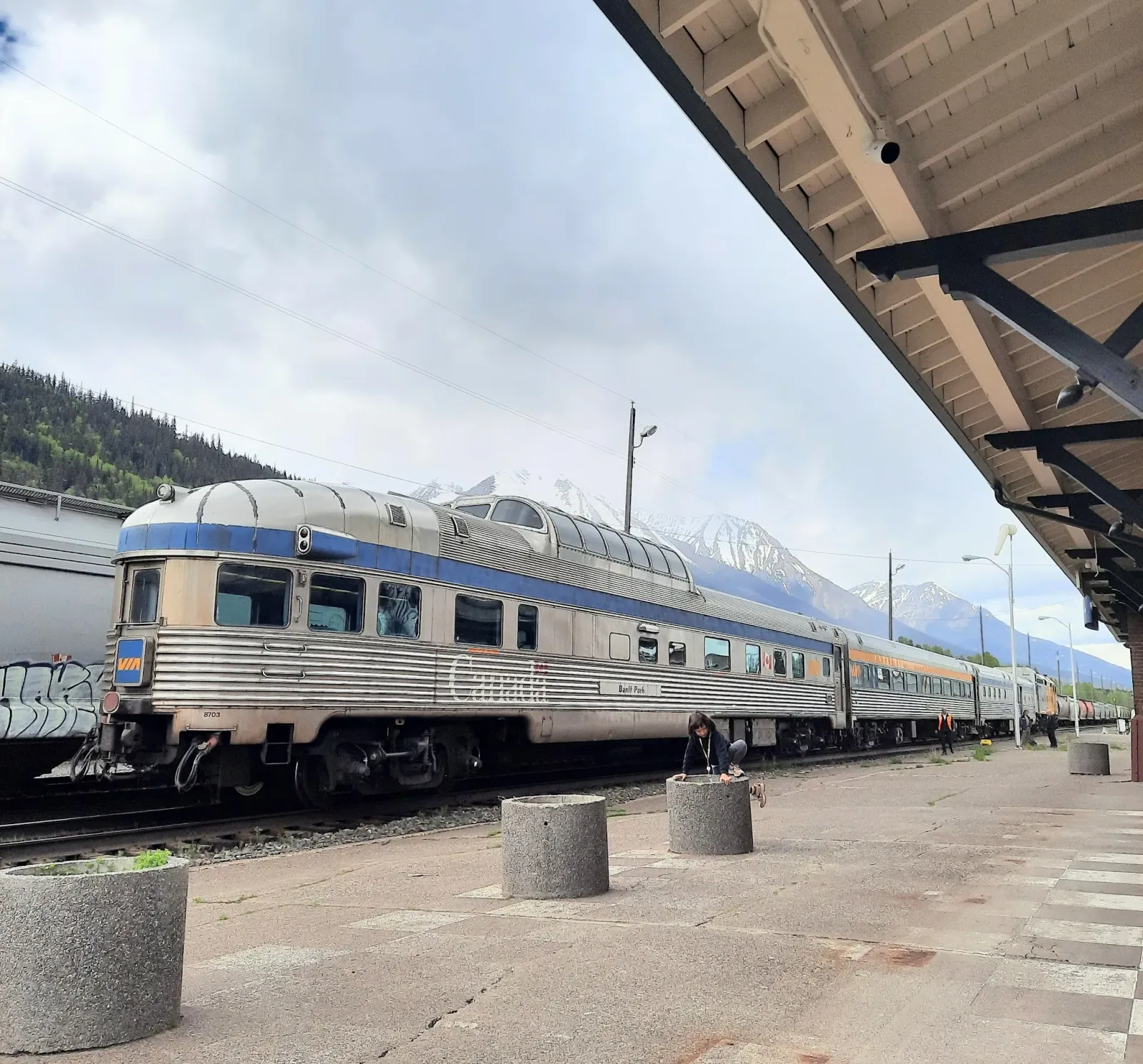 |
VIA Train 5 takes a reflective pause at Smithers, BC. May 2024.
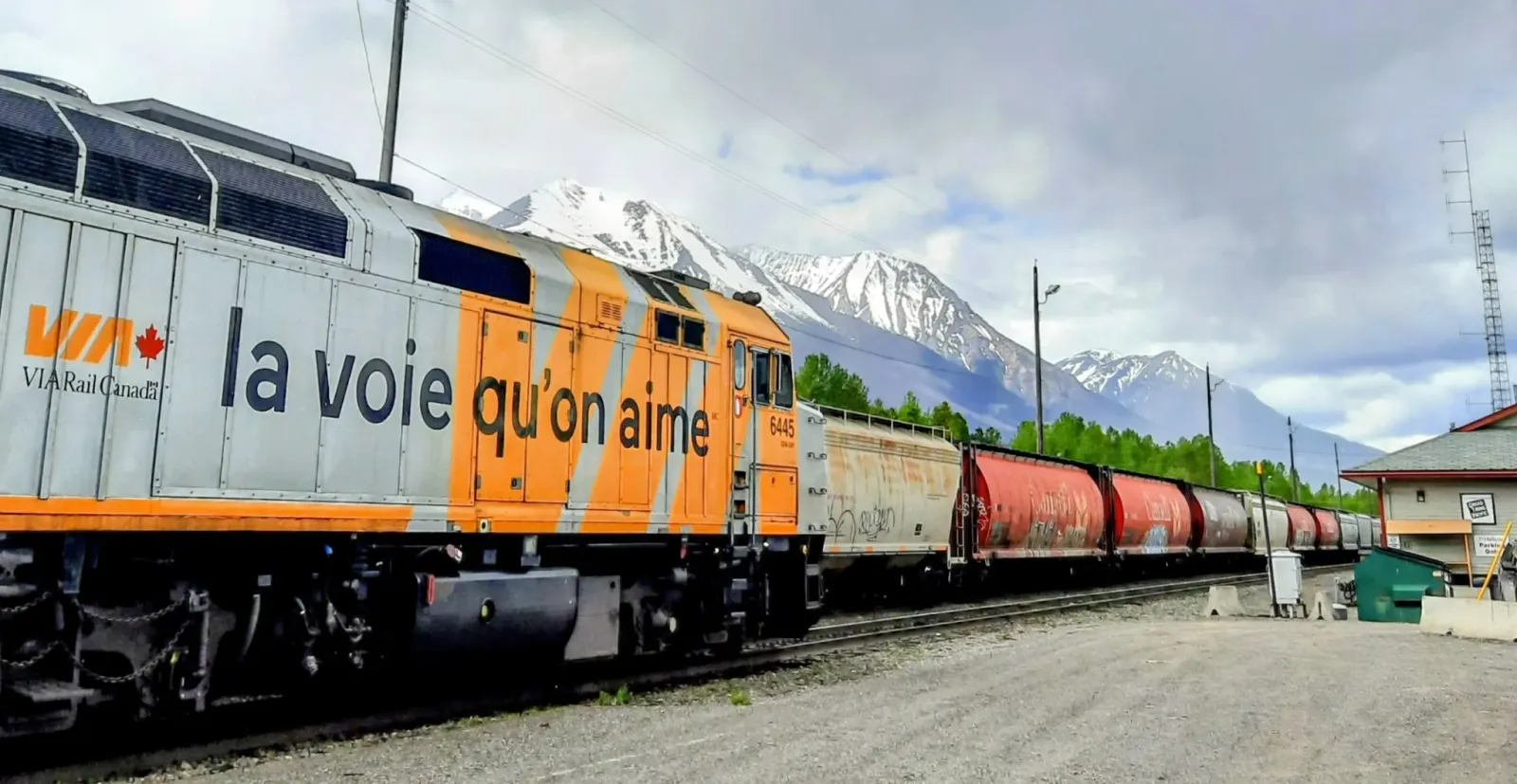 |
VIA Train 5 makes a refueling stop and crew change at Smithers, BC, in the shadow of the formidable peaks of Hudson Bay Mountain in the background. May 2024.
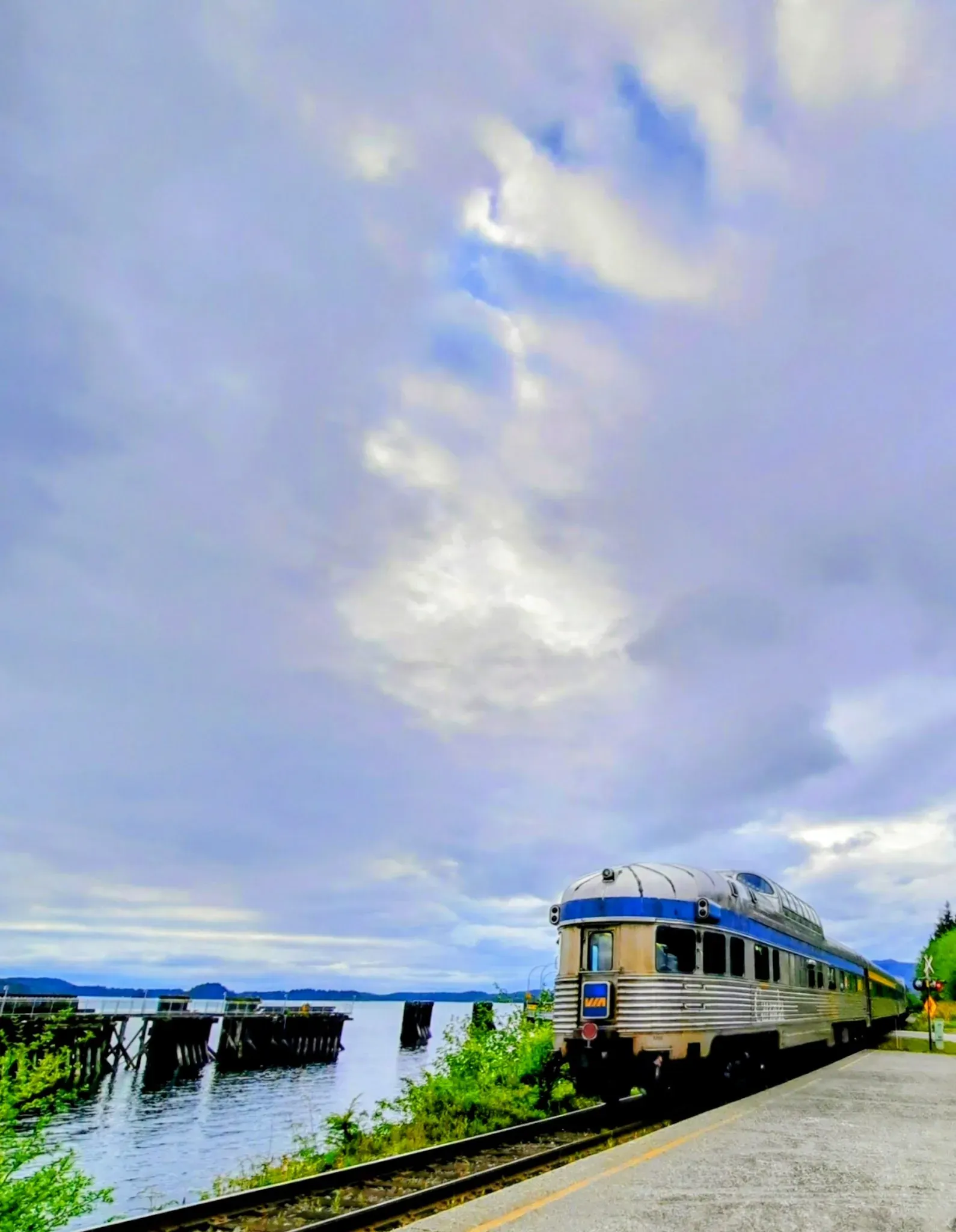 |
VIA Train 5 arrives at Prince Rupert, BC and at the Pacific Ocean, 6 days after having left the Atlantic. May 2024.
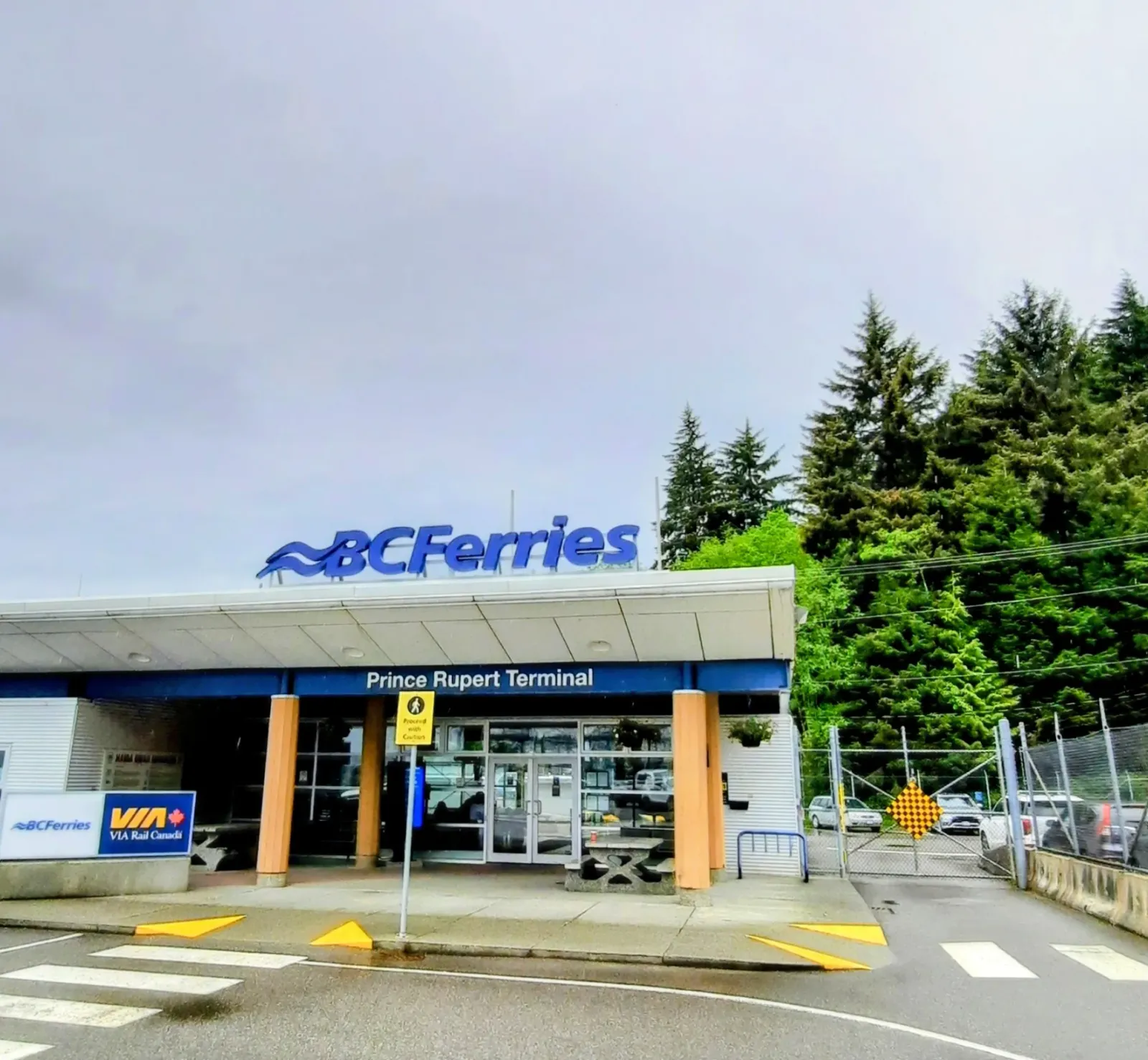 |
Arguably the northernmost intermodal terminal in North America at Prince Rupert, BC, point of connection for VIA Rail and BC Ferries, framed by the verdant, lush BC forests. May 2024.
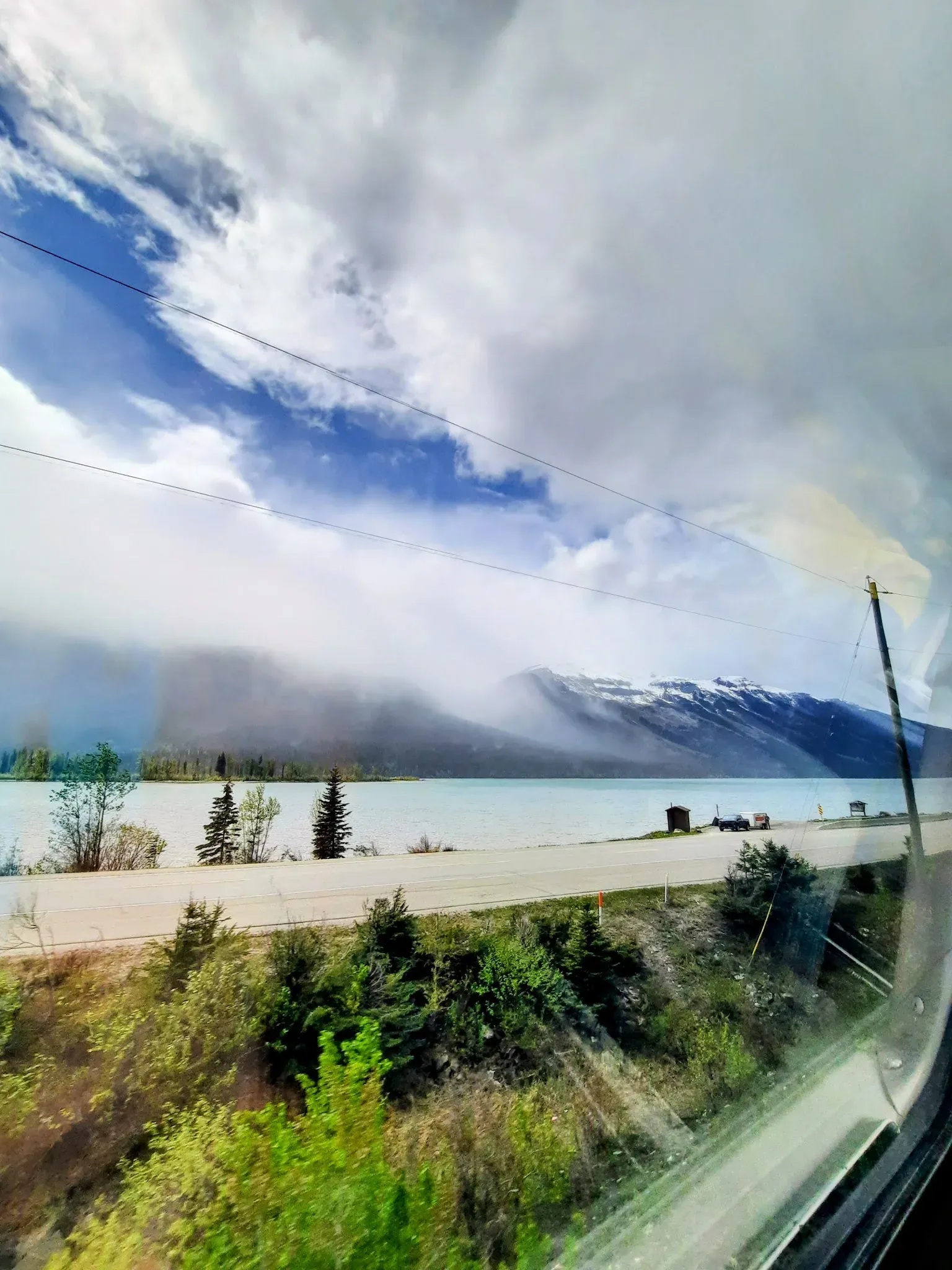
This harried descent, this marvelous, melancholy and misty downhill progression, transporting us from the highest peaks of the Rockies, across to the western side of the Continental Divide, where the full moisture of the Pacific Ocean lashes itself against the coast and the mountains, so that the peaks and everything below become moist and saturated, misty mountain giants towering above and all around, adorned, framed and aggrandised by the lush, verdant rainforests of the Pacific Northwest, misty giants in their own right, sturdy, noble, besodden; proffering a misty scene, lending a reflective, melancholy air to the final homestretch of our transcontinental Canadian rail odyssey.
JOURNEY’S END
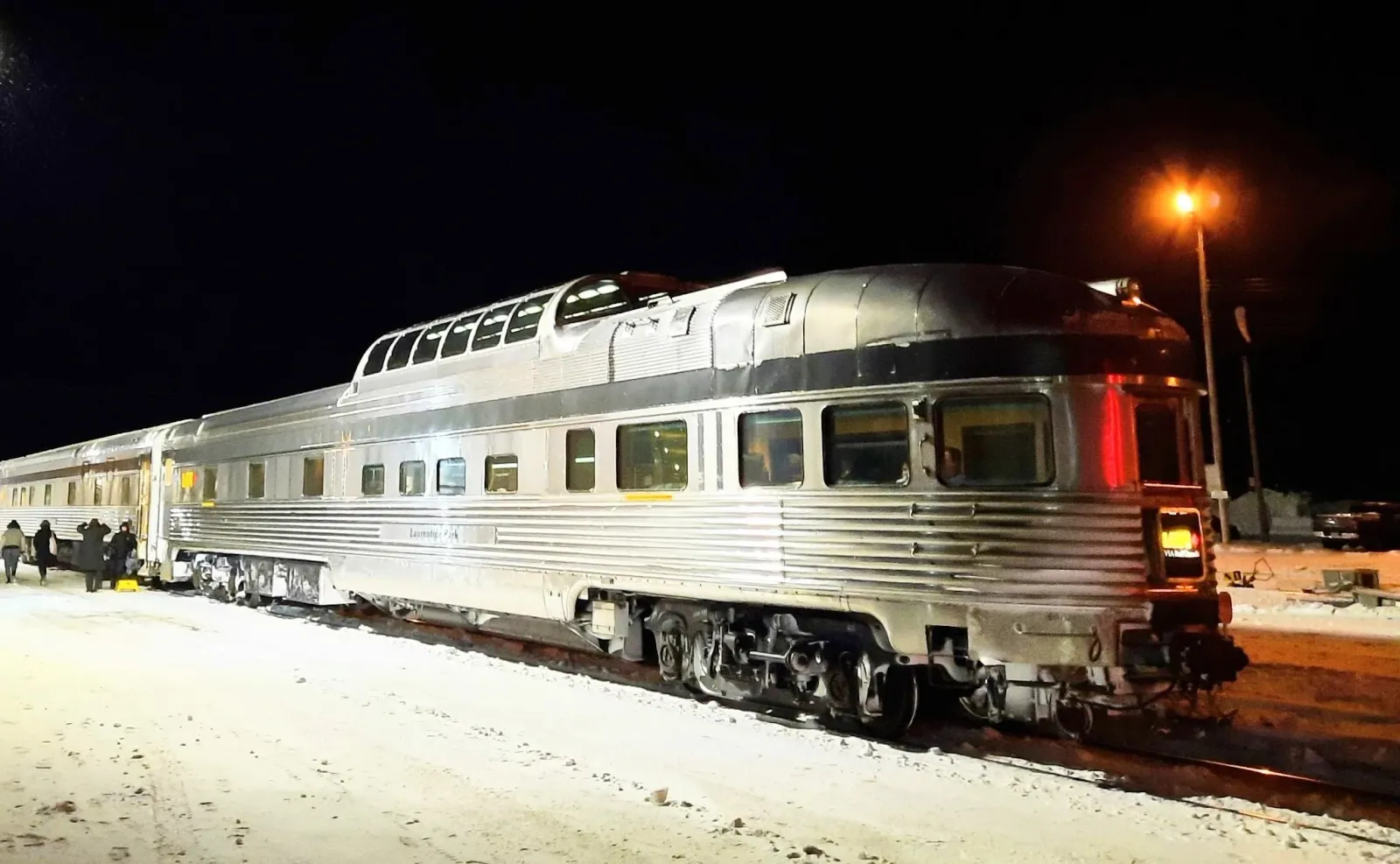 |
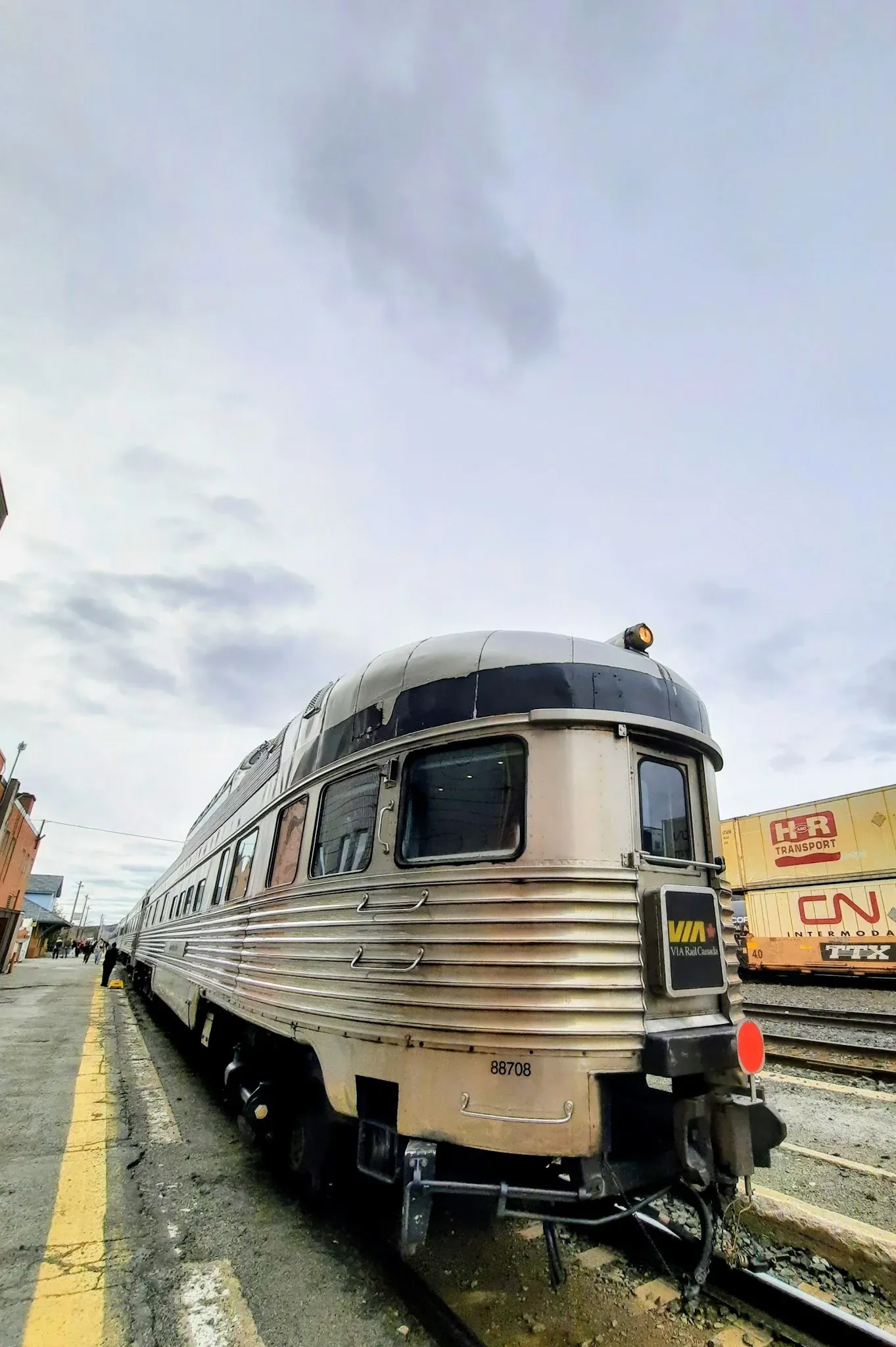
VIA Rail’s iconic Laurentian Park observation car bids farewell to Capreol, ON on the rear of Train 1. Dec 2024.
For most travelers, the arrival at the Pacific Ocean marks the end of a once-in-a-lifetime journey, an epic transcontinental voyage once dreamed of, now an incredible memory to be reconciled and cherished – and perhaps one never to be experienced again.
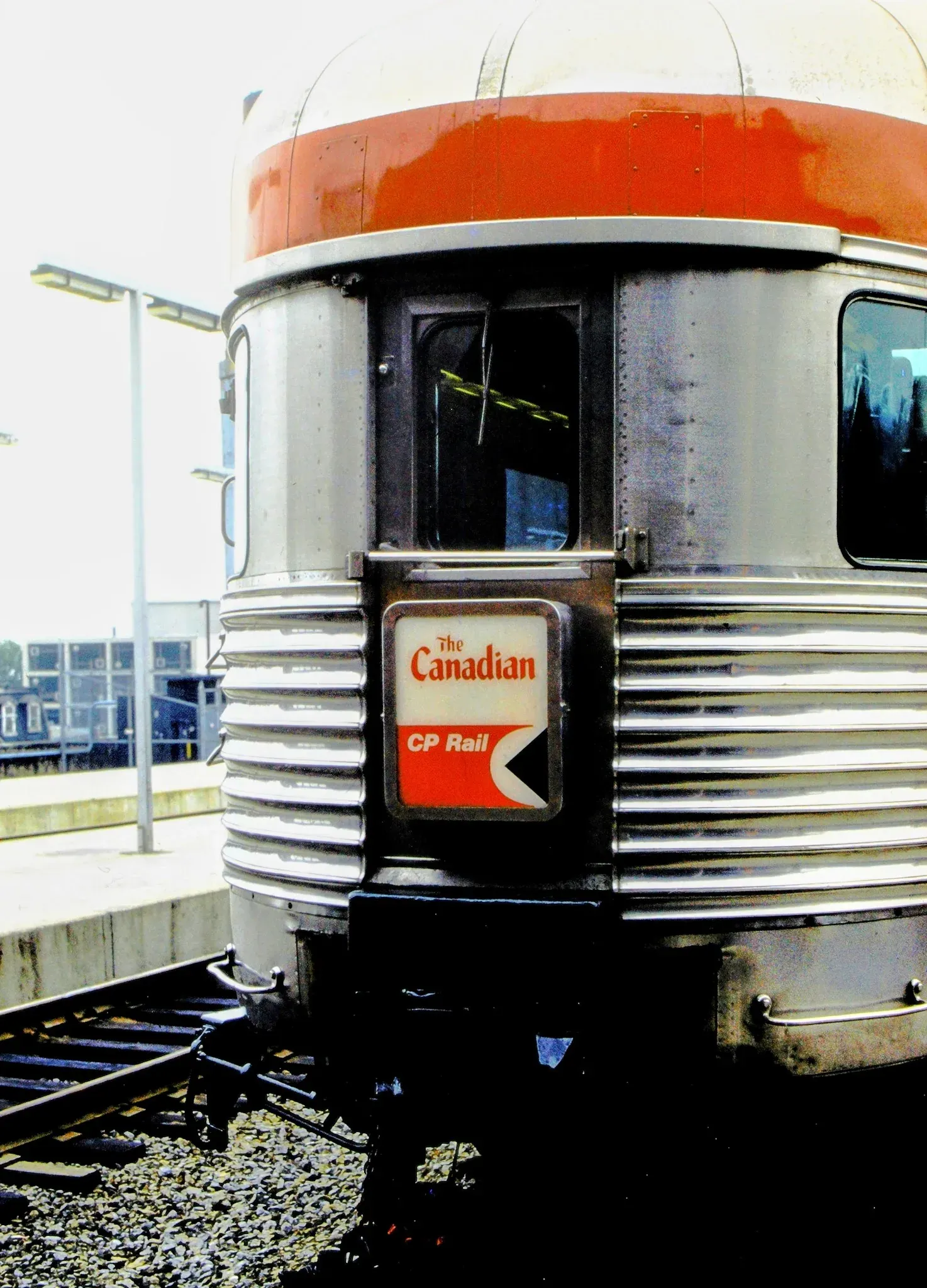 |
CPR Canadian at Montreal Windsor Station. August 1974. Photo by Bill Graper.
For railway workers like me, or Oscar's Dad, perhaps it is a return to the hearth of home and family, the end to a long shift after many days away from home.
 |
For those who view this journey with the wondrous eyes of a child, each moment spent searching the landscape through a railway car window opens our eyes to the enormity of the possibilities the world contains, a moving demonstration that Canada, and the world, are bigger and more full of marvelous things than we heretofore could ever have imagined, broadening the length and breadth of the imagination, and ultimately serving to encourage further exploration and discovery.